
















March 5, 2009
WALL STREET REPORT: $5 BILLION IN POLITICAL CONTRIBUTIONS BOUGHT WALL STREET FREEDOM FROM REGULATION, RESTRAINT
Steps to Financial Cataclysm Paved with Industry Dollars?

The financial sector invested more than $5 billion in political influence purchasing in Washington over the past decade, with as many as 3,000 lobbyists winning deregulation and other policy decisions that led directly to the current financial collapse, according to a 231-page report issued today by Essential Information and the Consumer Education Foundation.
The report, "Sold Out: How Wall Street and Washington Betrayed America," shows that, from 1998-2008, Wall Street investment firms, commercial banks, hedge funds, real estate companies and insurance conglomerates made $1.725 billion in political contributions and spent another $3.4 billion on lobbyists, a financial juggernaut aimed at undercutting federal regulation. Nearly 3,000 officially registered federal lobbyists worked for the industry in 2007 alone. The report documents a dozen distinct deregulatory moves that, together, led to the financial meltdown. These include prohibitions on regulating financial derivatives; the repeal of regulatory barriers between commercial banks and investment banks; a voluntary regulation scheme for big investment banks; and federal refusal to act to stop predatory subprime lending.
"The report details, step-by-step, how Washington systematically sold out to Wall Street," says Harvey Rosenfield, president of the Consumer Education Foundation, a California-based non-profit organization. "Depression-era programs that would have prevented the financial meltdown that began last year were dismantled, and the warnings of those who foresaw disaster were drowned in an ocean of political money. Americans were betrayed, and we are paying a high price -- trillions of dollars -- for that betrayal."
"Congress and the Executive Branch," says Robert Weissman of Essential Information and the lead author of the report, "responded to the legal bribes from the financial sector, rolling back common-sense standards, barring honest regulators from issuing rules to address emerging problems and trashing enforcement efforts. The progressive erosion of regulatory restraining walls led to a flood of bad loans, and a tsunami of bad bets based on those bad loans. Now, there is wreckage across the financial landscape."
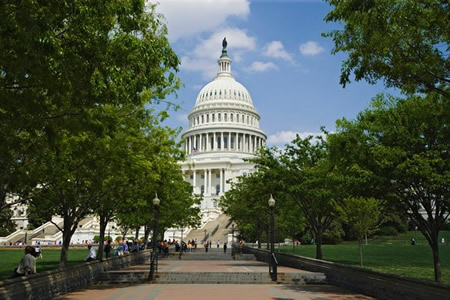
12 Key Policy Decisions Led to Cataclysm
The report concludes that financial deregulation led directly to the current economic meltdown. For the last three decades, government regulators, Congress and the executive branch, on a bipartisan basis, steadily eroded the regulatory system that restrained the financial sector from acting on its own worst tendencies. "Sold Out" details a dozen key steps to financial meltdown, revealing how industry pressure led to these deregulatory moves and their consequences:
1. 1. In 1999, Congress repealed the Glass-Steagall Act, which had prohibited the merger of commercial banking and investment banking.
2. Regulatory rules permitted off-balance sheet accounting -- tricks that enabled banks to hide their liabilities.
3. The Clinton administration blocked the Commodity Futures Trading Commission from regulating financial derivatives -- which became the basis for massive speculation.
4. Congress in 2000 prohibited regulation of financial derivatives when it passed the Commodity Futures Modernization Act.
5. The Securities and Exchange Commission in 2004 adopted a voluntary regulation scheme for investment banks that enabled them to incur much higher levels of debt.
6. Rules adopted by global regulators at the behest of the financial industry would enable commercial banks to determine their own capital reserve requirements, based on their internal "risk-assessment models."
7. Federal regulators refused to block widespread predatory lending practices earlier in this decade, failing to either issue appropriate regulations or even enforce existing ones.
8. Federal bank regulators claimed the power to supersede state consumer protection laws that could have diminished predatory lending and other abusive practices.
9. Federal rules prevent victims of abusive loans from suing firms that bought their loans from the banks that issued the original loan.
10. Fannie Mae and Freddie Mac expanded beyond their traditional scope of business and entered the subprime market, ultimately costing taxpayers hundreds of billions of dollars.
11. The abandonment of antitrust and related regulatory principles enabled the creation of too-big-to-fail megabanks, which engaged in much riskier practices than smaller banks.
12. Beset by conflicts of interest, private credit rating companies incorrectly assessed the quality of mortgage-backed securities; a 2006 law handcuffed the SEC from properly regulating the firms.
Financial Sector Political Money and 3000 Lobbyists Dictated Washington Policy
During the period 1998-2008:
• Commercial banks spent more than $154 million on campaign contributions, while investing $363 million in officially registered lobbying:
• Accounting firms spent $68 million on campaign contributions and $115 million on lobbying;
• Insurance companies donated more than $218 million and spent more than $1.1 billion on lobbying;
• Securities firms invested more than $504 million in campaign contributions, and an additional $576 million in lobbying. Included in this total: private equity firms contributed $56 million to federal candidates and spent $33 million on lobbying; and hedge funds spent $32 million on campaign contributions (about half in the 2008 election cycle).
The betrayal was bipartisan: about 55 percent of the political donations went to Republicans and 45 percent to Democrats, primarily reflecting the balance of power over the decade. Democrats took just more than half of the financial sector's 2008 election cycle contributions, the report clarifies.
According to the report, the financial sector buttressed its political strength by placing Wall Street expatriates in top regulatory positions, including the post of Treasury Secretary held by two former Goldman Sachs chairs, Robert Rubin and Henry Paulson.
Financial firms employed a legion of lobbyists, maintaining nearly 3,000 separate lobbyists in 2007 alone, says the report.
These companies drew heavily from government in choosing their lobbyists. Surveying 20 leading financial firms, "Sold Out" finds 142 of the lobbyists they employed from 1998-2008 were previously high-ranking officials or employees in the Executive Branch or Congress.
Essential Information is a Washington, D.C. nonprofit that seeks to curb excessive corporate power. The Consumer Education Foundation is a California-based nonprofit that supports measures to prevent losses to consumers.
Source: Essential Information
|GlobalGiants.com|
Click HERE for a full PDF copy of "Sold Out: How Wall Street and Washington Betrayed America".
"Information is the currency of democracy."
-- Thomas Jefferson

"As a very important source of strength and security, cherish public credit. One method of preserving it is, to use it as sparingly as possible; avoiding occasions of expense by cultivating peace, but remembering also that timely disbursements to prepare for danger frequently prevent much greater disbursements to repel it; avoiding likewise the accumulation of debt, not only by shunning occasions of expense, but by vigorous exertions in time of peace to discharge the debts, which unavoidable wars may have occasioned, not ungenerously throwing upon posterity the burthen, which we ourselves ought to bear."
-- GEORGE WASHINGTON, Farewell Address, Sep. 17, 1796
"The government, which was designed for the people, has got into the hands of the bosses and their employers, the special interests. An invisible empire has been set up above the forms of democracy."
-- Woodrow Wilson
"In politics... never retreat, never retract... never admit a mistake."
-- Napoleon Bonaparte


Edited & Posted by Editor | 5:56 AM | Link to this Post
February 21, 2009
Media Seen as the Primary Cause of the Depth and Length of the Global Recession, According to New Research From Frost & Sullivan
Companies Must Ignore Fear, Make Smart Moves to Emerge Stronger.

In a recent survey conducted by Frost & Sullivan, the Growth Partnership Company, 91% of CEOs blame the breadth and depth of the current economic situation on the media.
"The media's manipulation of statistics, negativity, exaggeration, and doomsday forecasts have driven fear and panic among consumers and businesses alike," says David Frigstad, Chairman of Frost & Sullivan.

According to Frost & Sullivan, "Economic statistics are often twisted and exaggerated. The fear of total economic collapse is perpetuated in the media to grab attention and sell more copies or attract more viewers or listeners. Because of this, consumers and business have frozen spending, canceled projects, sold investments, and laid off workers. This has caused a downward spiral in demand and pricing that has now caused about 20 trillion dollars of damage globally."
"As the media continues to perpetuate fear, uncertainty and doubt, there is a growing chance that it will result in a self-fulfilling prophecy," adds Frost & Sullivan Economist Sandeep Maheshwari.
"What clearly started out with financial mismanagement and fraud on Wall Street has now escalated into a major global recession exacerbated by the media," says Frost & Sullivan's research. "CEOs cite how the media has continued to drive fear through efforts to gain more readers, viewers, and listeners. The ironic turn is that the media is also being victimized by the current recession, with declining audiences and falling ad revenues."
In the responses portion of the study, CEOs made several interesting comments:
• "Several newspapers have compared the overall job losses to the Great Depression without taking into account the huge increase in U.S. population since that time. These comparisons only generate more fear and are counter-productive."
• "Economists miss every turn in the economy. Why do we rely on their forecasts today when they are so unreliable? They move like a herd of antelope -- their current forecasts all fit nicely into a pack."
• "I recently read a headline that said Microsoft will lay off 5,000 workers. At the end of the piece it mentioned it would be over a three year period. Compared to the overall size of Microsoft, this is not newsworthy."
"We are now at a turning point. An unprecedented global stimulus plan and guaranteed programs are now in place. All of these trends could signal the turning point if we change our outlook. The media, economists, politicians, bankers, and business executives could collectively turn the economy around by working simultaneously to restore confidence back into the system -- in turn, calming the public. It's time for us to give up on the doom and gloom," concludes Frigstad.
|GlobalGiants.com|
Edited & Posted by Editor | 11:18 AM | Link to this Post
February 14, 2009
Automaker Restructuring Plan Must Demonstrate Viability and Protect Taxpayer Investments -- U.S. House of Representatives Speaker

U.S. House of Representatives Speaker Nancy Pelosi and Financial Services Chairman Barney Frank have sent the following letters to Robert L. Nardelli, Chairman and CEO of Chrysler, and Rick Wagoner Jr., Chairman and CEO of General Motors, regarding their company restructuring plans, which are due next week.
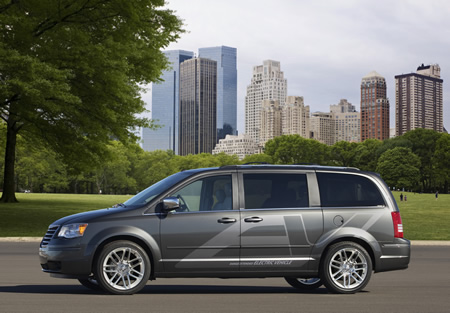
Photo: Chrysler Town & Country EV
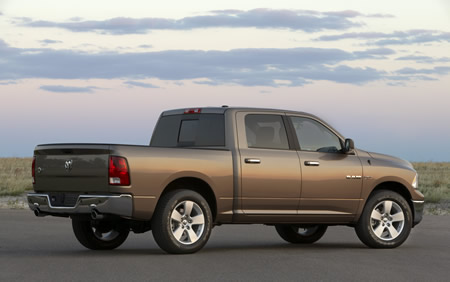
Photo: Chrysler 2009 Dodge Ram 1500
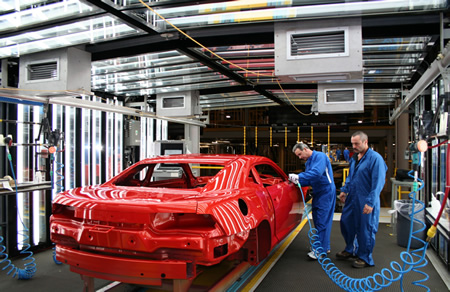
Photo: GM 2010 Chevrolet Camaro Build
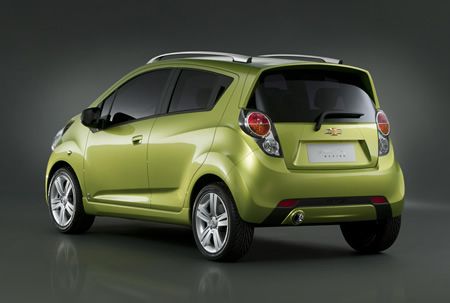
Photo: GM 2010 Chevrolet Spark
In the letter, Pelosi and Frank write: "We trust that your restructuring plan will demonstrate to the world that you are willing to make the tough decisions that modernize your operations, restructure your debt, enhance your competitive status in the global marketplace, and protect American jobs for the future."
Below is the full text of the letter:
February 13, 2009
Mr. Robert L. Nardelli
Chairman and CEO
Chrysler LLC
1000 Chrysler Drive
Auburn Hills, MI 58326
Mr. G. R. Wagoner, Jr.
Chairman and CEO
General Motors Corporation
300 Renaissance Center
MC 482-C39-B50
Detroit, MI 48265-3000
Dear Mr. Nardelli and Mr. Wagoner:
As the February 17 deadline approaches for the automobile companies to submit restructuring plans to the federal government, we are writing to stress the importance of your submitting a credible restructuring plan that results in a viable industry, with quality jobs, and economic opportunity for the 21st century, while protecting taxpayer investments.
In October of last year, Congress approved the Bush Administration's request to provide $700 billion in taxpayer assistance to stabilize the financial system, following warnings by the Administration that inaction would lead to a financial catastrophe. The Bush Administration's lack of transparency in implementing this initiative, and its failure to address the foreclosure crisis head-on (the root cause of the financial crisis), resulted in significant public skepticism about large-scale government interventions to rescue private corporations.
Amidst this public skepticism, the House of Representatives in December passed legislation that authorized taxpayer assistance to the auto industry. This legislation, which the Senate failed to pass, served as the basis for the Bush Administration's December initiative to provide loans to the automobile industry from the TARP.
Mindful that 1 in 10 American jobs is related to auto manufacturing, our national security depends on the industry's technologies and manufacturing capacity, and our competitiveness in the global economy depends on its pursuit of excellence.
Though we recognize that our economy faces significant challenges, Congress and the American people believe that your restructuring plan must include the following:
A documented assessment of your company's ability to ensure long-term viability as you retool for the future, including a target market size;
A commitment that the sacrifices necessary to turn the industry around will be shared equitably by all stakeholders;
A commitment to protecting and sustaining the health and pension benefits that have defined "quality" American jobs and allowed millions to enter the middle class;
A demonstrated commitment to restructure your company's debt in a manner that protects the interests of the taxpayers;
An additional assurance that taxpayers benefit as corporate conditions improve and shareholder value increases; and,
A demonstration of your ability to achieve or exceed the fuel efficiency requirements set forth in the Energy Independence and Security Act of 2007, and the emissions standards adopted by California and other states, if they receive Federal approval, and become a long-term global leader in the production of fuel-efficient and advanced technology vehicles.
We trust that your restructuring plan will demonstrate to the world that you are willing to make the tough decisions that modernize your operations, restructure your debt, enhance your competitive status in the global marketplace, and protect American jobs for the future. Thank you for your consideration of this matter.
best regards,
NANCY PELOSI
Speaker of the House Chairman
BARNEY FRANK
Financial Services Committee
Source: Office of the Speaker of the U.S. House of Representatives
|GlobalGiants.Com|
Edited & Posted by Editor | 10:38 AM | Link to this Post
January 30, 2009
Global Leaders Pledge Collaboration for Global Solutions to Global Crisis
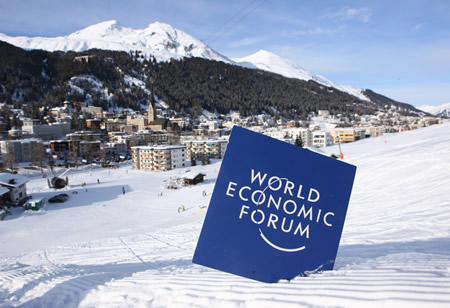
Photo: A sign with the logo of the World Economic Forum stands in the snow during preparations for the upcomming Annual Meeting 2009 of the World Economic Forum in Davos, Switzerland, January 26, 2009. (© World Economic Forum/Christof Sonderegger)
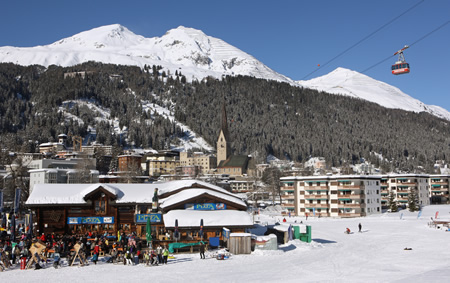
Photo: Impression of Davos: The biggest tourism resorts of the Swiss alps, captured before the opening of the Annual Meeting 2009 of the World Economic Forum in Davos, Switzerland, January 25, 2009. (© World Economic Forum/Christof Sonderegger)
Government, business and civil society leaders are at the World Economic Forum Annual Meeting 2009 at Davos, Switzerland, in record numbers to discuss ways out of the worst financial crisis in eight decades. "Davos fills the vital need for a global and dialogue-based platform where knowledgeable and empowered stakeholders can collaborate to address issues of common criticality. I can't think of a better time and a better reason to be at Davos," said Anand Mahindra, Vice-Chairman and Managing Director, Mahindra & Mahindra, India and Co-Chair of the Annual Meeting 2009.
"It is important that leaders who come here go back and work on ways of finding far-reaching policies that will allow us to create sustainable economic growth, create jobs and coordinate macroeconomic policies," insisted Kofi Annan, Secretary-General, United Nations (1997-2006), Member of the Foundation Board of the World Economic Forum and Co-Chair, Annual Meeting 2009, on the opening day of the five-day Annual Meeting.
"I believe we are also facing a crisis of governance at a national and international level. The current architecture of managing global affairs is broken and needs to be fixed. We have new players that have to be integrated and the poor have to be given a voice," he said. "The world has changed; are we capable of changing fast enough to save the planet?"
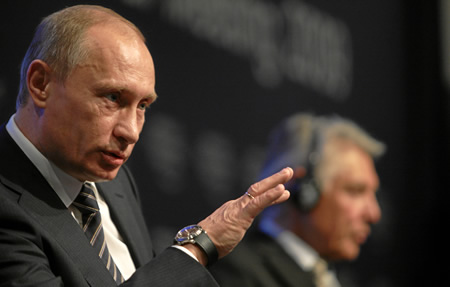
Photo: Vladimir Putin, Prime Minister of the Russian Federation talks to the participants of the 'Private Meeting of the Members of the International Business Council with Vladimir Putin' at the Annual Meeting 2009 of the World Economic Forum in Davos, Switzerland, January 29, 2009. (© World Economic Forum/Sebastian Derungs)
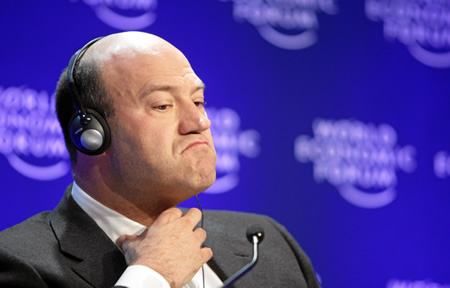
Photo: Gary D. Cohn, President and Co-Chief Operating Officer, Goldman Sachs, USA, captured during the session 'Managing Global Risks' at the Annual Meeting 2009 of the World Economic Forum in Davos, Switzerland, January 29, 2009. (© World Economic Forum/Sebastian Derungs)
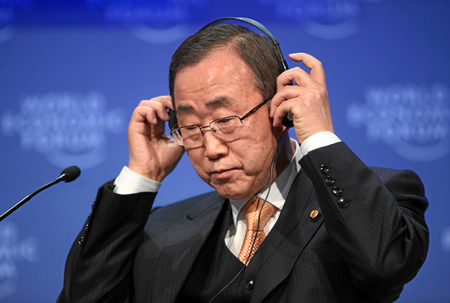
Photo: Ban Ki-moon, Secretary-General, United Nations, New York adjusts his headphones during the session 'Gaza: The Case for Middle East Peace' at the Annual Meeting 2009 of the World Economic Forum in Davos, Switzerland, January 29, 2009. (© World Economic Forum/Monika Flueckiger)
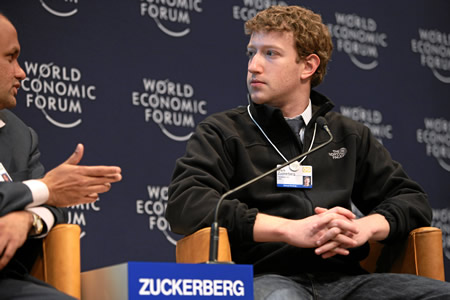
Photo: Mark Zuckerberg, Founder and Chief Executive Officer, Facebook, USA, captured during the session 'The Next Digital Experience' at the Annual Meeting 2009 of the World Economic Forum in Davos, Switzerland, January 30, 2009. (© World Economic Forum/Remy Steinegger)
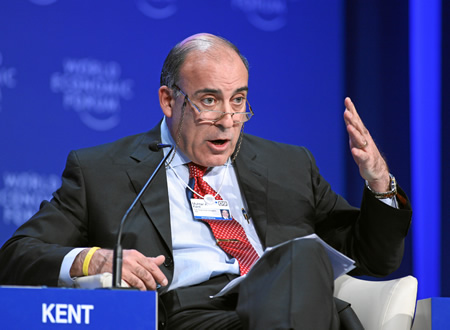
Photo: Muhtar A. Kent, President and Chief Executive Officer, The Coca-Cola Company, USA; Co-Chair of the Governors Meeting for Consumer Industries 2009, speaks during the session 'The Global Compact: Creating Sustainable Markets' at the Annual Meeting 2009 of the World Economic Forum in Davos, Switzerland, January 29, 2009. (© World Economic Forum/Christof Sonderegger)
Stephen Green, Group Chairman, HSBC Holdings, United Kingdom, and Co-Chair of the Annual Meeting 2009, agreed that the Annual Meeting gives leaders the space to share ideas needed to address current challenges. "Talking through what we need to do is important and that is why Davos is more than ordinarily important," he said.
The world is still in crisis, yet we should treat it "as an opportunity to set goals for how we want to come out of it, such as energy sufficiency, world pollution...and shape policies which will help to solve some of those problems," said Rupert Murdoch, Chairman and Chief Executive Officer, News Corporation, USA, and Co-Chair of the Annual Meeting 2009. "Don't let's lose sight of what creates wealth; it's open markets, capitalism and we've proved this again and again in last century," he cautioned.
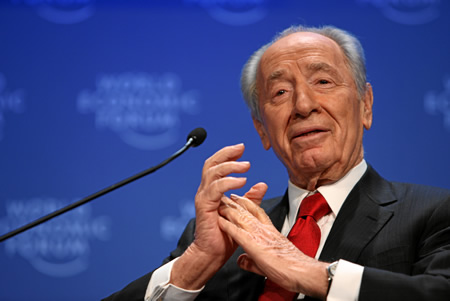
Photo: Shimon Peres, President of Israel, speaks during the session 'The Values behind Market Capitalism' at the Annual Meeting 2009 of the World Economic Forum in Davos, Switzerland, January 29, 2009. (© World Economic Forum/Remy Steinegger)
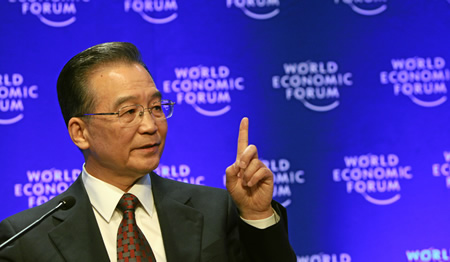
Photo: Wen Jiabao, Premier of the People's Republic of China is captured during a session at the Annual Meeting 2009 of the World Economic Forum in Davos, Switzerland, January 28, 2009. (© World Economic Forum/Christof Sonderegger)
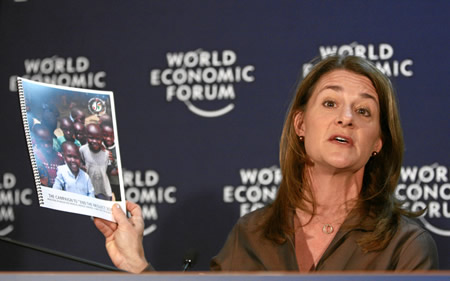
Photo: Melinda French Gates speaks during the 'Gates Foundation' press conference at the Annual Meeting 2009 of the World Economic Forum in Davos, Switzerland, January 30, 2009. (© World Economic Forum/Remy Steinegger)
"I do not expect we will find from Davos solutions, but expect that we are able to get a joint understanding of the reasons for the crisis, and that we get a good understanding of how we are really able to overcome such a severe crisis in a globalized world," said Werner Wenning, Chairman of the Board of Management, Bayer, Germany, and Co-Chair of the Annual Meeting 2009. "We're talking about growing populations; we have to address issues of how to secure energy supply and of climate change; we're also talking a lot about sustainability and returning to the basics of sustainable behavior."
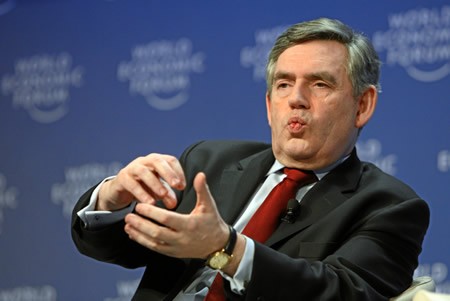
Photo: Gordon Brown, Prime Minister of the United Kingdom, speaks during the session 'A Conversation with' at the Annual Meeting 2009 of the World Economic Forum in Davos, Switzerland, January 31, 2009. (© World Economic Forum/Remy Steinegger)
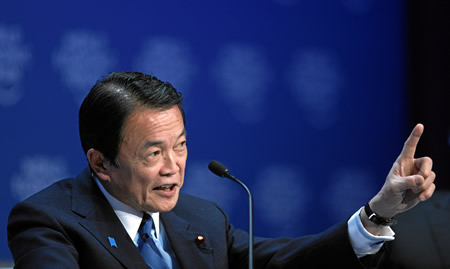
Photo: Taro Aso, Prime Minister of Japan, captured during the session 'Special Address by' at the Annual Meeting 2009 of the World Economic Forum in Davos, Switzerland, January 31, 2009. (© World Economic Forum/Sebastian Derungs)
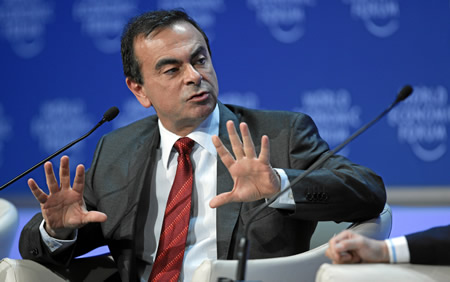
Photo: Carlos Ghosn, President and Chief Executive Officer, Renault, France; President and Chief Executive Officer, Nissan, Japan; Member of the Foundation Board of the World Economic Forum; Co-Chair of the Governors Meeting for the Automotive Industry 2009, captured during the session 'Special Address by Taro Aso' at the Annual Meeting 2009 of the World Economic Forum in Davos, Switzerland, January 31, 2009. (© World Economic Forum/Sebastian Derungs)
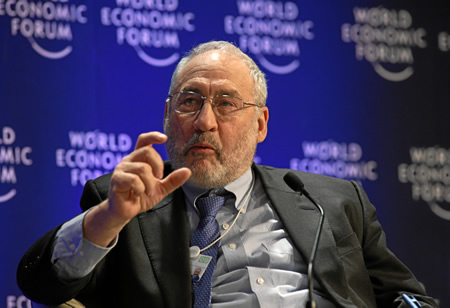
Photo: Joseph E. Stiglitz, Professor, Columbia University, USA, gestures during the session 'Rebooting the Global Economy' at the Annual Meeting 2009 of the World Economic Forum in Davos, Switzerland, January 31, 2009. (© World Economic Forum/Christof Sonderegger)
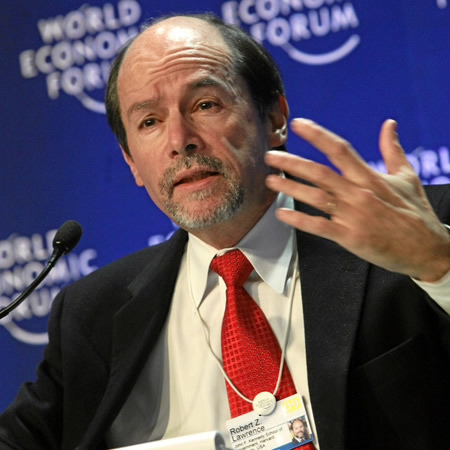
Photo: Robert Z. Lawrence, Albert L. Williams Professor of Trade and Investment, John F. Kennedy School of Government, Harvard University, USA; Chair, Global Agenda Council on Trade Facilitation, talks to the participants during the session 'The Fight against Protectionism' at the Annual Meeting 2009 of the World Economic Forum in Davos, Switzerland, January 31, 2009. (© World Economic Forum/Monika Flueckiger)
More than 2,500 participants from 96 countries are participating in the Annual Meeting held under the theme "Shaping the Post-Crisis World", including a record 40 heads of state or government. Key finance, foreign affairs, trade and energy ministers will join heads of non-governmental organizations, social entrepreneurs and religious leaders at the Meeting. Around 60% of the participants are business leaders drawn principally from the Forum's members - 1,000 of the foremost companies from around the world and across all economic sectors.
|GlobalGiants.com|
"Excessive accumulation of corrupt transactions (disguised as smart business) such as predatory, forcible or irrational lending via the agents whose sole objective is to pocket their commissions has landed us here.
It is NOT RECESSION, Gentlemen!
CORRECTION is taking place.
Analyze it technically and take authoritative actions to make it smooth and short."
© GlobalGiants.Com

"It is not by augmenting the capital of the country, but by rendering a greater part of that capital active and productive than would otherwise be so, that the most judicious operations of banking can increase the industry of the country."
-- Adam Smith
Edited & Posted by Editor | 5:27 AM | Link to this Post
January 9, 2009
Daimler AG to introduce "smart fortwo BRABUS" in the USA in January 2009
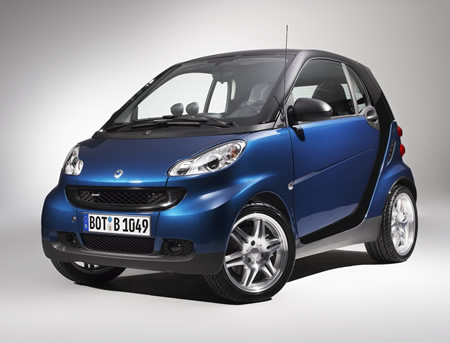

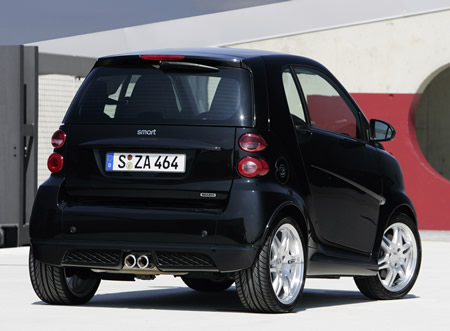
Photos: smart fortwo BRABUS
Mercedes-Benz USA (Daimler AG) has reported that its sales for the smart USA recorded 2,341 sales in December 2008.
According to Daimler AG, "Year-to-date sales for 2008 are an incredible 24,622 units. smart USA achieved this impressive sales volume in its first year of business in the U.S. market. American response indicates the micro-car segment is a viable transportation option and the smart fortwo is the right car at the right time in the U.S."
The smart fortwo offers a powerful combination of outstanding fuel efficiency, innovative safety features, environmental friendliness and excellent value.
The smart fortwo BRABUS will go on sale in the United States this January. There are currently 74 smart centers open in 35 states.
The smart brand is entering another automotive market following its successful launch in the USA. Starting in April 2009, the smart fortwo will be available in Brazil. This was announced by the company at the São Paulo Auto Show, where the two-seater celebrated its public debut.
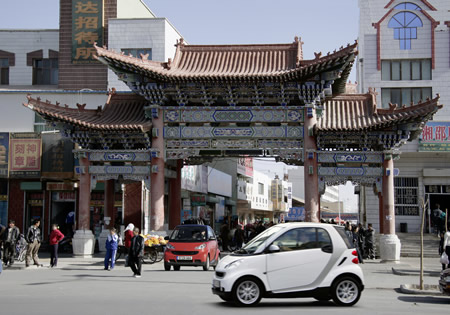
Photo: smart fortwo in China
According to Daimler, because of its outstanding features and its fresh design that combines functionality with joie de vivre, the smart fortwo has become a sought-after cult car in many countries. The sales figures also demonstrate this. Since the start of 2008 the number of smart fortwos delivered to customers worldwide rose by 53 percent to 101,900 cars.
Source: Daimler AG
|GlobalGiants.com|
Edited & Posted by Editor | 12:20 PM | Link to this Post
December 30, 2008
Ninety Things to Watch in 2009 -- JWT's Annual List
JWT, one of the largest advertising agencies in the world, has released its list of 90 things to watch in 2009.

"Our list points to the broader trends we're seeing, showing the ways in which these shifts will manifest in our everyday lives," says Ann Mack, director of trendspotting at JWT. Among these shifts, the recession will make the biggest impact, says Mack. "A lot of what to watch in 2009 relates to consumers' adaptation to the economic situation, from 'affordable nutrition' to 'more under one roof,'" notes Mack.

JWT's list of 90 Things to Watch in 2009 (unranked and in alphabetical order):
1. 21st-Century Networking
2. Affordable Nutrition
3. Amy Poehler
4. Apatow-esque Humor
5. Bruno
6. Building a Beauty Arsenal
7. Buraka Som Sistema
8. Career Reinvention and Extension
9. Chat-Avoidance Services
10. The Cleveland Show
11. Cloud Computing
12. The Collective Consciousness
13. Creativity in the Informal Economy
14. Credit Card Dieting
15. Crowdfunding
16. The Decline of E-Mail
17. Distraction as Entertainment
18. DIY Repairs and Renovations
19. Doha
20. Dragonball
21. EarthRoamer
22. Electric Bikes
23. Elizabeth Banks
24. Emma Stone
25. The Energy Race
26. Environmental Exercise
27. Family-Friendly TV
28. Freebies
29. Gerard Butler
30. Girl Talk
31. Giving Circles
32. Gluten-Free
33. Good Old-Fashioned Cooking
34. Graphic Novels Hit Hyperdrive
35. The Green-Collar Class
36. hi5
37. Holographic Projection
38. Home as Castle
39. HomeAway
40. Homemade Beauty Treatments
41. How to Talk to Girls
42. Incognito luxury
43. Inconspicuous Travel
44. Innocent Cosmetics
45. Lady GaGa
46. Lala.com
47. Lance Armstrong
48. Lykke Li
49. Maria Pinto
50. Marketing with Aromas
51. Michelle Obama
52. Microfinancing's Second Wave
53. Mobile Phones Get Personal
54. More Under One Roof
55. NASA's Kepler Telescope
56. Netbooks
57. Noor
58. No "Paper" in Newspapers
59. Nutrition Replaces Dieting
60. Obama-speak
61. ODO7
62. Online TV Network Crackle
63. Online Video Ads
64. Outliers (as a term)
65. Palin's Grandson
66. Personalized Travel Guides
67. Pisco Sours
68. Presidential Sightseeing
69. Prince William Wedding Watch
70. Product Source Tags
71. Radical Transparency Meets Genomics
72. Readers + Social Media = Revenue?
73. Residential Market for Solar Power
74. Ricky Rubio
75. Russell Brand
76. Safe-keeping
77. The Small Movement
78. Smart Garages
79. South Africa
80. Stuart Karten
81. Sustainable Fishery
82. T. Boone Pickens
83. Telepresence
84. Touch Screens
85. Twitter Copycats
86. Virtual Reality Therapy
87. Virtual Socializing
88. Widgets
89. Wikileaks
90. Xbox Streaming
Headquartered in New York, JWT is a global network with more than 200 offices in over 85 countries employing nearly 10,000 marketing professionals. JWT's parent company is WPP and its clients include Bayer, Cadbury, Diageo, DTC, Ford, HSBC, Johnson & Johnson, Kellogg's, Kimberly-Clark, Kraft, Nestle, Nokia, Rolex, Schick, Shell, Unilever, and Vodafone.
Source: JWT
U.S. Federal Government has done all it can currently do to sustain the ailing domestic (as well as global) economy.
It is a crime to put all the blame on the managements of the bankrupt or struggling American corporations and make them scapegoats.
The blame must be shared by all those who have been blind to (or unaware of) the Highest Law of Economics and have been advertently or inadvertently contributing towards the propagation of the easy-money excessive greed culture originating in the USA.
Such contributors include the Top American Business & Financial Newspapers & Magazines, Relevant Leading Advertising Agencies, and some Industry Specific Labor Unions.
© GlobalGiants.Com
Edited & Posted by Editor | 12:18 PM | Link to this Post
December 11, 2008
GM'S COMMITMENT TO THE AMERICAN PEOPLE
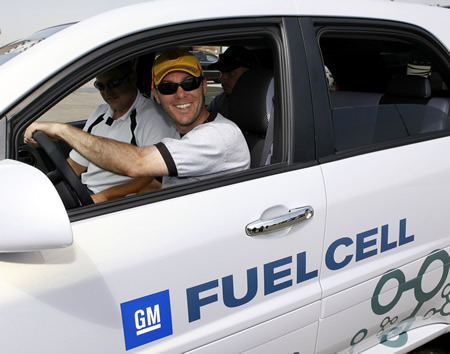
Photo: Team Chevy NASCAR driver Kevin Harvick takes the Chevrolet Equinox Fuel Cell vehicle for a test drive after being shown its General Motors advanced technology Friday, August 29, 2008 in Fontana, California. (General Motors News Photo) (United States)
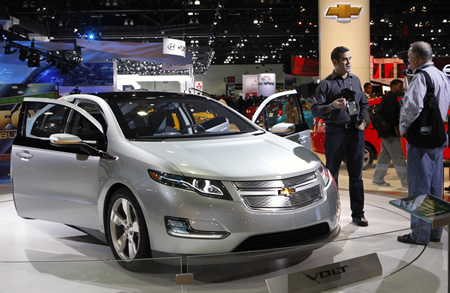
Photo: Chevrolet Volt Director of Design Bob Boniface (left) shows off the Chevrolet Volt to media as the vehicle makes its West Coast debut at the Los Angeles Auto Show in Los Angeles, California Wednesday, November 19, 2008. The Volt delivers up to 40 miles of gasoline and emissions-free electric driving with the extended-range capability of hundreds of additional miles. (General Motors News Photo) (United States)
Following is GM's letter published in Automotive News :
GM'S COMMITMENT TO THE AMERICAN PEOPLE
"We deeply appreciate the Congress considering General Motors' request to borrow up to $18 billion from the United States. We want to be sure the American people know why we need it, what we'll do with it and how it will make GM viable for the long term.
For a century, we have been serving your personal mobility needs, providing American jobs and serving local communities. We have been the U.S. sales leader for 76 consecutive years. Of the 250 million cars and trucks on U.S. roads today, more than 66 million are GM brands -- nearly 44 million more than Toyota brands. Our goal is to continue to fulfill your aspirations and exceed your expectations.
While we're still the U.S. sales leader, we acknowledge we have disappointed you. At times we violated your trust by letting our quality fall below industry standards and our designs become lackluster. We have proliferated our brands and dealer network to the point where we lost adequate focus on our core U.S. market. We also biased our product mix toward pick-up trucks and SUVs. And, we made commitments to compensation plans that have proven to be unsustainable in today's globally competitive industry. We have paid dearly for these decisions, learned from them and are working hard to correct them by restructuring our U.S. business to be viable for the long term.
Today, we have substantially overcome our quality gap; our newest designs like the Chevrolet Malibu and Cadillac CTS are widely heralded for their appeal; our new products are nearly all cars and "crossovers" rather than pick-ups and SUVs; our factories have greatly improved productivity and our labor agreements are much more competitive. We are also driven to lead in fuel economy, with more hybrid models for sale and biofuel-capable vehicles on the road than any other manufacturer, and determined to reinvent the automobile with products like the Chevrolet Volt extended-range electric vehicle and breakthrough technology like hydrogen fuel cells.
Until recent events, we felt the actions we'd been taking positioned us for a bright future. Just a year ago, after we reached transformational agreements with our unions, industry analysts were forecasting a positive GM turnaround. We had adequate cash on hand to continue our restructuring even under relatively conservative industry sales volume assumptions. Unfortunately, along with all Americans, we were hit by a "perfect storm." Over the past year we have all faced volatile energy prices, the collapse of the U.S. housing market, failing financial institutions, a stock market crash and the complete freezing of credit. We are in the midst of the worst economic crisis since the Great Depression. Just like you, we have been severely impacted by events outside our control. U.S. auto industry sales have fallen to their lowest per capita rate in half a century. Despite moving quickly to reduce our planned spending by over $20 billion, GM finds itself precariously and frighteningly close to running out of cash.
This is why we need to borrow money from U.S. taxpayers. If we run out of cash, we will be unable to pay our bills, sustain our operations and invest in advanced technology. A collapse of GM and the domestic auto industry will accelerate the downward spiral of an already anemic U.S. economy. This will be devastating to all Americans, not just GM stakeholders, because it would put millions of jobs at risk and deepen our recession. By lending GM money, you will provide us with a financial bridge until the U.S. economy and auto sales return to modestly healthy levels. This will allow us to keep operating and complete our restructuring.
We submitted a plan to Congress Dec. 2, 2008, detailing our commitments to ensure our viability, strengthen our competitiveness, and deliver energy-efficient products. Specifically, we are committed to:
• produce automobiles you want to buy and are excited to own
• lead the reinvention of the automobile based on promising new technology
• focus on our core brands to consistently deliver on their promises
• streamline our dealer network to ensure the best sales and service
• ensure sacrifices are shared by all GM stakeholders
• meet appropriate standards for executive pay and corporate governance
• work with our unions to quickly realize competitive wages and benefits
• reduce U.S. dependence on imported oil
• protect our environment
• pay you back the entire loan with appropriate oversight and returns
These actions, combined with a modest rebound of the U.S. economy, should allow us to begin repaying you in 2011.
In summary, our plan is designed to provide a secure return on your investment in GM's future. We accept the conditions of your loan, the commitments of our plan, and the results needed to transform our business for long-term success. We will contribute to strengthening U.S. energy and environmental security. We will contribute to America's technical and manufacturing know-how and create high quality jobs for the "new economy." And, we will continue to deliver personal mobility freedom to Americans using the most advanced transportation solutions. We are proud of our century of contribution to U.S. prosperity and look forward to making an equally meaningful contribution during our next 100 years."
"GM's foregoing appeal to the U.S. taxpayers leaves a negative impression on the shareholders and on the Investors-in-Waiting -- the key players that matter the most. The appeal makes no sense to them. They are looking for any tangible positive catalysis at GM.
If General Motors Corporation emboldens the shareholders and the Investors-in-Waiting by any courageous rational move, that would enable it to pull itself through."
© GlobalGiants.Com
"G.M. said it planned to focus on four core brands -- Chevrolet, Cadillac, Buick and GMC -- and sell, eliminate or consolidate the Saturn, Saab, Hummer and Pontiac brands.
Despite having downsized its operations in the last three years, G.M. said it would cut more than 20 percent of its remaining jobs, shut nine factories, seek to renegotiate the terms of $66 billion in debt, and push to reopen contract talks with the United Automobile Workers to reduce labor costs."
-- Article in The New York Times
"Bankruptcy, whether it's structured or not, would destroy demand for that company's vehicles and put dealers out of business."
-- Annette Sykora, Chairman of the National Automobile Dealers Association
"The terms of the loans will require auto companies to demonstrate how they would become viable. They must pay back all their loans to the government, and show that their firms can earn a profit and achieve a positive net worth. This restructuring will require meaningful concessions from all involved in the auto industry -- management, labor unions, creditors, bondholders, dealers, and suppliers.
In particular, automakers must meet conditions that experts agree are necessary for long-term viability -- including putting their retirement plans on a sustainable footing, persuading bondholders to convert their debt into capital the companies need to address immediate financial shortfalls, and making their compensation competitive with foreign automakers who have major operations in the United States. If a company fails to come up with a viable plan by March 31st, it will be required to repay its federal loans.
The automakers and unions must understand what is at stake, and make hard decisions necessary to reform. These conditions send a clear message to everyone involved in the future of American automakers: The time to make the hard decisions to become viable is now -- or the only option will be bankruptcy."
-- President George W. Bush on the administration's plan to assist U.S. auto makers. December 19, 2008.
Edited & Posted by Editor | 2:55 AM | Link to this Post
November 17, 2008
The Cost of GM's Death: Automotive News's Warning to the US Federal Government
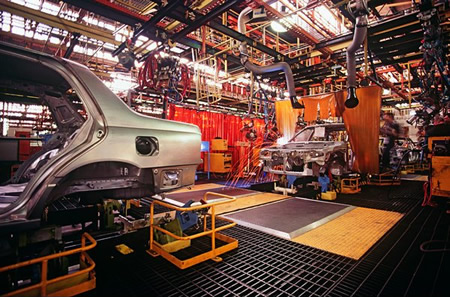
Acquainting the U.S. federal government with "The Cost of GM's Death", Crain Communications's automotive industry tabloid newsweekly 'Automotive News' has issued the following statement:
 If Congress thinks a bailout of General Motors is expensive, it should consider the cost of a GM failure.
Let's be clear. The alternative to government cash for GM is not a dreamy Chapter 11 filing, a reorganization that puts dealers and the UAW in their place, ensuring future success.
No, even if GM could get debtor-in-possession financing to keep the lights on (which it can't), Chapter 11 means a collapse of sales and a spiral into a Chapter 7 liquidation.
GM's 100,000 American jobs will die. Health care for a million Americans will be lost or at risk. Hundreds of GM's 1,300 suppliers will die. Their collapse could take down Ford Motor Co. and Chrysler LLC, perhaps even North American transplants. Dealers in every county of America will close.
The government will face greater unemployment, more Americans without health insurance and greater pension liabilities.
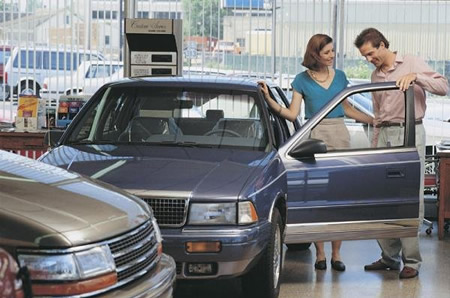
Criticize Detroit 3 executives all you want. But the issue today is not whether GM should have closed Buick years ago, been tougher with the UAW or supported higher fuel economy standards.
In the next two to four months, GM will run out of cash and turn out the lights. Only government money can prevent that. Every other alternative is fantasy.
The $25 billion in loans that Congress approved to partially fund improvements in fuel economy? Irrelevant. Dead automakers do not invest in technology.
The collapse of the global financial system has crushed the American car market, dried up revenues for the Detroit 3 and highlighted their weaknesses.
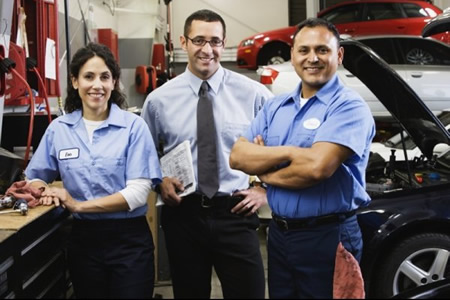
Each of the Detroit 3 is in crisis. But Ford, which borrowed big two years ago and thus has more cash today, may skip a bailout and the strings attached. Cerberus, which bought Chrysler last year, doesn't deserve money. Government cash might help sell Chrysler to a strategic owner.
Some Detroit critics want their pound of flesh: Throw the bums out and install a government czar. Treasury Secretary Henry Paulson won't use any of his $700 billion bank bailout money to help manufacturers. In any case, he'd need a guarantee that a bailout would make Detroit "viable."
Well, nobody -- not even AIG -- is insuring guarantees for viability.
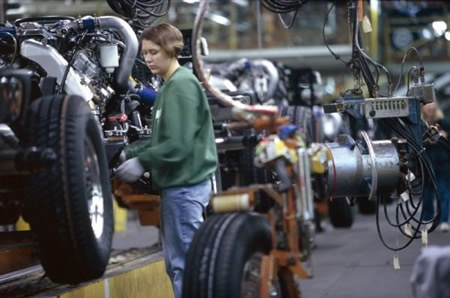
The taxpayer needs protection and an upside. GM's top management may need to go. Government-as-shareholder deserves a big voice. Those details can be worked out.
The Detroit 3 CEOs and UAW President Ron Gettelfinger had better tell two critical congressional hearings next week what sacrifices they are prepared to make.
But the stark fact remains: Absent a bailout, GM dies, and with it much of manufacturing in America. Congress needs to do the right thing -- now.
Source: Automotive News
"From the sublime to the ridiculous there is but one step."
-- Napoleon Bonaparte
"We saw how the Japanese auto companies changed their business practices and were able to stay competitive. We had about 25 years or so to try to deal with this, and we didn't. Now it looks like the reckoning is coming.
My heart says, 'yes,' to the federal loan because of the phenomenal ripple effect throughout the economy if Congress doesn't do it, especially in the Midwest. [The leaders of General Motors, Ford and Chrysler are pleading with Congress for a $25 billion loan as a bailout to the auto industry to prevent bankruptcy.]
But my head says, 'no,' because I don't have a lot of faith the government can intervene and fix this without much more money going in to what would be a bottomless pit, particularly with the hubris of the Big 3 leadership over the past 50 years.
The proposed loan would just be a 'Band-Aid'. All they'd be doing is buying time, perhaps through 2010 when the union contract ends or for the release of the Chevy Volt and other planned hybrid cars.
We'd be starting to see America more like a colonial economy, no longer the primary owners of what we make, and we'd see more of the wealth go overseas."
-- John Heitmann, Automotive Historian and Expert, University of Dayton
"Notwithstanding the criticism of its management, General Motors Corporation must remain intact. Americans must remember that for the last many years, the words 'General Motors' and 'Chevrolet' have been synonymous with the word USA, and have been their brand ambassadors worldwide.
The issue of 'GM's Bailout' is not merely an issue concerning domestic finance, commerce, industry, or economy. It is much more than that. It is an issue of America's honor, goodwill, and credibility in the international business."
© GlobalGiants.Com
|GlobalGiants.com|



Edited & Posted by Editor | 1:35 AM | Link to this Post
October 7, 2008
Reader's Digest Conducts Global Presidential Poll
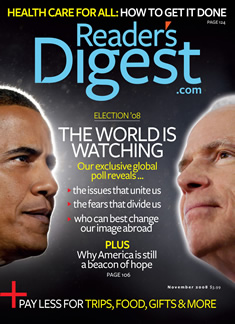
According to the results of a first-ever global presidential poll conducted by Reader's Digest magazine and published in the November issue (on newsstands October 21), Barack Obama is the world's preferred choice for president of the United States by far.
(Reader's Digest magazine is published in 21 languages and reaches 70 million readers worldwide. It is part of The Reader's Digest Association, Inc., a global multi-brand media and marketing company headquartered in Pleasantville, New York, USA.)
The poll, part of the cover story "How the World Sees Us" by Reader's Digest Washington Bureau Chief Carl Cannon, asked 17,000 people in 17 countries, including the United States, whom they would like to see in the White House, and to weigh in on the global issues they most care about. They were also asked to characterize how America is perceived abroad.
"For the first time, Reader's Digest used its unique international footprint to provide a tapestry of global perspectives on several of the most important issues of our time, leading with the election of the next American president," said Peggy Northrop, U.S. Editor-in-Chief, Reader's Digest.
• Regarding the question of which candidate they would vote for if they could, respondents voted overwhelmingly for Obama in every country polled, with the exception of the United States, where Republican John McCain was preferred over Democrat Obama by a narrow margin.
• "It's Obama by a landslide -- except in the country in which he's actually running for president," said John Fredricks, Director of Polling for Reader's Digest. "What is most striking is the margin of his support."
In the Netherlands, Obama-mania surpassed 90 percent. In Germany, it was at 85 percent--numbers not usually seen in political polling. Similar results held true on all six continents that the magazine polled.
One of the questions was "When you think of the U.S. government, do you consider yourself pro-American, neutral or anti-American?" The poll also asked respondents to rank eight issues in importance: terrorism, the war in Iraq, the global economy, global poverty, human rights, the environment, international trade, and nuclear proliferation.
Key Snapshots:
• Americans ranked the global economy as most important; terrorism, second; and the war in Iraq, third. Only the Russians were more concerned with terrorism than Americans.
• In seven nations (Australia, Brazil, Canada, Finland, Germany, Great Britain and Taiwan), the environment came out on top as a major concern.
• Respondents in Canada, Germany, Netherlands, Finland, Australia, and South Africa reported paying the most attention to the U.S. election. Respondents in Brazil, Poland, Russia, India, and Taiwan reported paying the least attention.
• While preference for the candidates is nearly equal in the U.S., support for Obama is significantly stronger in all other nations.
• In the U.S., McCain is seen as more qualified to address issues related to war and security, while Obama is the stronger candidate for humanitarian issues, such as poverty, the environment and human rights.
• Globally, the most important issues are the economy, poverty, and the environment.
• The election of Obama would be more likely to improve the image of the U.S.
• Most countries polled have a neutral opinion of the U.S. government. India is the most pro-American government (31%) while Spain, Netherlands, Indonesia and Canada have the highest percent (21%, 21%, 20%, 19%) of respondents who are anti-American government.
• The majority in India (73%), South Africa (65%), the Netherlands (55%) and France (52%) would be interested in moving to the U.S. while about 70% of respondents in Poland, Russia, Indonesia, and Australia expressed a lack of interest in moving to the U.S.
• South Africa is the only country where the election of McCain would have a slightly more positive impact on the image of the U.S.
Source: Reader's Digest
"Well, also, was it written by Theologians: a King rules by divine right. He carries in him an authority from God, or man will never give it him. Can I choose my own King? I can choose my own King Popinjay, and play what farce or tragedy I may with him: but he who is to be my Ruler, whose will is to be higher than my will, was chosen for me in Heaven."
- Thomas Carlyle, Sartor Resartus
|GlobalGiants.com|
Edited & Posted by Editor | 7:32 AM | Link to this Post
October 4, 2008
Realtors, Accountants Applaud House Passage of Financial Stability Bill

"The National Association of Realtors(R) is truly relieved that members of the U.S. House of Representatives, like their counterparts in the Senate, were able to come together in a bipartisan effort to pass the Emergency Economic Stability Act of 2008. As we have been saying, this legislation is critical to stopping the economic turmoil that millions of Americans are facing. Today's action will go a long way toward ending the current economic crisis crippling the housing and financial markets.
This legislation would quickly restore liquidity to the mortgage market, which would stabilize the housing market and protect homeowners. Mortgages as well as personal and small business loans would become more available and less costly. Protecting Main Street not only benefits individuals, families and communities, but also supports the larger U.S. economy.
We expect that the president will act quickly to sign and enact this bill. We thank President Bush for his steadfast leadership on this issue, commend all parties that worked on this legislation, and look forward to working together toward a strengthened economy for the benefit of all Americans."
- Richard F. Gaylord, President, National Association of Realtors. [National Association of Realtors, 430 North Michigan Avenue, Chicago, IL 60611, USA.]

"The House of Representatives' historic vote demonstrated leadership in difficult times. Americans and businesses, small and large, are already suffering financial challenges as a result of this crisis. This legislation is the first step in restoring liquidity in our economy. CPAs will roll-up our sleeves to do our part to help individuals and businesses move forward. The profession has already been actively reaching out through extensive financial literacy efforts to help Americans cope with the personal financial challenges they face.
The AICPA is pleased Congress avoided calls by some for an immediate suspension of fair value accounting rules. The bill includes a call for an objective study of mark-to-market accounting. We look forward to participating with the Securities and Exchange Commission and the Financial Accounting Standards Board in a thoughtful review.
Accounting standards are the keystone of our financial reporting system and are designed to provide investors and management with timely signals about the financial condition of our publicly-traded companies. Our longstanding position is that accounting standards ultimately should be set by the private sector."
- Barry Melancon, President, American Institute of Certified Public Accountants (AICPA). [HQ: AICPA, 1211 Avenue of the Americas, New York, NY 10036, USA. The American Institute of Certified Public Accountants is the national, professional association of CPAs, with more than 350,000 CPA members in business and industry, public practice, government, education, student affiliates, and international associates. It sets ethical standards for the profession and U.S. auditing standards for audits of private companies, non-profit organizations, federal, state and local governments. It develops and grades the Uniform CPA Examination.]
|GlobalGiants.com|
Edited & Posted by Editor | 12:50 PM | Link to this Post
September 29, 2008
U.S. Government Rescue Plan Praised by Franchise Industry
The International Franchise Association (IFA) today applauded the bipartisan economic rescue plan agreed to by congressional leaders and urged both the House and Senate to pass it quickly. The International Franchise Association is the world's oldest and largest organization representing franchising.

"We support the plan as outlined today by negotiators as a critical step in freeing up needed credit to help keep Main Street businesses operating and growing," said IFA Vice President of government relations David French. "Our members commend the extraordinary efforts by leading policymakers over the weekend to bring this important legislation together. The addition of crucial oversight and taxpayer safeguards strengthens the plan, and the package should send a positive signal to the financial markets and bring stability to the U.S financial system."

The franchised business sector is made up of locally owned businesses that create 21 million jobs and contribute $2.3 trillion to the private sector economy. Thousands of IFA members made their views known to congressional leaders this weekend with the message to come together on a bipartisan plan to bring stability to our nation's financial markets.
"We are grateful that our views and the views of thousands of small businesses across the country were heard," French said. "Now, Congress should pass the bill quickly and get it to the President for signing."
• Other Voices:

"Workers will not accept their tax dollars being turned over to the fat cats who took multi-million dollar bonuses and then bankrupted their companies and now threaten our entire economy. Action on the bailout will shape the votes of working Americans in November."
- Anna Burger, Chairperson, Change to Win. [Change to Win, 1900 L Street, NW Suite 900, Washington, DC 20036, USA, is one of the largest organizations of working Americans.]

"This massive bailout is nothing short of a scheme by irresponsible corporate pirates to privatize gains and socialize debt. Such a move will only further add to the burden of individuals and families, who are already struggling to make ends meet. Not one of our tax dollars should go toward rescuing an industry that is failing because of unregulated lending and trading practices.
We are tired of giving golden parachutes to greedy corporate interests. We're standing up and saying, 'Not this time, not with my money and not with my consent'."
- Cindy Sheehan, Candidate for Congress.
"Proposed $700 Billion Bailout Is Too Little, Too Late to End the Debt Crisis; Too Much, Too Soon for the U.S. Bond Market: The proposal before Congress for a $700 billion financial industry bailout will not only fail to end the massive U.S. debt crisis but could actually aggravate the crisis by driving up interest rates.
Based on recently released FDIC and Federal Reserve data, Weiss Research finds that:
1. 1,479 U.S. banks and 158 U.S. thrifts are at risk of failure, with total assets of $3.2 trillion, or 41 times the assets of banks on the FDIC's list of troubled institutions.
2. Among those with $5 billion or more in assets, 61 banks and 25 thrifts are heavily exposed to nonperforming mortgages.
3. The bailouts announced and proposed to date, although expected to cost over $1 trillion, are too small to rescue most institutions at risk, let alone address multiple problems with U.S. interest-bearing debts outstanding of $51 trillion and derivatives held by U.S. banks of $180 trillion.
There should be no illusion that the $700 billion estimate proposed by the Administration will be enough to end the crisis. Nor should there be any false hopes that the market for U.S. government securities can absorb the additional burden of a $700 billion bailout without putting major upward pressure on U.S. interest rates, aggravating the very debt crisis that the government is seeking to alleviate."
- Weiss Research, Inc. [Weiss Research, Inc., 15430 Endeavour Drive, Jupiter, FL 33478, USA.]
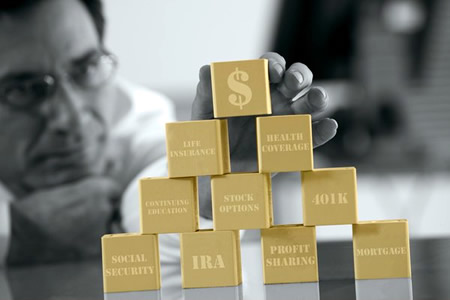
"Members of Congress are being asked to come together in a bipartisan effort to deal with an unprecedented financial crisis that threatens the stability of the global economy. For good reason, many are reluctant to take abrupt and dramatic action without giving due consideration to the long-term implications. This caution and thoroughness is appropriate. But it does not diminish the need to take convincing action very soon.
• There will be a time for investigation and the assessment of blame and guilt. This is not it.
• There will be a time to re-balance the powers of the executive and legislative branches of government. This is not it.
• There will be time to ensure government is not intruding unimpeded into the realm of private markets. This is not it.
The objections of lawmakers and many in the public to news of the "bailout" on the grounds of political philosophy and legislative oversight, and pure fear of government growth are legitimate and worthy. But the urgency of the situation -- the possibility of economic chaos and all that would mean -- is also legitimate.
What the economy requires immediately is first aid -- not long-term care. A first responder deals with the "ABCs" -- "airway, breathing and circulation." The same triage is required for the global economy. We are choking on bad debt and in real danger of the complete loss of financial circulation. We have to get the economy breathing again and world markets circulating freely. Then we can deal with everything else.
We do not have the leisure to stand over the victim arguing about who is to blame for the injury or who is going to pay for the treatment. That must come after we know the victim will live."
- Pennsylvania Business Council. [Pennsylvania Business Council, 116 Pine Street, Suite 201, Harrisburg, Pennsylvania 17101, USA.]
"It's fine to hope for the best, but we should budget for the worst. While the intent of this plan is to recoup much, if not all, of the initial cost to taxpayers there are no guarantees. The value of the assets to be purchased is highly uncertain. What we know for certain is that the government will incur a huge upfront cost, immediately adding to the debt and immediately incurring compounding interest payments. All of this will be layered on top of a deficit expected to exceed $500 billion next year, and an overall fiscal policy that is unsustainable. Meanwhile, we are borrowing increasing amounts from abroad to make up for our inability to make crucial budgetary decisions. The answer to every problem in Washington seems to be more debt. That simply cannot go on. Given the uncertainty of the return on this $700 billion of new borrowing, and the daunting challenges already confronting the fiscal outlook, Congress should adjust budget policy either though phased-in spending cuts or tax increases to ensure against any permanent fiscal deterioration.
Washington can normally act in the face of a crisis. We don't need to relearn that lesson. A more fundamental issue is whether we can learn from the current crisis and finally break the pattern of routinely ignoring long festering problems. It is no secret that our nation is entering an unprecedented and permanent demographic transformation to an older society and that we are doing so with steadily rising health care costs and steadily falling national savings. This is a dangerous combination for the future health of the economy. And yet, nothing in the budget process requires Congress to review the current-law outlook beyond the next five years, much less take corrective action. If we learn from Wall Street's mistakes, we can act more effectively, with less pain, and more time to prepare the public for difficult but necessary choices. If we don't change course, the federal government itself will be in need of a bailout."
- Robert L. Bixby, Executive Director, The Concord Coalition. [The Concord Coalition, 1011 Arlington Blvd., Suite 300, Arlington, VA 22209, USA.]
"As you know, about a week and a half ago, the Administration visited Capitol Hill and described the crisis in our financial markets and in our economy. A couple of days later, they presented us with their legislation, and since then we have worked in a bipartisan way to improve that legislation. We've entered into those conversations in the spirit of bipartisanship, with the understanding that each side would have half of our votes to pass the bill.
Today when the legislation came to the floor, the Democratic side more than lived up to its side of the bargain. While the legislation may have failed, the crisis is still with us.
Some of the issues that we worked on with the Republicans to improve the initial legislation related to oversight and protecting the taxpayer as we stabilize the markets. It was about ownership and equity in return for some of the investments that were made. It was about forbearance for homeowners so they could stay in their home. It was about corporate pay and how that had no more golden parachutes, and it was also about, again, oversight, oversight, oversight. I think these were major improvements to the bill, and as I say, they were bipartisan.
Again, the Administration pressed upon us the seriousness of this crisis in terms of the markets. We know how serious this is in terms of the middle class in our country. Whether it's a question of credit for small businesses or homeowners, for protecting savings for people, their penchants for retirement, for the education of their children. Keeping the store on the corner open to service the needs of the people in the neighborhood. America's communities have been feeling the downturn in the economy for a very long time...
The President impressed the Members about the gravity of the situation; that action is necessary to stabilize the markets and to protect the taxpayer.
Clearly, that message has not been received yet by the Republican Caucus. But again, we extend a hand of cooperation to the White House, to the Republicans, so that we can get this issue resolved for the benefit of America's working families, to strengthen our economy, and therefore strengthen our country...
So again, the legislation has failed but the crisis has not gone away. We must work in a bipartisan way, in order to have another bite of the apple, in terms of some legislation."
- Nancy Pelosi, Speaker of the House of Representatives, after the House rejected the Bailout Package 228-205 on Monday, September 29, 2008.
"September 29, 2008
TO THE MEMBERS OF THE UNITED STATES CONGRESS:
The U.S. Chamber of Commerce, the world's largest business federation representing more than three million businesses and organizations of every size, sector, and region, urges Congress to immediately pass the bipartisan financial rescue package to stem the financial panic. Congress must not adjourn without taking action to stabilize the financial markets.
Today's failure to approve legislation addressing the financial crisis has resulted in uncertainty and turmoil that have dramatically affected the markets, and lowered equity prices, eroding individual savings and destroying billions of dollars of household wealth.
Make no mistake: when the aftermath of Congressional inaction becomes clear, Americans will not tolerate those who stood by and let the calamity happen. If, on the other hand, Congress supports a plan to successfully restore the financial system and preserve the flow of credit to the economy, the American people will recognize that act of courage.
The Chamber urges Congress to immediately pass financial rescue legislation. The Chamber will score votes on, or in relation to, this issue in our annual How They Voted scorecard.
Sincerely,
R. Bruce Josten"
- U.S. Chamber of Commerce. [U.S. Chamber of Commerce, 1615 H St NW, Washington DC 20062, USA.]
"Over the last decade, U.S. Chamber of Commerce has spearheaded and accelerated the movement for less corporate accountability and less regulation. During this same time period, there have been major corporate fraud convictions, accounting scandals, and the biggest economic crisis since the Great Depression at a great cost to the American people.
The current financial crisis was caused by U.S. Chamber's aggressive lobbying to eliminate accountability and oversight. Today, U.S. Chamber is the loudest supporter of a $700 billion taxpayer bailout, even though it spent the last decade fighting to eliminate corporate accountability -- one of the major factors that led to the current financial crisis.
U.S. Chamber has been paid millions by large corporations to limit the rights of shareholders, roll back Sarbanes-Oxley reforms, prevent disclosures to investors, and protect boardrooms while preventing consumers from holding them accountable.
U.S. Chamber of Commerce has sought to destroy any check on corporate excess, accountability and greed. By conducting the dirty work of Enron, Exxon, AIG, and a host of other negligent corporations, U.S. Chamber has put countless Americans in financial jeopardy."
- American Association for Justice. [American Association for Justice, 777 6th Street, NW, Washington, DC 20001, USA (formerly known as the Association of Trial Lawyers of America), is the world's largest trial bar.]
"On behalf of our ten member companies representing nearly 80% of the U.S. new car sales market, the Alliance of Automobile Manufacturers strongly urges Congress and the Administration to come together swiftly to stabilize the credit market.
• For many Americans, after their homes, automobiles are the largest purchase they will ever make.
• With more than 90% of all new vehicles financed with credit it is crucial to our industry's survival that consumers have the ability to borrow money.
• This financial crisis not only compromises the vitality of our companies but also, and more importantly, the one in ten Americans whose jobs are supported by the auto industry, including suppliers, dealers and small businesses. Immediate action is imperative.
• We commend the bipartisan leadership of Congress and the Administration for their efforts to craft a compromise and urge Congress to quickly pass, by the end of this week, a financial rescue package that aids both the credit markets and the ability of consumers to finance vehicle purchases."
- Dave McCurdy, President and CEO, Alliance of Automobile Manufacturers. [The Alliance of Automobile Manufacturers is a trade association of 10 car and light truck manufacturers including • BMW Group, • Chrysler LLC, • Ford Motor Company, • General Motors, • Mazda, • Mercedes-Benz USA, • Mitsubishi Motors, • Porsche, • Toyota and • Volkswagen. Formed in 1999, the Alliance serves as a leading advocacy group for the automobile industry on a range of public policy issues.]
|GlobalGiants.com|
Edited & Posted by Editor | 10:21 PM | Link to this Post
September 28, 2008
UNCTAD Report: Financial Crisis, Economic Downturn Affecting Companies' Plans For Future Foreign Investment

The economic downturn and financial instability have made the largest transnational corporations (TNCs) more cautious about their medium-term foreign direct investment (FDI) ambitions, UNCTAD´s World Investment Prospects Survey 2008-2010 reports.
The percentage of companies planning large increases in investment overseas over the next three years has dropped significantly from 2007. The annual survey, known as the WIPS (World Investment Prospects Survey), was released yesterday in Geneva, Switzerland, in conjunction with the World Investment Report 2008. WIPS results are based on 226 responses to queries sent to the world´s largest TNCs.

The survey indicates that a majority of respondent companies still plan to increase their international investment expenditures, albeit at a more moderate level, over the next three years. This is largely due to an underlying and persistent trend towards expanding the share of TNC production, employment, and sales abroad. This trend towards internationalization will affect all corporate functions, including research and development (R&D) and decision-making centres, which so far have tended to remain in TNCs´ home countries.
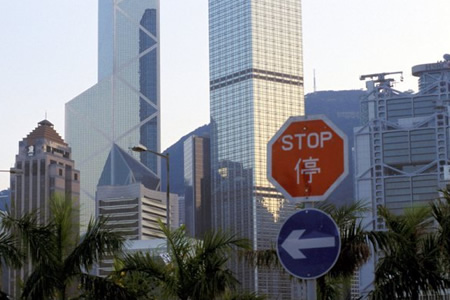
Analysis by home region shows the quickly growing international ambitions of companies from the developing world, particularly Asia, while FDI prospects for companies from developed countries, especially North American and Japan, have dimmed as compared to a year ago. Although still very focused on investing in their home regions, companies are expressing a growing interest in "far-shore" investments, providing evidence of a gradual extension of their strategic scope.

Five very large countries are considered by large TNCs as the most attractive destinations for future foreign investment: China, India, the United States, the Russian Federation, and Brazil. Their rankings are unchanged from last year´s survey. However, the Russian Federation and Brazil have caught up noticeably in attractiveness. It is noteworthy that four of the five top destinations are the emerging economies known collectively as BRICs (Brazil, Russia, India, and China).
Among the top 15 destination countries, Viet Nam again ranks 6th; Germany and Indonesia have improved to 7th and 8th, respectively. Australia, the United Kingdom, Poland, and France have declined slightly in the rankings but still remain in the top 15. Newcomers to the top 15 are South Africa, Canada, and Turkey.
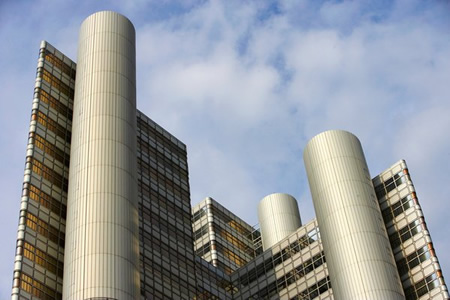
Market growth, market size, and access to international/regional markets are by far the most important factors influencing companies´ choices of investment location (50% of answers combined), followed by quality of business environment, including availability of skilled labour (8%), suppliers (6%), and adequate infrastructure (7%). The legal environment and government effectiveness were also mentioned frequently by TNCs responding to the survey. Availability of cheap labour, although not a negligible factor on average (8% of responses), appears to be a major determinant only for a few labour-intensive manufacturing activities such as garment production.
The World Investment Prospects Survey 2008-2010 is the most recent of a series of surveys on FDI prospects. UNCTAD has carried similar surveys since 1995.
In performing its functions, United Nations Conference on Trade and Development (UNCTAD) works together with member Governments and interacts with organizations of the United Nations system and regional commissions, as well as with governmental institutions, non-governmental organizations, the private sector, including trade and industry associations, research institutes and universities worldwide.
Source: United Nations Conference on Trade and Development (UNCTAD), Palais des Nations, 8-14, Av. de la Paix, 1211 Geneva 10, Switzerland.
|GlobalGiants.com|
Edited & Posted by Editor | 1:02 AM | Link to this Post
September 17, 2008
Bank of America becomes Financial Services Global Giant as it Buys Merrill Lynch
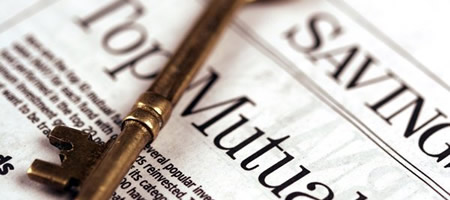
Bank of America Corporation's announcement that it has agreed to acquire Merrill Lynch & Co., Inc. in a $50 billion all-stock transaction, has created a company unrivalled in its breadth of financial services and global reach. While Bank of America is one of the world's largest financial institutions, Merrill Lynch is one of the world's leading wealth management, capital markets and advisory companies, with offices in 40 countries and territories. As an investment bank, it is a leading global trader and underwriter of securities and derivatives across a broad range of asset classes and serves as a strategic advisor to corporations, governments, institutions and individuals worldwide.
"Acquiring one of the premier wealth management, capital markets, and advisory companies is a great opportunity for our shareholders," Bank of America Chairman and Chief Executive Officer Ken Lewis said. "Together, our companies are more valuable because of the synergies in our businesses."
"Merrill Lynch is a great global franchise and I look forward to working with Ken Lewis and our senior management teams to create what will be the leading financial institution in the world with the combination of these two firms," said John Thain, chairman and CEO of Merrill Lynch.
The transaction is expected to close in the first quarter of 2009. It has been approved by directors of both companies and is subject to shareholder votes at both companies and standard regulatory approvals. Under the agreement, three directors of Merrill Lynch will join the Bank of America Board of Directors. By adding Merrill Lynch's more than 16,000 financial advisers, Bank of America would have the largest brokerage in the world with more than 20,000 advisers and $2.5 trillion in client assets.

At the same time, the sale of Merrill Lynch (MER) to Bank of America (BAC) has triggered one of the largest and most historical talent feeding frenzies in recent history.
"We have received a lot of calls from Merrill FAs already," says Darin Manis, CEO of RJ & Makay a national financial recruiting firm. "Once the dust settles Merrill brokers will be waiting to hear what their retention packages will be."
RJ & Makay is a financial recruiting firm that has recruited many dozens of brokers representing billions in assets this year and hopes to capitalize on the turbulent landscape to grab billions more in the fourth quarter.
"Even if the pending announcement of the retention package is competitive there will still be attrition. Historically there is an average pattern of 8%-15% attrition. With Merrill's size that could mean over 2,000 brokers ending up with a Merrill competitor. With the average Merrill FA having about 100 million in assets this is clearly a unique and welcome recruiting opportunity," Manis adds.
"Merrill Lynch and Lehman Brothers are the latest corporate casualties in the financial crisis caused by abusive loans from reckless lenders. Even the former chair of the Mortgage Bankers Association now concedes that brokers, lenders and investors 'forgot about [their] customers' because 'making money and our commission checks were more important.' In short, these loans never should have been made. The failure of Lehman and forced sale of Merrill underscore the need for stronger regulation of the mortgage market to prevent this from recurring, and, if we want to fix the economy, the need to modify the millions of bad loans that created this mess."
- Center for Responsible Lending, Sep 15, 2008. [Center for Responsible Lending, 302 West Main Street, Durham, NC 27701, USA.]
"Lehman Brothers aside, the government's actions toward Bear Stearns, Fannie and Freddie, and now handout requests from Detroit automakers could signal an ominous new trend of meddling in markets. Politicians have been digging taxpayers deeper into the fiscal hole, and we have to take their shovels away before we're all buried for good."
- Pete Sepp, Vice President for Policy & Communications, National Taxpayers Union (NTU), Sep 16, 2008. [National Taxpayers Union, 108 N. Alfred Street, Alexandria, Virginia 22314, USA.]
|GlobalGiants.com|
Edited & Posted by Editor | 1:47 AM | Link to this Post
September 15, 2008
Barack Obama, John McCain Outline China Views
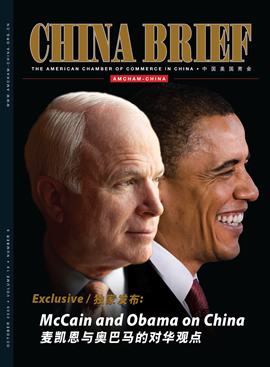
Photo: John McCain, Barack Obama Outline China Views Through AmCham-China.
The American Chamber of Commerce in China (AmCham-China) today announced in Beijing that US presidential candidates John McCain and Barack Obama have outlined their views on what US-China relations would be like under their respective administrations in articles written exclusively for AmCham. The articles, to be published in the October issue of AmCham-China's monthly magazine, China Brief, are believed to represent the first time the two candidates have publicly offered substantive details about their proposed China policies.
AmCham-China is a Beijing-based, non-profit organization representing the interests of some 2,700 companies and individuals doing business throughout China.
The articles outline the candidates' positions on a range of critical China-related business and policy issues facing the next US administration including trade balances, currency, security and the environment, as well as their thoughts on US competitiveness in the world economy.
"The fact that senators McCain and Obama chose to share their insights first with AmCham members is a testament to the chamber's reach and standing as an advocate for positive US-China business relations," said AmCham-China Chairman James Zimmerman. "We are encouraged to see both candidates call for further business development and more US engagement -- rather than isolationism -- in the years ahead. As a non-profit, non-partisan organization, AmCham-China looks forward to continuing good relations with the next administration."
Among many topics addressed, both candidates lay out clear indications of their views on trade.
For example, in his article Senator Obama writes that he will "undertake more sustained and serious efforts to combat intellectual property piracy in China, and to address regulations that discriminate against foreign investments in major sectors and other unfair trading practices." In addition, the senator pledges to work with China's leaders "to establish a better system for both countries to monitor products produced for export and act when dangerous products are identified."
Meanwhile, Senator McCain stresses China's obligations in improving bilateral trade relations. China's "commitment to open markets must include enforcement of international trade rules, protecting intellectual property, lowering manufacturing tariffs," he writes. "The next administration should be clear about where China needs to make progress, hold it to its commitments through enforcement at the World Trade Organization, and enforce US trade and product safety laws."
Source: The American Chamber of Commerce in China
|GlobalGiants.com|
Edited & Posted by Editor | 5:17 AM | Link to this Post
August 22, 2008
Michelle Obama interview on TV One -- Sunday, August 24
TV One commentator Roland Martin's interview with Mrs. Obama to serve as prelude to TV One's live coverage of the Democratic convention beginning Monday, Aug. 25 at 8 PM ET USA
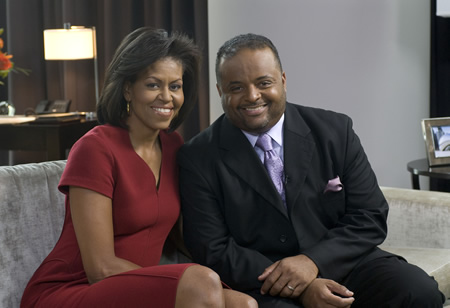
TV One, a new cable and satellite television network, programming primarily to African American adults has interviewed Michelle Obama who sits down with TV One commentator Roland Martin to discuss a wide range of topics that provide a personal glimpse of the presumptive Democratic Presidential candidate's spouse, her relationship with her husband and family, and what she thinks about the historic role into which they have stepped. The show (In Conversation ... The Michelle Obama Interview) will be broadcast on Sunday, August 24 from 8-9 PM ET USA on TV One.
According to TV One announcement, during this revealing interview, which repeats at 11 PM ET, Martin talks to Mrs. Obama about a host of topics, including her role in the campaign, how she deals with political attacks, the challenges of being away from their children on the campaign trail, how they find time for family and each other, her faith and their decision to leave Trinity Church, life in a fishbowl, how her upbringing shaped her values, and people's perceptions and misperceptions about her.
Mrs. Obama tells Martin that she spent much of her marriage trying to talk her husband out of politics, but she says her daughters are at the heart of the reason she decided to support his desire to pursue public office -- because she recognized that through politics he could make a better world for them.
She says that a spouse's role in the campaign is important because it gives a broader insight of who the candidate is.
"So much of who I am is where I grew up," Mrs. Obama says. She talks about growing up on the South Side of Chicago, her father as a shift worker who had MS and who believed in sacrificing for his family but never complained. She says both her parents taught her the importance of working hard and giving back.
She also believes voters can see themselves reflected in her and her husband's working and middle class family backgrounds. She says that black women, in particular, have not had their views and their lives reflected in the larger world, and she is delighted when she hears from black women that they see themselves reflected in her.
She tells Martin she and her husband learned how to sustain their relationship back in his state senate days, including carving out a regular date night. She says it's important for her daughters to see their parents' loving relationship, to see them holding hands, and that it helps them feel secure and loved.
While her own schedule is hectic, she recognizes that the average working family faces much more difficult struggles, with every woman she knows struggling to balance resources. She tells Martin that she passionately wants to give voice to the challenges of working families, especially military families, who struggle with housing, schools, and health matters, many of them barely getting by.
Mrs. Obama says that it's truly humbling to be part of the next step in history, and she clearly does recognize that they are part of a historic moment.
"You need to celebrate what [Sen. Obama] represents even if you don't vote for him," Mrs. Obama says.
The interview, conducted in Chicago on Aug. 20, is part of TV One's continuing series of hour-long interviews with major public figures of interest to African Americans. Over the past four years, TV One has featured hour-long interviews with Senators Barack Obama and Hillary Clinton, then- Secretary of State Colin Powell, then-National Security Adviser and current Secretary of State Condoleezza Rice, Supreme Court Justice Clarence Thomas and former Secretary of Education Roderick Paige.
"We are delighted to bring this interview with Mrs. Obama to our viewers as part of our public affairs programming during the Presidential election season," said TV One President and CEO Johnathan Rodgers. "We also hope to have an opportunity soon to offer our viewers an in-depth interview with Senator McCain," Rodgers added.
Source: TV One
|GlobalGiants.com|
Edited & Posted by Editor | 1:06 PM | Link to this Post
August 20, 2008
Branding at the Olympics
Photo: Cindy Crawford at the OMEGA Pavilion on the Olympic Green in Beijing on 14 August, 2008.

Photo: American pole-vault athlete Jennifer Stuczynski at adidas Brand Center in Beijing, China, August 11, 2008. At the center's Olympic Brand Launch Area, consumers can get close and personal with the special products, designs and technologies that adidas has developed for the Beijing 2008 Olympic Games.

Photo: Women's 200m Olympian Marshevet Hooker of the USA at adidas Brand Center in Beijing, China, August 15, 2008. The new adidas Brand Center showcases and highlights the breadth and depth of the adidas brand to the Chinese consumers as well as to all visitors of the Olympic Games.
As the Olympic Games unfold, the branding experts at Siegel+Gale are commenting on topics such as how the Olympics are affecting the "brand" of China, how companies are using the Olympics to further their brands, specific corporate ad campaigns, branding through sports events in general, and other strategic branding and positioning issues.

Following are some comments by Larry Vincent, Siegel+Gale's Group Director of Strategy in Los Angeles, and Julius Roberge, Siegel+Gale's Strategy Director in New York, most recently relocated from Shanghai:
Why Companies Align With the Olympics - Larry Vincent
• "Most companies align with the Olympics because they hope to borrow equity or transfer goodwill from that of the Olympics to their own brands."
• "Twenty years ago it was a slam dunk. McDonald's and Coca-Cola measured noticeable lifts in preference, favorability, and attitudes toward the brand during the co-brand window of the Games."
• "1984 was the turning point, however. The Los Angeles Games, in some ways, reinvented the sponsorship model (so much so that LA had a surplus of funds after the Games). It was so successful, that more brands wanted in."
• "Today, sponsors have changed quite a bit: there are more of them and the affiliation competes with branded partnerships in vastly more channels and platforms."
• "The Olympic equity is still strong (although research shows that it is the strongest when the Games are actually in progress), but it's harder to transfer or borrow the equity."
• "'False reporting' of 'unaided awareness' of Olympic sponsorships is on the rise (meaning, consumers attribute an Olympic sponsorship to the wrong company) and ambush tactics by other marketers are more prolific. In that context, you have to ask, 'What is the return on investment for a company that spends millions to sponsor the Games, and millions more to purchase the media that activates the sponsorship?'"

Photo: adidas Olympics advertising campaign: Together in 2008 - Impossible is Nothing.
• "It still works for some. We expect Adidas, Coca-Cola, and McDonald's will still do well. Part of that is the legacy. In Adidas' case, it's the innovative way they've gone to market."
"At the Beijing 2008 Olympics, American global giants are blindly following a crude and hazy sponsorship advertising policy. Consequently, their global brand equity enhancement is only a fraction of what they deserve for spending huge money on this pursuit.
While sponsoring the Beijing Games, their focus is on China. Excellent. But they, as well as America's top business commentators and writers, have put the rest of the world into oblivion. They seem to have no idea that without much further expenditure, these multinationals could have utilized this rare opportunity to firmly establish their brands throughout the world.
Localized print advertisements publicizing the company's privileged involvement in the 2008 Olympics, for example, would have won them universal goodwill and respect in all their target markets worldwide."
© GlobalGiants.Com
• "We do think the Olympics is a horrible place to debut new brands, however. There is too much clutter and competition."
• "It CAN be an effective place to reposition a brand, particularly if the brand is in the B2B space and the repositioning can occur onsite at the events. Many of the attendees of Olympic events are executives (just like the Super Bowl). UPS is using the Beijing Games as an interesting venue to debut some of their new international brand activity."
• "Intuitively, we should be seeing international companies getting more involved in the Games in the future. It can become the coming out event for large international companies who wish to elevate brand awareness on a global stage. But the challenge is that for many viewers, the brands will be so foreign they won't know who they are or what they do. It requires the brand to do a lot of seeding work before the Games begin, and very aggressive follow-up work once the brand has launched with the marks."
Photos: Shanghai, China.
The "China Brand" - Julius Roberge
• "Until China, never before has the market potential of the host country on its own been viewed as possibly worth the significant investment. Despite the degree of controversy before the Games began, the market opportunity seems irresistible."
• "The Olympics have a clear purpose for the "China" brand: to prove to the world that China is capable of hosting Games at a quality level that the Olympic brand, the athletes and spectators worldwide demand and expect."
• "The China brand today is often correlated with low quality (products), so the challenge is Herculean. With the world watching their every step, success in Beijing will send a strong new message about China as a world power. If it missteps, it will not soon have such visibility to transform a lagging image."
• "It's safe to assume Americans understand that Olympic sponsorship is not the same as supporting China's political policies. That said, given the ongoing buzz and interest in how China enters the world stage, how a brand behaves in and/or partners with China may draw more attention in the future from international media, thus elevating the potential for a negative effect on a brand's image. This may be more of a concern for B2B organizations that deal more closely with the Chinese government or in government monitored sectors."
Siegel+Gale is one of the world's premier strategic branding companies. The firm has worked with an array of leading organizations, including American Express, AARP, College Board, Cornell University, Dell, Duke University, Lexus, MBA.com, Merrill Lynch, Motorola, the National Basketball Association, 3M, Dow, and The Four Seasons Hotel Group, Sony, and Yahoo! Siegel+Gale has full-service offices in New York, Los Angeles, London, and Dubai and strategic partnerships around the world. Siegel+Gale is part of the Omnicom Group Inc., a leading global marketing and corporate communications company.
Source: Siegel+Gale
|GlobalGiants.com|
Edited & Posted by Editor | 2:02 AM | Link to this Post
August 12, 2008
Branson cautions Obama and McCain against American Airlines British Airways Link-Up
Sir Richard Branson, the President of Virgin Atlantic Airways, has written to both US Presidential candidates warning that a proposed alliance between British Airways and American Airlines would severely damage competition on major transatlantic routes and leave consumers worse off.
In his letter to Senators Barack Obama and John McCain, Sir Richard says that "airlines everywhere are struggling with the current price of oil, but the solution to their problems should not lie in an anti-competitive agreement, which will inevitably lead to less competition and higher fares."
BA and American Airlines, who together with Iberia would have nearly half of all takeoff and landing slots at London's Heathrow airport, are expected to file an application this week for permission to fix prices and timetables, and share revenues and frequent flyer details, on their route networks.
The two airlines have tried twice before to gain permission to bring together their operations and, on both occasions, every regulator that examined the alliance raised serious concerns about the anti-competitive nature of the proposal.
Senator Obama represents Illinois, a state where many workers are employed by American Airlines at Chicago O'Hare airport.
Photo: Sir Richard Branson spins at the 2007 Virgin Mobile USA Art Auction in New York City.
Sir Richard writes in the letter: "BA and AA will argue that their alliance is now acceptable because the competitive environment has changed with the Open Skies accord on UK-US routes. This is a complete red herring. Open Skies (which is only a temporary accord as it may be unwound in 2010) has not significantly increased competition on UK/London-US routes." Open Skies hasn't reduced ticket prices, either.
Against the background of high oil prices, Sir Richard writes: "Neither is the current economic slowdown a justification for waiving through any application. The job of the regulators is to assess the long-term impact of the alliance on competition, not to provide special protection from the immediate challenges of the economic cycle, with which every other airline has to deal with."
The key issue for the competition authorities is the market dominance that a combined BA/AA will have in individual markets. There are six Heathrow routes on which BA and AA overlap and where competition would be reduced.


BA/AA would have dominant market shares on the following routes to and from Heathrow in terms of capacity:
• JFK - 63%
• Chicago - 66%
• Boston - 82%
• Miami - 72%
• Los Angeles - 49%
• Dallas Fort Worth - 100%
In the letter Sir Richard explained that "BA/AA would have a combination of high frequencies and a transatlantic network that could not be replicated by any other airline/alliance, and which would make it impossible for other carriers to compete for time-sensitive corporate or business travelers."
Sir Richard also highlighted the fact that Heathrow being full, another major airport is limiting access: "We now have a similar situation at New York airports, with government imposed restrictions. The Heathrow-New York JFK route is by far the most important transatlantic market, accounting for over 25% of the total Heathrow/US market."
Virgin Atlantic will be launching a major lobbying and advertising campaign in due course telling the regulators and the consumers that "BA/AA and Iberia alliance is dangerous and it should be blocked".
Source: Virgin Atlantic Airways
|GlobalGiants.com|
Edited & Posted by Editor | 11:36 PM | Link to this Post
August 10, 2008
Polo Ralph Lauren designed U.S. Olympic Team Parade Outfits for Beijing Opening Ceremony
As American athletes took to the stage during the commencement celebration in Beijing, the Polo Ralph Lauren 2008 U.S. Olympic Team Opening Ceremony Parade Outfits were unveiled to spectators around the world.
Inspired by the rich past of the Olympic Games, and in keeping with the time-honored tradition of this historic event, Polo Ralph Lauren brought an elegant and contemporary style to the U.S. Olympic Team.
According to the company, "Reflecting the brand's trademark sporty sophistication and refined sensibility, the Opening Ceremony uniforms evoke the heritage and legacy of the 1920's and 1930's. Featuring a polished and tailored silhouette, the ensemble is comprised of a crisp white cotton shirt and ivory cuffed pants, complemented by a timeless navy blue blazer in tropical wool, adorned with the iconic Polo Pony and the 2008 U.S. 'Look of the Team' logo. The chic outfits are accented by Americana-infused accessories with red, white and blue silk ties and scarves and classic canvas sneakers with red and blue lateral stripes, topped off with a white twill hat."
In addition to designing the Official Opening Ceremony Parade Outfits for the U.S. Olympic Team, Polo Ralph Lauren has also created their Closing Ceremony Parade Outfits and an assortment of Olympic Village Wear pieces to be provided to the U.S. Teams.

The Olympic Village Wear designs offer more casual sportswear looks with zip-up hooded sweatshirts, sleek track jackets and brightly colored cotton polo shirts all displaying the official U.S. Olympic Team logo and the classic Polo pony logo. Incorporating the theme of the Games' location, Chinese characters reading Beijing also decorate the apparel, while red, white and blue accents mark the pieces as quintessentially American.

The 2008 Beijing Summer Olympic Games are being celebrated from August 8 to August 24 with an estimated four billion viewers watching global-televised coverage, which is expected to be the largest audience ever to view the Olympic Games.
Source: Polo Ralph Lauren Corporation
|GlobalGiants.com|
Edited & Posted by Editor | 8:24 AM | Link to this Post
March 24, 2008
New Jersey Tourism's Spring Advertising Campaign: "You Have Arrived"
As Travelers Plan Spring and Summer Itineraries, Multifaceted Campaign Uses Popular GPS Imagery to Spotlight New Jersey's "Great Destinations in Any Direction"
New Jersey Division of Travel & Tourism debuts the state's new multifaceted Spring advertising campaign today March 24. Two compelling new television commercials take center stage in a media mix featuring radio, billboards and the Internet. The 30-second TV spots go beyond simply suggesting a visit to the Garden State -- they draw viewers in by highlighting New Jersey's signature attractions as well as a sampling of the state's artistic, cultural and historic destinations.

The campaign, which features images of GPS navigation screens and the familiar "you have arrived" broadcast voice-overs, capture New Jersey's range of experiences -- from bicycling to birdwatching, from starfish to spa treatments.
NJ Tourism Spring TV Commercial
According to the New Jersey Division of Travel & Tourism, viewers will see historic venues such as Red Bank's revitalized Count Basie Theatre, exciting dining and nightlife, and families bonding over Wildwood's exhilarating rides and nostalgic "Doo Wop" culture. New Jersey's great destinations will be splashed across the Eastern seaboard -- from Toronto, Ontario to Roanoke, Virginia, and from Cincinnati, Ohio to Long Island, New York. Drivers will see billboard images of the state's diverse tourism gems -- as colorful GPS screens -- along major thoroughfares. Web surfers can explore online through Internet advertising. And radio listeners will hear "mini itineraries," perfect for a quick getaway. " |GlobalGiants.com|
Edited & Posted by Editor | 11:13 PM | Link to this Post
February 14, 2008
Center for Public Leadership at Harvard's Kennedy School serves the common good

The Center for Public Leadership (CPL) at Harvard's Kennedy School of Government has been recognized by Affinity Research's VISTA Awards for having one of the most widely read magazine pieces in 2007. The America's Best Leader's feature in the November 19 issue of U.S. News & World Report, a joint effort of CPL and U.S. News, was read by 86% of those surveyed, making it the third most popular piece for the fourth quarter.

CPL's collaboration with U.S. News involves a selection process, conducted by an independent panel, which results in the honoring of 15-25 of the country's most effective leaders. CPL and U.S. News also jointly commission a public opinion survey of Americans' attitudes about leaders from all sectors of society. CPL then analyzes the survey data to produce the National Leadership Index. This year's index reveals that more than three-quarters of the public (77%) now say that our country has a crisis in leadership. It also provides some thought-provoking findings relative to the upcoming presidential election. For example, the next president's likeability is more important to the youngest Americans surveyed (those age 18-24) and the oldest Americans (those 65 years and older) than it is to those age 25 to 64. But these same two groups believe that it is less important for the next president to be decisive than do Americans age 25 to 64.
Established in 2000 through a generous grant from the Wexner Foundation, the Center for Public Leadership at Harvard's Kennedy School serves the common good by providing cutting-edge teaching and research as well as hands-on training in the practical skills of leadership for people in government, nonprofits, and business. |GlobalGiants.com|
Edited & Posted by Editor | 9:48 AM | Link to this Post