
















August 4, 2015
World Leaders to Formally Adopt the Post-2015 Development Agenda in September
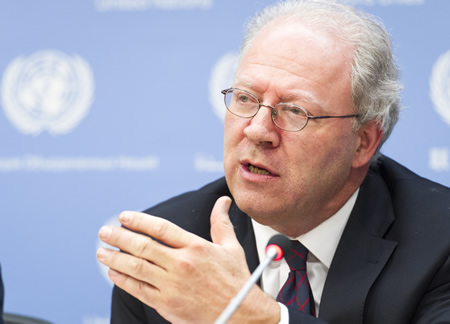
Photo: David Donoghue, Permanent Representative of Ireland to the UN, addresses a press conference on the agreement achieved on 2 August by Member States on the outcome document of the United Nations Summit to adopt the post-2015 development agenda to be held in New York from 25 to 27 September 2015. Mr. Donoghue, along with Macharia Kamau, Permanent Representative of the Republic of Kenya, co-facilitated the negotiations leading to the agreement on the document. 03 August 2015. United Nations, New York. UN Photo/Mark Garten.
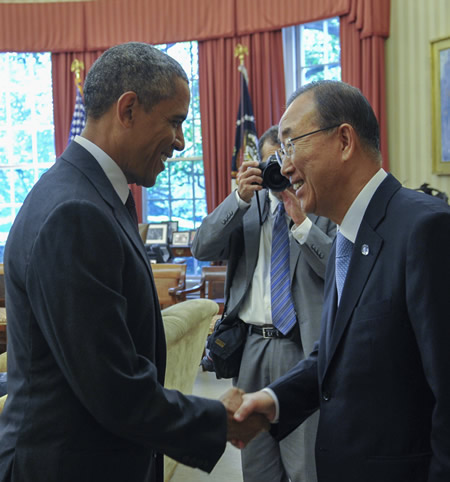
Photo: UN Secretary-General Ban Ki-moon (right) meets with Barack Obama, President of the United States, in the Oval Office in Washington, D.C. 04 August 2015. Washington, DC, United States. UN Photo/Mark Garten.
• The 193 Member States of the United Nations reached agreement today on the outcome document that will constitute the new sustainable development agenda that will be adopted this September by world leaders at the Sustainable Development Summit in New York.
Concluding a negotiating process that has spanned more than two years and has featured the unprecedented participation of civil society, countries agreed to an ambitious agenda that features 17 new sustainable development goals that aim to end poverty, promote prosperity and people’s well-being while protecting the environment by 2030.
More than 150 world leaders are expected to attend the Sustainable Development Summit at the UN headquarters in New York between 25 to 27 September to formally adopt the outcome document of the new sustainable agenda.
The preamble of the 29-page text, “Transforming Our World: The 2030 Agenda for Sustainable Development,” states, “We are resolved to free the human race from the tyranny of poverty and want and to heal and secure our planet.” It continues, “We are determined to take the bold and transformative steps which are urgently needed to shift the world onto a sustainable and resilient path. As we embark on this collective journey, we pledge that no one will be left behind.”
|GlobalGiants.Com|


Edited & Posted by Editor | 9:01 AM | Link to this Post
July 23, 2015
IBM Partners with 200 Universities Globally to Train Next-Generation of Cloud Developers

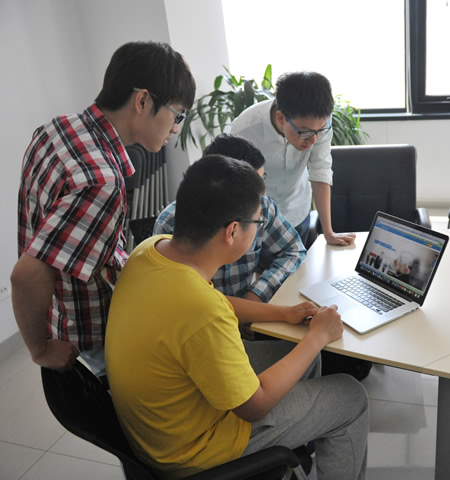
Photo: Students from Tsinghua University (Beijing, China) are using the IBM-developed SuperVessel cloud service to develop cloud and emerging technology applications. These students are part of a growing community of developers contributing to the OpenPOWER ecosystem worldwide. (Credit: IBM).

Photo: Project managers in IBM’s Costa Rica Delivery Center talk with global clients about implementing solutions in the areas of cloud, security, data storage and analytics to optimize their IT infrastructure. Forrester Research named IBM the leading supplier in global infrastructure outsourcing, based on a survey of 13 top firms, noting IBM’s vision for cloud and the rise of hybrid cloud as a priority for clients. (Credit: IBM).
ARMONK, N.Y - 22 Jul 2015: IBM is introducing a new commitment to enable the next generation of developers with the Academic Initiative for Cloud, aimed to mentor and energize them to innovate using IBM Cloud technologies. The new program will create cloud development curricula using Bluemix, IBM’s platform-as-a-service, in over 200 universities, reaching more than 20,000 students in 36 countries.
“Putting Bluemix in the hands of today’s and tomorrow’s innovators creates the opportunity to foster a new generation of talent in cloud application development,” said IBM General Manager for Cloud Ecosystem and Developers, Sandy Carter. “Our commitment to provide deep cloud expertise to programs aimed at future cloud developers from academics to professionals is necessary to sustain the growth our industry forecasts.”
• Introducing the Academic Initiative for Cloud
IBM’s new Academic Initiative for Cloud will introduce students to the latest cloud technologies and solutions as they build the transferrable skills needed to launch their own businesses or become industry leaders in the workforce. This new program continues IBM’s leadership and commitment to closing the skills gap between higher education curricula and workforce needs, which already includes Big Data Analytics and Cognitive Computing academic programs.
Starting this fall, universities around the world will commence more than 250 courses and programs that will utilize educational materials, technologies and methodologies from IBM with a focus on using Bluemix in a variety of courses ranging from computer science, information technology, analytics and data science to mobile and entrepreneurship. The list of over 210 marquee institutions includes:
- Ben-Gurion University (Israel)
- Carnegie Mellon University
- Imperial College of Science (England)
- International Institute of Information Technology (India)
- National College of Ireland
- National University of Singapore
- Northwestern University
- University of California Irvine
- University of Cambridge
- University of Southern California
- University of Stuttgart
- University of Tokyo
The use of Bluemix in the classroom will allow faculty to extend their teaching beyond theory and into practice.
“Leaders in business and higher education must come together to foster a new generation of digital-savvy talent,” said Kevin Werbach, a professor and expert on gamification at the Wharton School of the University of Pennsylvania. “It’s great that IBM is so committed to connecting with top universities like ours, and to giving students and faculty exposure to the latest cloud technologies and business concepts. This experience will help prepare our students as they enter the marketplace.”
Additionally, IBM is launching a new Student Developer Community that helps students get started on their journey of cloud education, and provides quick access to learning resources and information on how students can join Bluemix U, where students can showcase their accomplishments and the impact of their real-world projects.
• Supporting Girls Who Code and ReBoot Accelerator to Diversify the Tech Talent Pipeline
Diversity drives innovation. With only 14% of computer science graduates being women today, down from 37% in 1984, IBM is committed to innovation-driven cloud development by supporting programs that empower women in technology and address the lack of women in technology professions.
As such, IBM is working with Girls Who Code to introduce the next generation of women developers to cloud innovation by hosting a class of female high-school students in New York City for a seven-week summer immersion program. For 2016, IBM has committed to further expand its relationship with the organization to support additional programs in San Francisco, Los Angeles and Austin, alongside continued support for the New York City summer immersion program.
IBM is also announcing a new collaboration with GSVlabs on the ReBoot Accelerator for Women, a program designed to help women become current, connected, and confident as they return to work after a multi-year sabbatical. IBM will host several instructional sessions that will focus on cloud development using Bluemix, aimed at demystifying coding and making it more approachable. IBM will also be providing mentorship and assistance with job placement strategies in hopes of attracting more women back to the workplace, including at IBM.
IBM is also working to create programs for developers to help them transform industry and enterprise.
|GlobalGiants.Com|
“The value of an idea lies in the using of it.”
— Thomas A. Edison.

“When I have fully decided that a result is worth getting I go ahead of it and make trial after trial until it comes.”
— Thomas A. Edison.
“I never did anything by accident, nor did any of my inventions come by accident; they came by work.”
— Thomas A. Edison.
Edited & Posted by Editor | 5:20 AM | Link to this Post
July 20, 2015
Report of Commission on Global Security, Justice & Governance Launched
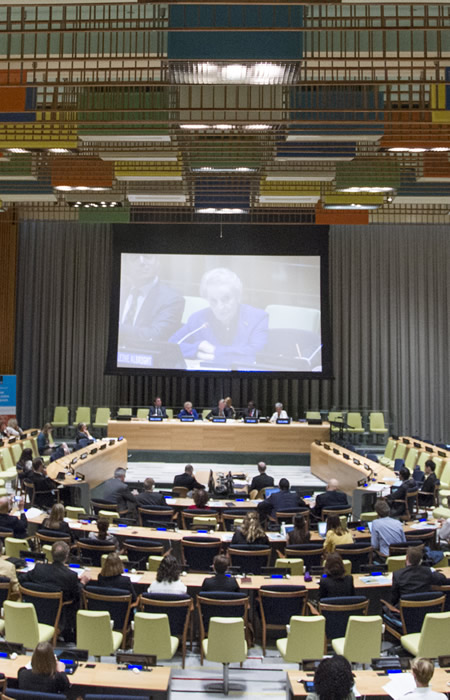
Photo: A special event was held on the new report, “Confronting the Crisis of Global Governance”, issued by the Commission on Global Security, Justice & Governance. The event was co-organized by the Permanent Mission of the Netherlands to the UN, the Stimson Centre, and The Hague Institute for Global Justice.
A view of the Trusteeship Council Chamber. Karel Jan Gustaaf van Oosterom (centre on dais), Permanent Representative of the Kingdom of the Netherlands to the UN, with Madeleine Albright (second from left), Co-Chair of the Commission and former United States Secretary of State, during the event. 14 July 2015. United Nations, New York. UN Photo/Rick Bajornas.
|GlobalGiants.Com|
“The battlefield is a scene of constant chaos. The winner will be the one who controls that chaos, both his own and the enemy’s.”
— Napoleon Bonaparte.
Edited & Posted by Editor | 11:16 AM | Link to this Post
July 8, 2015
China Dominates QS University Rankings: BRICS 2015

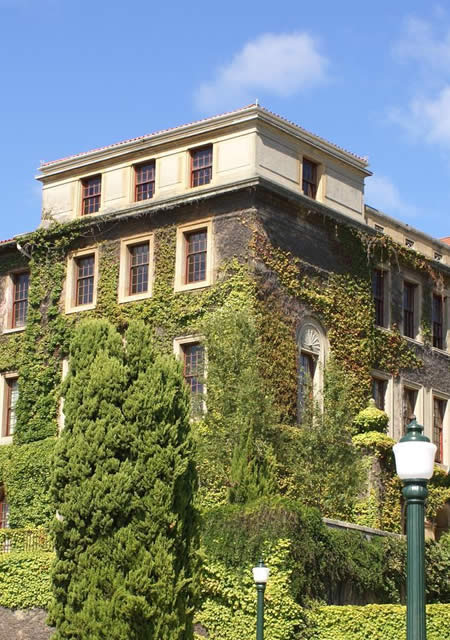
Photo: An ivy-covered building at the University of Cape Town (UCT), South Africa. UCT was established in 1829. Image credit © Danie van der Merwe.
The QS University Rankings: BRICS compares the Top 200 institutions in Brazil, Russia, India, China and South Africa.
Released today, the 2015 edition of the QS University Rankings: BRICS reflects the increasingly strong global presence of leading Chinese universities - with the top three spots going to Tsinghua University, Peking University and Fudan University.
While all five BRICS countries are represented within the top 20, China’s dominance is clear throughout the ranking. Driven by strong performance in the two global reputation surveys of academics and employers, Chinese universities take seven of the top 10 spots and almost half of the top 50. With 53 institutions in the top 200, Russia is second only to China, which has 67 universities featured. Yet only seven Russian institutions make the top 50, compared to China’s 21, Brazil’s 10, and India’s 9.
Russia’s leading entrant, Lomonosov Moscow State University, falls one position this year, but retains a highly respectable fourth place. India’s top representative, the Indian Institute of Science Bangalore, follows immediately behind in fifth. Brazil makes its first appearance with the Universidade de Sao Paulo in ninth place, while South Africa’s leader is the University of Cape Town in 14th - both having fallen slightly since last year.
Now in its third annual edition, the QS University Rankings: BRICS was developed to track the relative progress of leading universities in the five fast-developing BRICS countries - all of which have made investment in higher education and research high national priorities.
As a recent OECD (Organisation for Economic Co-operation and Development) report showed, China now spends more on research and development than any country other than the US. It is forecast to overtake the entire European Union and the US on this measure by the end of the current decade.
Meanwhile recent years have seen the Russian government step up efforts to internationalize its higher education, with a focus on gaining ground in the global rankings. More than 10 billion roubles (US$300m) has been committed in grants for leading Russian universities, with the “Council on Global Competitiveness Enhancement of Russian Universities” established to monitor progress and guide the project.
India likewise has its eye on the international stage, with the government’s “brain gain” policy aspiring to establish 14 world-class universities.
QS UNIVERSITY RANKINGS: BRICS 2015 — TOP 20
RANK — INSTITUTION — COUNTRY
- 01 — Tsinghua University — China
- 02 — Peking University — China
- 03 — Fudan University — China
- 04 — Lomonosov Moscow State University — Russia
- 05 — Indian Institute of Science (IISc) Bangalore — India
- 06 — Shanghai Jiao Tong University — China
- 06 — University of Science and Technology of China — China
- 08 — Nanjing University — China
- 09 — Universidade de Sao Paulo — Brazil
- 10 — Beijing Normal University — China
- 11 — Zhejiang University — China
- 12 — Universidade estadual de Campinas (Unicamp) — Brazil
- 13 — Indian Institute of Technology Delhi (IITD) — India
- 14 — University of Cape Town — South Africa
- 15 — Saint-Petersburg State University — Russia
- 16 — Indian Institute of Technology Bombay (IITB) — India
- 17 — Wuhan University — China
- 18 — Indian Institute of Technology Kanpur (IITK) — India
- 19 — Novosibirsk State University — Russia
- 20 — Indian Institute of Technology Madras (IITM) — India
QS UNIVERSITY RANKINGS: BRICS 2015 — INDIA
BRICS RANK — INSTITUTION
- 05 — Indian Institute of Science (IISc) Bangalore
- 13 — Indian Institute of Technology Delhi (IITD)
- 16 — Indian Institute of Technology Bombay (IITB)
- 18 — Indian Institute of Technology Kanpur (IITK)
- 20 — Indian Institute of Technology Madras (IITM)
- 24 — Indian Institute of Technology, Kharagpur
- 43 — Indian Institute of Technology Roorkee (IITR)
- 46 — University of Delhi
- 50 — Indian Institute of Technology Guwahati (IITG)
- 52 — University of Calcutta
- 58 — University of Mumbai
- 78 — University of Madras
- 93 — Banaras Hindu University
- 95 — Birla Institute of Technology and Science, Pilani
- 97 — Manipal University (Manipal Academy of Higher Education)
- 101-110 — University of Calicut
- 101-110 — University of Pune
- 111-120 — Aligarh Muslim University (AMU), Aligarh
- 111-120 — National Institute of Technology Rourkela
- 131-140 — University of Kashmir, Srinagar
- 141-150 — Amity University
- 141-150 — G.B. Pant University of Agriculture and Technology, Pantnagar
- 141-150 — University of Mysore
- 151-200 — Amrita Vishwa Vidyapeetham
- 151-200 — Andhra University
- 151-200 — Anna University
- 151-200 — Bharathidasan University
- 151-200 — Dr. Harisingh Gour University (University of Sagar), Sagar
- 151-200 — Jadavpur University
- 151-200 — Panjab University, Chandigarh
- 151-200 — VIT University
The QS University Rankings: BRICS is based on eight key performance indicators that relate to global reputation, internationalization, academic staff levels, research production, and impact. This year more than 500 universities in the BRICS countries were considered for inclusion, with the top 200 published.
|GlobalGiants.Com|
ADDENDUM
• Press Note issued by Rashtrapati Bhavan (Presidential Mansion), New Delhi, India —
PRESIDENT OF INDIA EXPRESSES HAPPINESS OVER IISC COMING IN FIFTH PLACE AND 31 INDIAN INSTITUTIONS FIGURING IN TOP 200 IN THE QS BRICS UNIVERSITIES RANKING 2015.
Edited & Posted by Editor | 5:52 AM | Link to this Post
June 29, 2015
Special Event to Mark 70th Anniversary of Signing of United Nations Charter
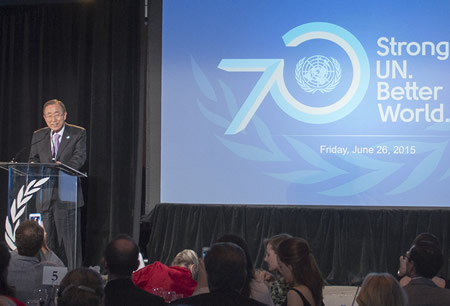

Photo: Secretary-General Ban Ki-moon delivers a speech at the United Nations Champions Dinner at the Venetian Ballroom, Fairmont Hotel in San Francisco. This special event was a part of the celebration of the 70th anniversary of the signing of the United Nations Charter in San Francisco on this day in 1945. 26 June 2015. San Francisco, United States. UN Photo/Mark Garten.
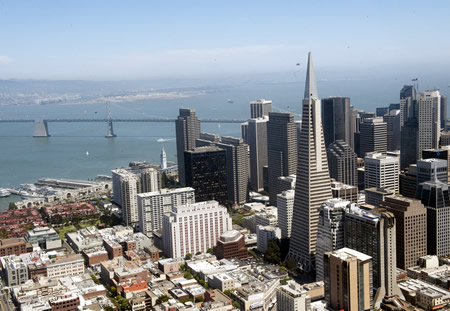
Photo: Aerial View of San Francisco, California, during the Secretary-General Ban Ki-moon trip to Palo Alto to deliver a speech at Encina Hall of Stanford University in California entitled “The UN at 70: A conversation with UN Secretary-General Ban Ki-moon”. 26 June 2015. San Francisco, United States. UN Photo/Mark Garten.

Photo: The San Francisco Conference, 25 April - 26 June 1945. India Signs the United Nations Charter. Sir A. Ramaswami Mudaliar, Member of the Governor-General’s Executive Council and leader of the delegation of India, signs the United Nations Charter. 26 June 1945. San Francisco, United States. © UN Photo/Rosenberg.
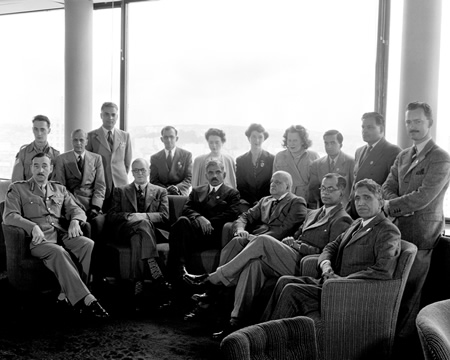
Photo: The San Francisco Conference, 25 April - 26 June 1945. Members of the Delegation from India. Standing (left to right): Sgt. Crickmay, Mr. Ollenbach, Mr. Nagar, Mr. Thampi, Miss Felton, Miss Jones, Miss Hull, Mr. P. A. Menon, Mr. Nair, Capt. Brownsdon. Seated (left to right): General Cawthorn, Mr. Bartley, Sir Ramaswami Mudaliar (Chairman), Sir V. T. Krishnamachari, Mr. K.P.S. Menon, Dr. Thomas. 26 June 1945. San Francisco, United States. © UN Photo.
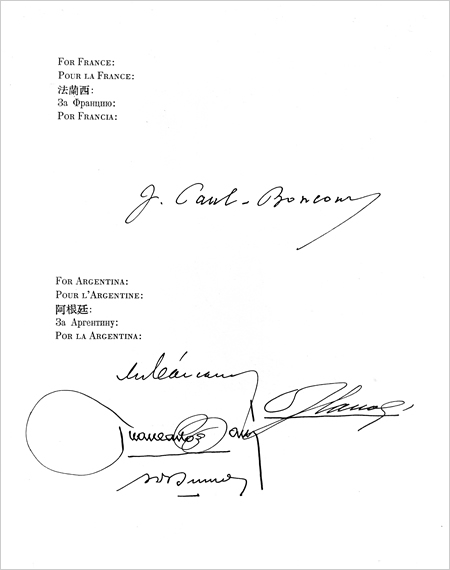
Photo: The San Francisco Conference, 25 April-26 June 1945. The signatures of France and Argentina for the Charter of the United Nations. 26 June 1945. San Francisco, United States. © UN Photo.

Photo: The San Francisco Conference, 25 April-26 June 1945. The signature of China for the Charter of the United Nations. 26 June 1945. San Francisco, United States. © UN Photo.
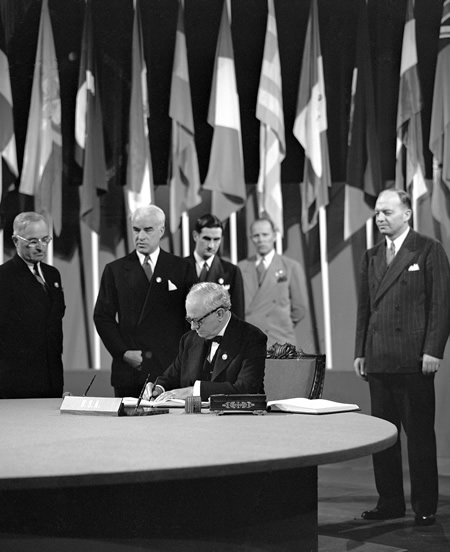
Photo: The San Francisco Conference, 25 April - 26 June 1945. The United States Sign the United Nations Charter. Tom Connaly, United States Senate, member of the U.S. Delegation, signs the United Nations Charter. 26 June 1945. San Francisco, United States. © UN Photo/McCreary.
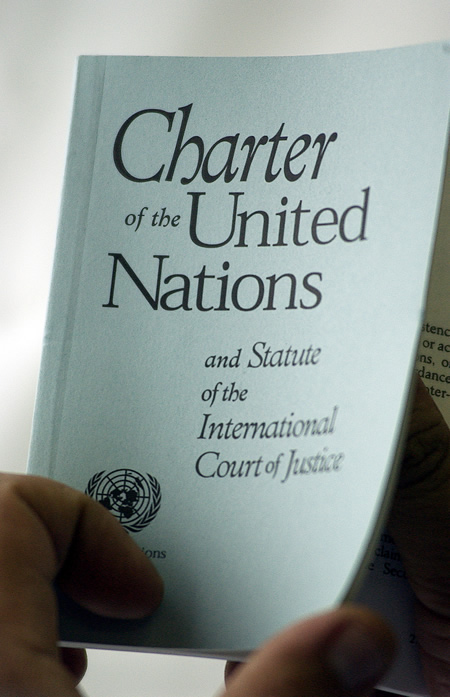
Photo: Picture of a copy of the “Charter of the United Nations”. United Nations, New York. UN Photo/Mark Garten.
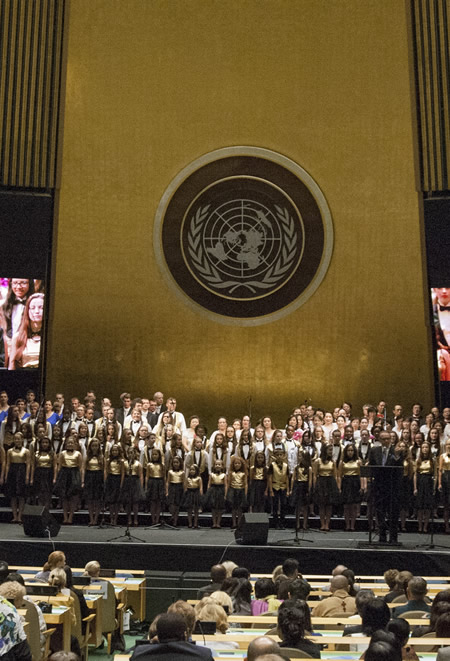
Photo: A view of the Rhythms of One World International Choral Festival Concert, a global event celebrating the 70th anniversary of the signing of the UN Charter “We the Peoples”. The event was organized by the Permanent Mission of Romania and the Friendship Ambassadors Foundation, Inc. under the patronage of UNESCO in cooperation with the United Nations Department of Public Information. 29 June 2015. United Nations, New York. UN Photo/Loey Felipe.
|GlobalGiants.Com|
“We, the peoples of the United Nations, determined to save succeeding generations from the scourge of war, which twice in our lifetime has brought untold sorrow to mankind, and to reaffirm faith in fundamental human rights, in the dignity and worth of the human person, in the equal right of men and women and of nations large and small….And for these ends to practice tolerance and live together in peace with one another as good neighbors…have resolved to combine our efforts to accomplish these aims.”
— Preamble, Charter of the United Nations.
“If they want peace, nations should avoid the pin-pricks that precede cannon shots.”
— Napoleon Bonaparte.
Edited & Posted by Editor | 1:46 AM | Link to this Post
June 19, 2015
Safe City Market Revenue Worth $226 Billion by 2020, Says Report
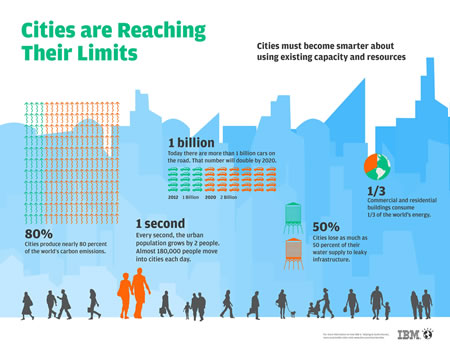
Photo: Cities are Reaching their Limit Infographic (Credit: IBM).
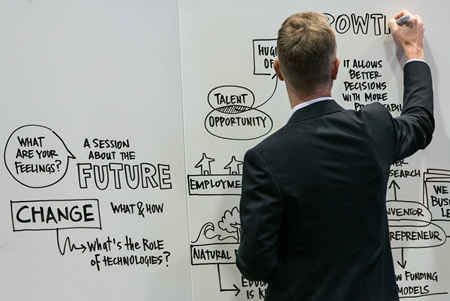
Photo: Technologies of Tomorrow. © World Economic Forum / Faruk Pinjo.
DALLAS, TX, June 16, 2015 — “Global Safe City: Industry, Technologies & Market - 2015-2020” is a new research report that says major defence contractors, the ICT (Information and Communications Technologies) and surveillance & sensors industry cannot ignore the fast growing revenues of the safe city market, which will accumulate to $226 billion over the next 6 years.
According to the report, the global safe city market technologies and industry are going through major shifts. Public opinion and political pressures combined with maturing safe city technologies such as video analytics, Physical Security Information Management (PSIM), Public-Safety Answering Point (PSAP), Distributed Sensors Systems, Sensor and Data Fusion Algorithms, Software as a Service (SaaS), Social Media Emergency Response software, Geo-Design and advanced ICT technologies are creating fresh business opportunities.
This safe city market report examines each dollar spent in the safe city market. The report explains that the safe city market growth is boosted by drivers like cities, towns and communities drive for quality of life and economic prosperity; Governmental funding policy of modern infrastructure; Urbanization; and Citizens expectations of safety from their local elected politicians.
Companies profiled and discussed in this safe city market 2015-2020 research report include —
3I-MIND, 3VR, ABB, Accenture, ACTi Corporation, ADT Security Services, Agent Video Intelligence, AGT international, ALPHAOPEN, Anixter, Aralia System, AT&T Inc., Augusta Systems, Avigilon Corporation, Axis, AxxonSoft, BAE Systems, Bosch Security Systems, BT, Camero, Cassidian, CelPlan, China Security & Surveillance Inc., Cisco, Citilog, Computer Network Limited (CNL), Diebold, DVTel, Elsag Datamat, Emerson Electric, Ericsson, Firetide, GS, General Electric, Hexagon AB, Honeywell, IBM, IndigoVision, Intel Security, IntuVision Inc, iOmniscient, IPConfigure, IPS Intelligent Video Analytics, ISS, MACROSCOP, MDS, Mer group, Milestone Systems A/S, Mirasys, National Instruments, NICE Systems, Northrop Grumman Corporation, ObjectVideo, Orsus, Panasonic, Pelco, Pivot, Proximex, Raytheon Company, Salient Stills, Samsung Techwin, Schneider Electric, SeeTec, Siemens, Smart China (Holdings) Limited, Sony, Synectics Plc, Tandu Technologies & Security Systems Ltd, Thales Group, Total Recall, Unisys, Verint, Vialogy LLC, Vigilant Technology, xLOGIC and Zhejiang Dahua Technology.
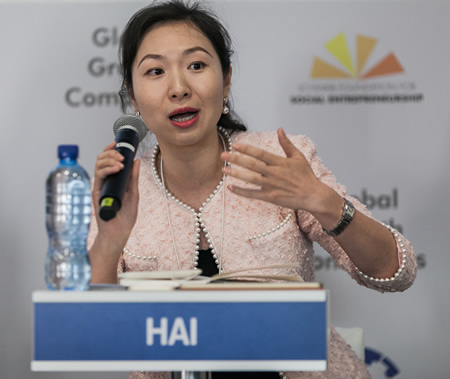
Photo: Data Revolution. Helen Hai, Goodwill Ambassador, United Nations Industrial Development Organization (UNIDO), Shanghai; Young Global Leader, at the World Economic Forum on Africa 2015 in Cape Town. © World Economic Forum / Jakob Polacsek.
On similar lines, another research titled “Smart Cities Market by Smart Home, Intelligent Building Automation, Energy Management, Smart Healthcare, Smart Education, Smart Water, Smart Transportation, Smart Security, & Services - Worldwide Market Forecasts and Analysis (2014 - 2019)” consists of the future market trends of smart solutions like intelligent building automation, energy management, smart grids, smart transportation, smart healthcare and many more; it also presents detailed analysis and implementation of new smart city projects. The report focuses on analyzing global trends, future growth, key drivers, opportunities and challenges in smart cities.
These reports are published by and are available from ReportsnReports.com , which is an online market research reports library of 500,000+ in-depth studies of over 5000 micro markets.
|GlobalGiants.Com|
Edited & Posted by Editor | 11:54 AM | Link to this Post
June 13, 2015
Signature Panel for Campaign to End Modern Slavery
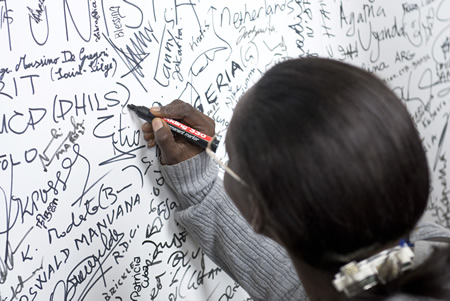
Photo: A young visitor to the Palais des Nations in Geneva adds her name to a symbolic signature panel in support of the “50 for Freedom” campaign to end modern slavery. The campaign, which was officially launched today, aims at promoting ratification and implementation of the International Labour Organization’s (ILO) Protocol on Forced Labour, with the first 50 Member States ratifying it by 2018. The Protocol was adopted by the International Labour Conference in 2014 and calls on governments to adopt stronger measures to prevent all forms of forced labour, of human trafficking, and of modern slavery, affecting about 21 million men, women and children in the world at present. June 12, 2015. Geneva, Switzerland. UN Photo/Jean-Marc Ferre.

Photo: A visitor to the Palais des Nations in Geneva, Switzerland, signs her name on the “50 for Freedom” panel. (Image Credits: Pouteau / Crozet / International Labour Organization).
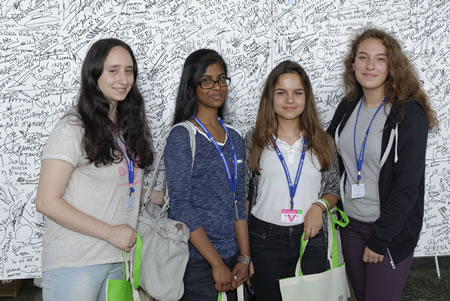
Photo: Visitors to the Palais des Nations in Geneva, Switzerland, sign their names on the “50 for Freedom” panel. (Image Credits: Pouteau / Crozet / International Labour Organization).
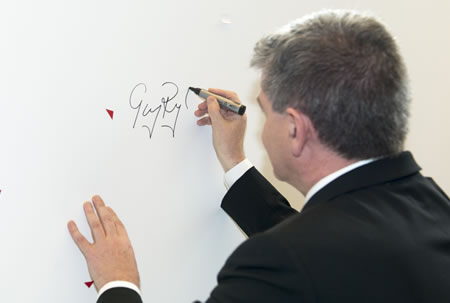
Photo: Director-General of the International Labour Organization (ILO), Guy Ryder, was the first to sign the ‘50 for Freedom’ panel. (Image Credits: Pouteau / Crozet / International Labour Organization).
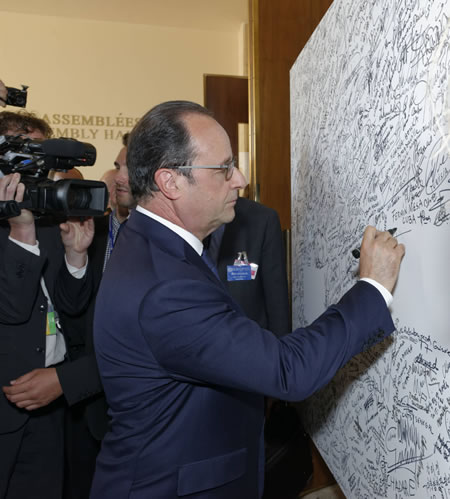
Photo: Mr Francois Hollande, President of France, signs the “50 for Freedom” Panel. (Image Credits: Pouteau / Crozet / International Labour Organization).
|GlobalGiants.Com|
“None are more hopelessly enslaved than those who falsely believe they are free.”
— Johann Wolfgang von Goethe, Elective Affinities.
“Excess of liberty, whether it lies in state or individuals, seems only to pass into excess of slavery.”
— Plato, The Republic.
“Two things are infinite: the universe and human stupidity; and I’m not sure about the universe.”
— Albert Einstein.
Edited & Posted by Editor | 4:01 AM | Link to this Post
June 8, 2015
G7 Summit Concludes in Germany
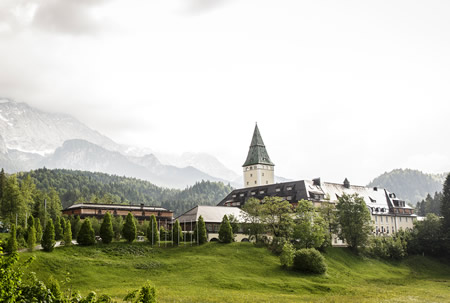
Photo: Schloss Elmau in Upper Bavaria’s Wetterstein mountain range, with its delightful scenery, is an attractive backdrop and an ideal venue for this year’s G7 summit. Image provided by & copyright © German Government/Kugler.
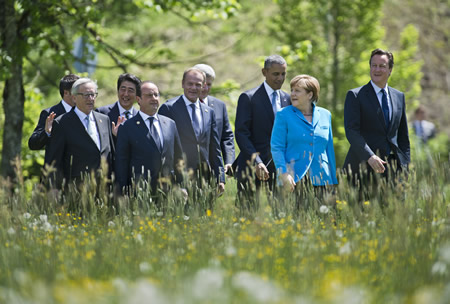
Photo: The heads of state and government of the G7 walking to the group photo. Image provided by & copyright © German Government/Kugler.
The heads of state and government from Canada, France, Germany, Italy, Japan, the United Kingdom and the United States of America came together with the European Council President and the European Commission President at Schloss Elmau, Germany, for the G7 summit.
In their Leaders’ Declaration the G7 heads of state and government emphasised their common values of freedom and democracy, the rule of law and respect for human rights, and fostering peace and security.
Among other matters, the G7 summit participants discussed economic issues and trade. Also on their agenda was the transatlantic free trade agreement TTIP. “We want to have achieved important milestones by the end of the year,” said Chancellor Angela Merkel.
|GlobalGiants.Com|
Edited & Posted by Editor | 2:13 PM | Link to this Post
April 10, 2015
India’s Prime Minister Modi highlights the Importance of UNESCO
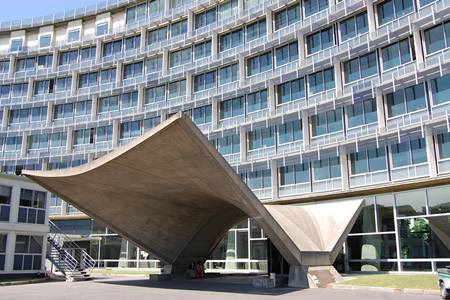
Photo: UNESCO Headquarters, Paris, France. Photo Credit: Anna Armstrong.
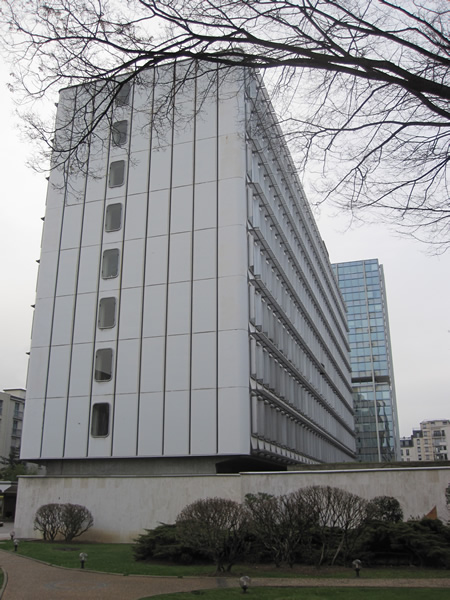
Photo: UNESCO Annex Building, Paris, France. Photo Credit: Chris Freeland.
Paris, France, April 10, 2015 — The Prime Minister of India, Narendra Modi, visited UNESCO (United Nations Educational, Scientific and Cultural Organization) headquarters to mark its 70th anniversary. Speaking to a cheering, overflowing audience on his first official visit, he used the occasion to emphasize the importance of India’s relationship with the Organization.
“I am truly honoured to address UNESCO.”
“I feel specially privileged to visit this great institution in its 70th anniversary year.”
“No organization serves our cause more than this one.”
“It draws strength from the basic character of nature - the harmony and unity in diversity.”
“That is why UNESCO was among the first missions of the United Nations.”
“That is why India values the work of UNESCO so deeply; and, cherishes our partnership so immensely.”
In his speech, he explained why UNESCO’s mandate is so important to India, and to the world.
India has a strong relationship with UNESCO. It has inscribed 32 properties on the World Heritage List, including the Taj Mahal, the Red Fort Complex and the Manas Wildlife Sanctuary. The country has listed seven elements of documentary heritage on UNESCO’s Memory of the World Register, nine reserves under UNESCO’s Man and Biosphere Programme and supports 10 UNESCO Chairs in a range of educational fields.
|GlobalGiants.Com|
Edited & Posted by Editor | 12:00 PM | Link to this Post
November 16, 2014
G20 Summit Concludes in Brisbane, Australia
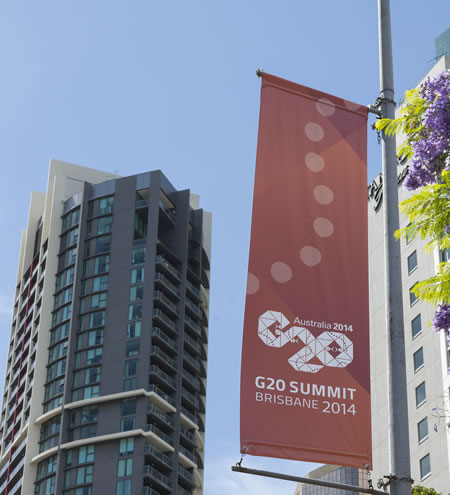
Photo: G20 banners in South Bank, Brisbane, Australia. Photograph by Ray Cash. © Copyright All rights reserved by G20 Australia.
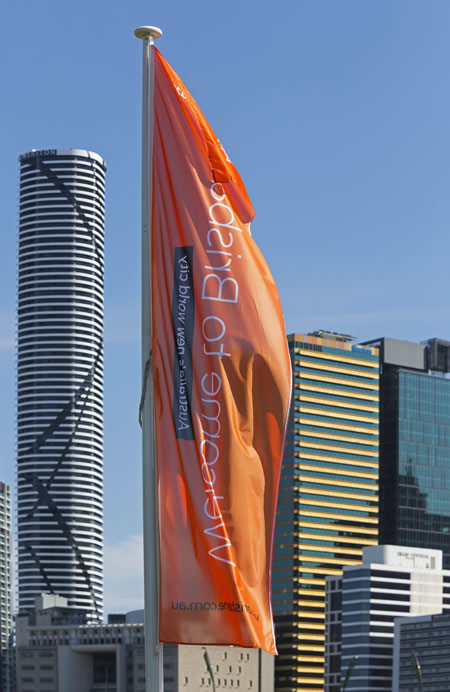
Photo: G20 banners in Brisbane, Australia. Photograph by Ray Cash. © Copyright All rights reserved by G20 Australia.
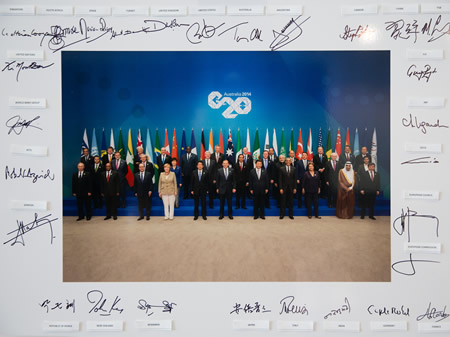
Photo: The official G20 Leaders’ Summit group photograph signed by G20 leaders. Photograph by Andrew Taylor. © Copyright All rights reserved by G20 Australia.
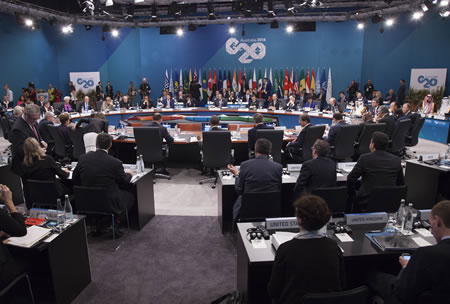
Photo: General view of the G20 Leaders’ Summit opening session in Brisbane. Photograph by Ray Cash. © Copyright All rights reserved by G20 Australia.
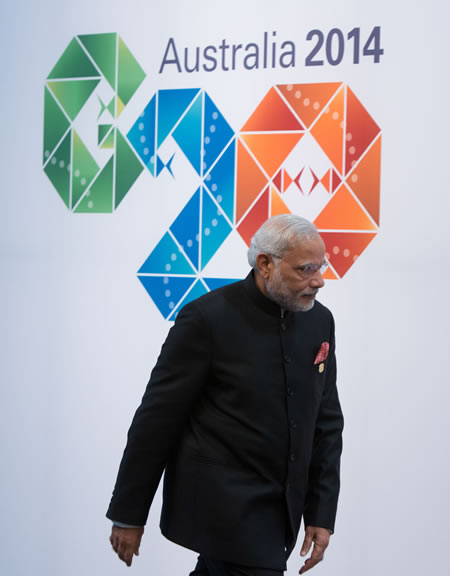
Photo: India’s Prime Minister Narendra Modi arrives for the G20 Leader’s Summit in Brisbane. Photograph by Ray Cash. © Copyright All rights reserved by G20 Australia.
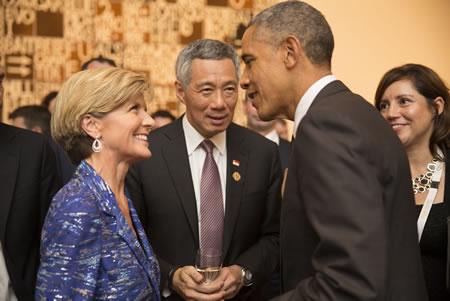
Photo: G20 Summit Leaders’ reception. Australia’s Foreign Minister Julie Bishop with Singapore’s Prime Minister Lee Hsien Loong and United States’ President Barack Obama. Photograph by Rob Maccoll. © Copyright All rights reserved by G20 Australia.

Photo: Entertainment at the G20 Summit Leaders’ reception. Photograph by Rob Maccoll. © Copyright All rights reserved by G20 Australia.
|GlobalGiants.Com|
Edited & Posted by Editor | 11:42 AM | Link to this Post
May 28, 2014
The World Heritage Committee to consider the inscription of 40 sites on UNESCO’s World Heritage List
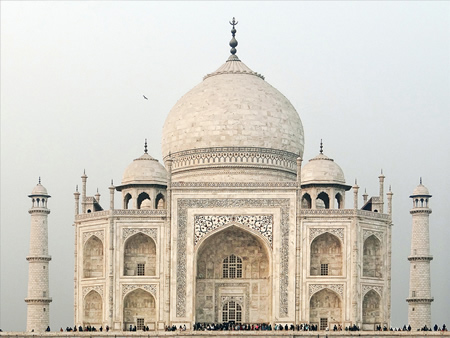
Photo: The Taj Mahal, Agra, India. The Taj Mahal is a UNESCO World Heritage Site. Photo Credit: Jean-Pierre Dalbera.
• The World Heritage Committee will consider the inscription of 40 sites on UNESCO’s World Heritage List when it meets in Doha (Qatar) from 15 to 25 June, 2014, UNESCO announced today at its headquarters in Paris, France.
More than 1200 delegates, experts and observers from around the world will participate in the meeting.
Sites to be considered include five that are extensions to sites already on the List. The state of conservation of existing World Heritage sites will also be reviewed during the session.
The following nominations by States Parties to the World Heritage List are expected to be examined during the session:
Natural Sites:
• Okavango Delta (Botswana)
• South China Karst (Phase II) (China)
• Stevns Klint (Denmark)
• Wadden Sea [extension] (Denmark and Germany)
• Tectono-volcanic Ensemble of the Chaine des Puys and Limagne Fault (France)
• Great Himalayan National Park (India)
• Mt. Hamiguitan Range Wildlife Sanctuary (Philippines)
• Bialowieza Forest [extension] (Belarus/Poland)
• Cat Ba Archipelago (Viet Nam).
Mixed Natural and Cultural Sites:
• Ancient Maya City and Protected Tropical Forests of Calakmul, Campeche [extension] (Mexico)
• Trang An Landscape Complex (Viet Nam).
Cultural Sites:
• Qhapaq Nan, Andean Road System (Argentina, Bolivia, Chile, Colombia, Ecuador, Peru)
• The Grand Canal (China)
• Precolumbian Chiefdom Settlements with Stone Spheres of the Diquis (Costa Rica)
• Sites of Great Moravia: The Slavonic Fortified Settlement at Mikulcice and the Church of St Margaret of Antioch at Kopcany (Czech Republic, Slovakia)
• Decorated Cave of Pont d’Arc, known as Grotte Chauvet-Pont d’Arc, Ardeche (France)
• Carolingian Westwork and Civitas Corvey (Germany)
• Tongo-Tengzuk Tallensi Cultural Landscape (Ghana)
• Rani-ki-Vav (The Queen’s Stepwell) at Patan, Gujarat (India)
• Sharhr-I Sokhta (Iran)
• Erbil Citadel (Iraq)
• Caves of Maresha and Bet-Guvrin in the Judean Lowlands as a Microcosm of the Land of the Caves (Israel)
• The Vineyard Landscape of Piedmont: Langhe-Roero and Monferrato (Italy)
• Tomioka Silk Mill and Related Sites (Japan)
• Silk Roads: Initial Section of the Silk Roads, the Routes Network of Tian-shan Corridor (Kyrgyzstan, China and Kazakhstan)
• Mount Mulanje Cultural Landscape (Malawi)
• Pyu Ancient Cities (Myanmar)
• Van Nellefabriek (Netherlands)
• Namhansanseong (Republic of Korea)
• Bolgar Historical and Archaeological Complex (Russian Federation)
• Historic Jeddah, the Gate to Makkah (Saudi Arabia)
• Cultural Landscape of Valle Salado de Anana (Spain)
• Jaen Cathedral (Extension of the “Renaissance Monumental Ensemble of Ubeda and Baeza”) (Spain)
• Silk Roads: Penjikent-Samarkand-Poykent Corridor, (Tajikistan and Uzbekistan)
• Bursa and Cumalikizik: the Birth of the Ottoman Empire (Turkey)
• Pergamon and its Multi-Layered Cultural Landscape (Turkey)
• Khor Dubai (Dubai Creek) (United Arab Emirates)
• Monumental Earthworks of Poverty Point (United States of America)
• Barotse Cultural Landscape (Zambia).
The proposed inscription of Palestine: Land of Olives and Vines - Cultural Landscape of Southern Jerusalem, Battir, will be reviewed by the Committee under the emergency procedure applied to sites facing serious dangers.
India has 30 properties inscribed on the World Heritage List. These include:
• Ajanta Caves,
• Elephanta Caves,
• Ellora Caves,
• Fatehpur Sikri,
• Mountain Railways of India,
• The Taj Mahal,
• Sun Temple, Konarak, and
• Jantar Mantar, Jaipur (among others).
Properties submitted by India on the Tentative List include:
• Ancient Buddhist Site, Sarnath, Varanasi, Uttar Pradesh,
• Sri Harimandir Sahib, Amritsar, Punjab,
• Urban and Architectural Work of Le Corbusier in Chandigarh,
• Churchgate - Extension to Mumbai CST,
• Mughal Gardens in Kashmir,
• Chilika Lake,
• Delhi - A Heritage City,
• Historic city of Ahmadabad, and
• The Victorian & Art Deco Ensemble of Mumbai (among others).
A “Tentative List” is an inventory of those properties which each State Party intends to consider for nomination.
• UNESCO encourages States Parties to submit their Tentative Lists — properties which they consider to be cultural and/or natural heritage of outstanding universal value and therefore suitable for inscription on the World Heritage List.
• States Parties are encouraged to prepare their Tentative Lists with the participation of a wide variety of stakeholders, including site managers, local and regional governments, local communities, NGOs and other interested parties and partners.
|GlobalGiants.Com|
Edited & Posted by Editor | 1:01 AM | Link to this Post
September 5, 2013
G20 Heads of State meet in St. Petersburg, Russia

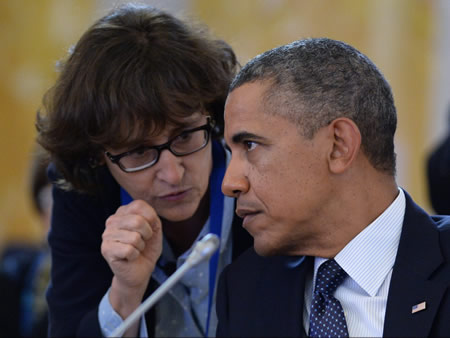
Photo: President of the United States of America Barack Obama at the second working meeting of the G20 heads of state and government, heads of invited states and international organizations. G20 Summit, September 6, 2013, St. Petersburg, Russia. © Host Photo Agency.
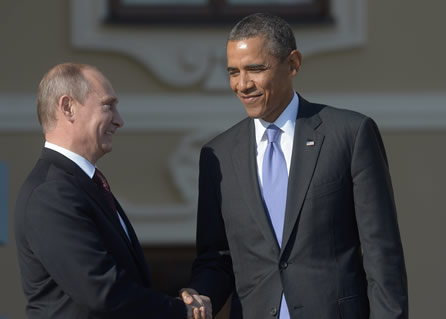
Photo: Russian President Vladimir Putin, left, and President of the United States of America Barack Obama during the official welcome of heads of delegations of G20 member states, invited countries, and international organizations. G20 Summit, September 5, 2013, St. Petersburg, Russia. © Host Photo Agency.
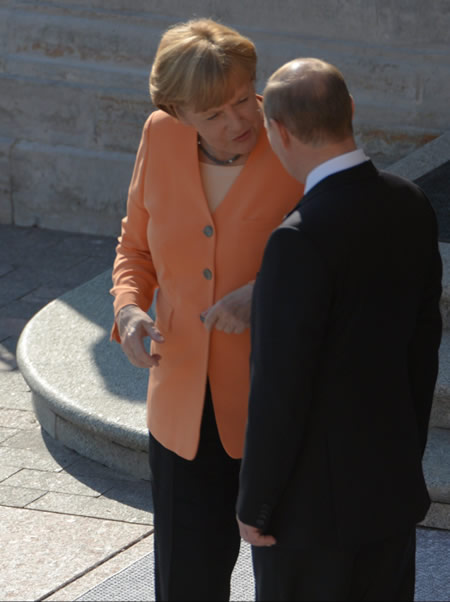
Photo: Russian President Vladimir Putin and Federal Chancellor of Germany Angela Merkel during an official welcome of G20 heads of state and government, heads of invited states and international organizations. G20 Summit, September 5, 2013, St. Petersburg, Russia. © Host Photo Agency.
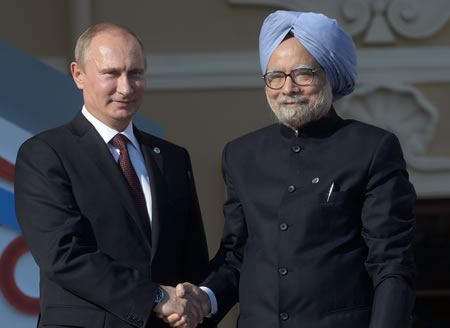
Photo: Russian President Vladimir Putin, left, and Prime Minister of the Republic of India Manmohan Singh during an official welcome of G20 heads of state and government, heads of invited states and international organizations. G20 Summit, September 5, 2013, St. Petersburg, Russia. © Host Photo Agency.
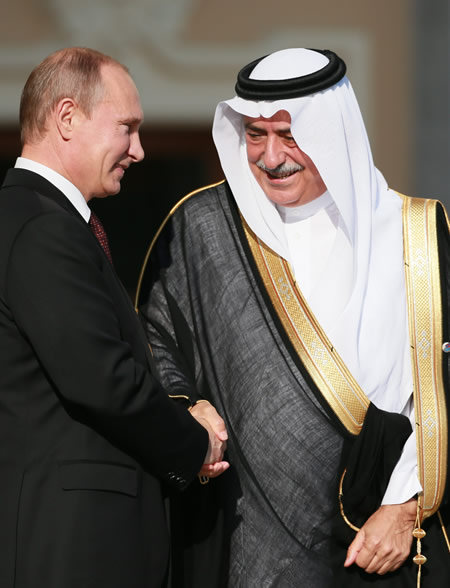
Photo: Russian President Vladimir Putin, left, and Ibrahim bin Abdulaziz Al-Assaf, Minister of Finance of Saudi Arabia, during an official welcome of G20 heads of state and government, heads of invited states and international organizations. G20 Summit, September 5, 2013, St. Petersburg, Russia. © Host Photo Agency.

Photo: Russian President Vladimir Putin and President of Argentina Cristina Fernandez de Kirchner during the official welcome of heads of delegations of G20 member states, invited countries, and international organizations. G20 Summit, September 5, 2013, St. Petersburg, Russia. © Host Photo Agency.
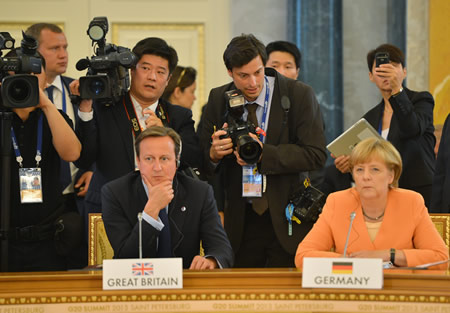
Photo: Prime Minister of the United Kingdom of Great Britain and Northern Ireland David Cameron and Federal Chancellor of the Federal Republic of Germany Angela Merkel at the first working meeting of the G20 heads of state and government, heads of invited states and international organizations. G20 Summit, September 5, 2013, St. Petersburg, Russia. © Host Photo Agency.

Photo: President of the Republic of South Africa Jacob Zuma’s wife Gloria Bongi Ngema visits the Vaganova Academy of Russian Ballet. G20 Summit, September 5, 2013, St. Petersburg, Russia. © Host Photo Agency.
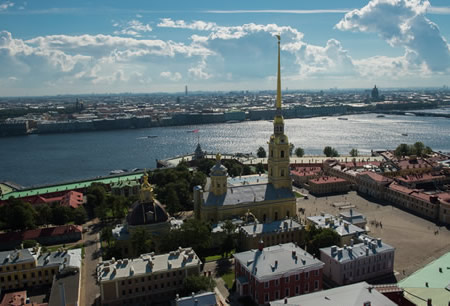
Photo: City of St. Petersburg, Russia. © Host Photo Agency.
The participants of the G20 Leaders’ Summit have arrived at their first working meeting. Over the two days, they will discuss the priorities of Russia’s G20 Presidency in 2013 and outline future plans. The Summit is expected to conclude with a joint declaration from the leaders.
Prior to the meeting was the official welcome of the G20 heads of state and government and heads of invited states and international organizations.
Russia assumed the G20 presidency for the first time on December 1, 2012. The G20 is the leading international cooperation forum, focusing on the most important international economic and financial issues. The G20 Leaders’ Summit, being held in St. Petersburg on September 5-6, 2013, is the main G20 event of 2013.
|GlobalGiants.Com|
“There must be, not a balance of power, but a community of power; not organized rivalries, but an organized peace.”
— Woodrow Wilson (28th President of the United States, from 1913 to 1921. President of Princeton University from 1902 to 1910).
Edited & Posted by Editor | 12:42 PM | Link to this Post
June 18, 2013
G8 Summit 2013 concludes in Lough Erne, Northern Ireland

Photo: One of the lodges at the Lough Erne Resort in County Fermanagh, Northern Ireland; the venue of the UK’s Presidency of the G8 Summit 2013. © G8 UK Presidency.
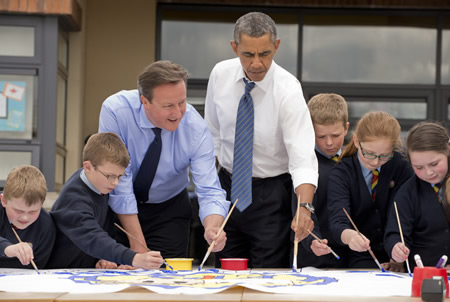
Photo: UK Prime Minister David Cameron and United States of America President Barack Obama visit school. © G8 UK Presidency.
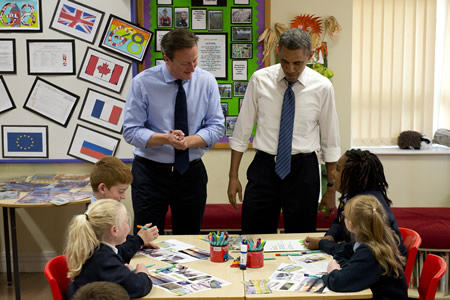
Photo: UK Prime Minister David Cameron and United States of America President Barack Obama visit school. © G8 UK Presidency.
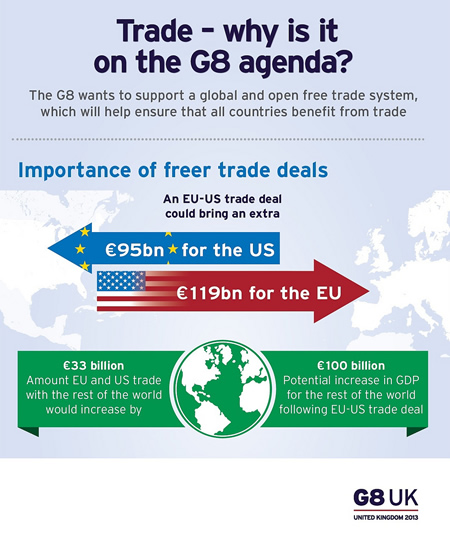
G8 is a forum that brings together 8 global leaders to address international issues and tackle the most pressing global challenges.
The G8 (Group of 8) is made up of Canada, France, Germany, Italy, Japan, Russia, the USA and the UK. The EU is represented by Jose Manuel Barroso, the President of the European Commission, and Herman Van Rompuy, the President of the European Council.
The Presidency of the G8 rotates each calendar year and the country holding the G8 Presidency is responsible for hosting and organising the annual summit, with a number of preparatory meetings leading up to it. At the summit, the G8 leaders discuss important global issues of the day.
UK Prime Minister David Cameron has the presidency of the G8 Summit 2013. Other G8 members who attended the summit are: Canada — Prime Minister Stephen Harper, France — President Francois Hollande, Germany — Chancellor Angela Merkel, Italy — Prime Minister Enrico Letta, Japan — Prime Minister Shinzo Abe, Russia — President Vladimir Putin, United States of America — President Barack Obama, European Union — Council President Herman Van Rompuy and Commission President Jose Manuel Barroso.
The Lough Erne Declaration from the G8 Summit 2013 sets out agreed principles for the future. It focuses on private enterprise, which drives growth, reduces poverty, and creates jobs and prosperity for people around the world. It also sets out that governments have a special responsibility to make proper rules and promote good governance. In addition, fair taxes, increased transparency and open trade are vital drivers of this. The G8 leaders will make a real difference by acting on the principles in the declaration.
In the preamble of the communique agreed to by G8 leaders at the 2013 summit, the leaders write:
“As leaders of the G8, we are committed to open economies, open societies and open governments as the basis of lasting growth and stability. We have today agreed concrete steps to play our part in ensuring a safe and prosperous world.”
|GlobalGiants.Com|
Edited & Posted by Editor | 9:24 AM | Link to this Post
January 26, 2013
World Economic Forum Annual Meeting 2013
Photo: The Logo of the World Economic Forum is seen at the congress centre at the Annual Meeting 2013 in Davos, Switzerland, January 22, 2013. (Photo © Remy Steinegger/World Economic Forum).
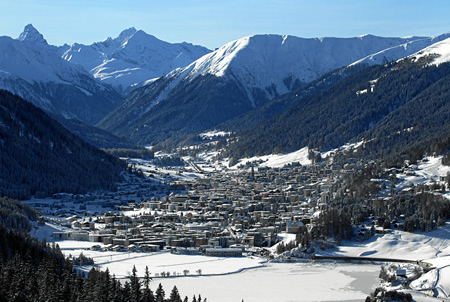
Photo: Aerial view of the alpine city Davos, Switzerland, where the World Economic Forum Annual Meeting 2013 is taking place January 23 - 27, 2013. (Photo © Andy Mettler/World Economic Forum).
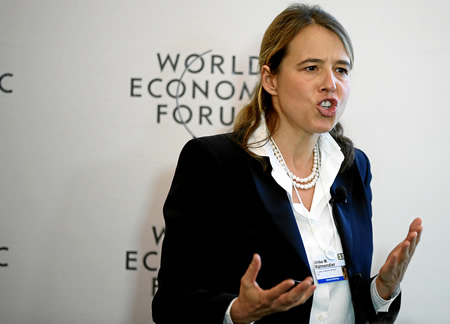
Photo: Ulrike M. Malmendier, Professor of Economics, Department of Economics, and Professor of Finance, Haas School of Business, University of California, Berkeley, USA, gives a speech during the session ‘From Tribalism to Globalism: The Evolution of Human Cooperation’ at the Annual Meeting 2013 of the World Economic Forum in Davos, Switzerland, January 25, 2013. (Photo © Mirko Ries/World Economic Forum).
The 43rd World Economic Forum Annual Meeting is taking place from 23 to 27 January under the theme Resilient Dynamism. More than 2,500 participants from over 100 countries are taking part in the Meeting. Participants include nearly 50 heads of state or government and more than 1,500 business leaders from the Forum’s 1,000 Member companies, as well as Social Entrepreneurs, Global Shapers, Young Global Leaders and representatives from civil society, media, academia and the arts.
Speaking at the Annual Meeting, Shimon Peres, President of Israel, said the world is becoming ungovernable. “Governments have found themselves unemployed because the economy has become global while governments remain national,” he said.
Peres described his view that global companies are replacing the role of governments. “Forty global companies have more fortune than all the governments in the world,” he pointed out.
The co-chairs of Annual Meeting 2013 are: Frederico Curado, President and Chief Executive Officer, EMBRAER, Brazil; Muhtar A. Kent, Chairman of the Board and Chief Executive Officer, The Coca-Cola Company, USA; Huguette Labelle, Chair, Transparency International, Germany; Global Agenda Council on Responsible Mineral Resources Management; Andrew N. Liveris, Chairman and Chief Executive Officer, The Dow Chemical Company, USA; Atsutoshi Nishida, Chairman of the Board, Toshiba Corporation, Japan; and Axel A. Weber, Chairman of the Board of Directors, UBS, Switzerland.
|GlobalGiants.Com|
“Which is the best government? That which teaches us to govern ourselves.”
— Johann Wolfgang von Goethe.
Edited & Posted by Editor | 4:02 AM | Link to this Post
November 15, 2012
IBM Announces 2013 Smarter Cities Challenge Grants Winners
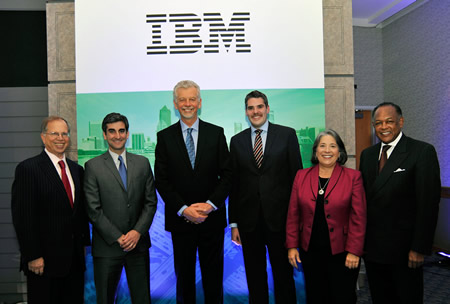
Photo: In Palisades, NY, Stanley Litow (left), IBM’s VP of Corporate Citizenship and Corporate Affairs, names recipients of Smarter Cities Challenge grants at the IBM Smarter Cities Challenge Summit. (left to right) Winning mayors include: Mayor Miro Weinberger, Burlington, Vermont; Mayor Jose Fortunati of Porto Alegre, Brazil, The Right Honourable the Lord Mayor Alderman Gavin Robinson, Belfast, UK; Mayor Madeline Rogero, Knoxville, Tennessee; and Mayor Dwight Jones, Richmond, Virginia. IBM’s largest philanthropic initiative, the IBM Smarter Cities Challenge is a three-year, 100-city, US$50 million competitive grant program that assigns teams of IBM experts to winning cities to analyze key issues. (Source: IBM).
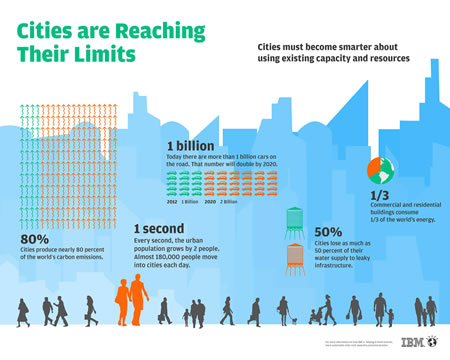
Photo: Cities are Reaching their Limit Infographic (Credit: IBM)
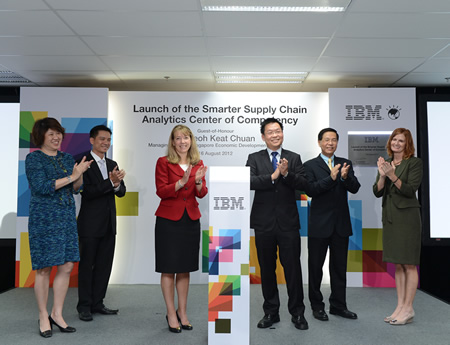
Photo: Representatives from IBM and Singapore Economic Development celebrate the opening of the IBM Supply Chain Analytics Center of Competency. (Credit: IBM)
• IBM today named 31 cities globally as recipients of IBM’s Smarter Cities Challenge grants for 2013.
Launched in 2011, the IBM Smarter Cities Challenge is a three-year, 100-city, US$50 million competitive grant program. The program assigns a team of six top IBM experts to each winning city to study a key issue identified by the city’s leadership.
IBM teams work with city officials to analyze data, soliciting the input of dozens of local agencies and advocacy groups. IBM then provides detailed recommendations for how the city can efficiently and effectively address the issue.
The grant recipients are being announced at an invitation-only summit bringing mayors and city leaders together with experts and urban policy leaders. Mayors in attendance include those from among cities that were previously awarded Smarter Cities Challenge grants, as well as those whose cities are today being named 2013 winners.
IBM said that at the summit, mayors will share successful strategies on topics ranging from transportation and economic development, to sustainability and citizen participation. They will review innovative solutions to the major challenges facing cities today, such as identifying financing, refining operating strategies, improving productivity, driving organizational change, and using data and technology effectively.
Following are the 31 cities that have won IBM Smarter Cities Challenge grants for 2013:
• Belfast, United Kingdom
• Buffalo, USA
• Burlington, USA
• Cape Town, South Africa
• Chennai, India
• Christchurch, New Zealand
• Copenhagen, Denmark
• Date, Japan
• Faro, Portugal
• Foshan, China
• Fresno, USA
• Gurgaon, India
• Jeju, Korea
• Khon Kaen, Thailand
• Knoxville, USA
• Kyoto, Japan
• Lagos, Nigeria
• Lodz, Poland
• Makati City, Philippines
• Negeri Sembilan, Malaysia
• Pingtung County, Taiwan
• Porto Alegre, Brazil
• Quebec City, Canada
• Reno, USA
• Richmond, USA
• Stavanger, Norway
• Trujillo, Peru
• Tucson, USA
• Valparaiso, Chile
• Vitoria, Brazil
• Waterloo, Canada
According to IBM, in year-one and two of the Smarter Cities Challenge, IBM completed work in more than 60 cities globally, deploying nearly 400 of its most talented experts who delivered concrete and measurable results to winning cities.
Smarter Cities Challenge is a variant of IBM’s Corporate Service Corps, a pro bono consulting program that assists governments with projects that intersect business, technology, and society. Since its launch in 2008, Corporate Service Corps has sent more than 2,000 of IBM’s top talent based in 50 countries on more than 200 team assignments in 30 countries. While Corporate Service Corps focuses on the developing world, IBM’s Smarter Cities Challenge addresses urban concerns in both industrialized and developing countries, IBM elucidated.
|GlobalGiants.Com|
Edited & Posted by Editor | 12:43 PM | Link to this Post
September 16, 2012
IBM Helps Cities Worldwide Measure Public Social Sentiment on Critical Issues

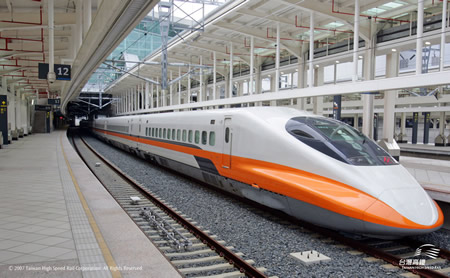
Photo: Taiwan High Speed Rail Corporation (THSRC) is using IBM software to manage maintenance and logistics for the revolutionary high-speed rail network that runs along the west coast of Taiwan. The express trains are capable of traveling at up to 186 miles per hour (300 km/hr) meaning travel between Taipei City and Kaohsiung City is only roughly 90 minutes as opposed to the 4.5 hours by conventional rail. (Photo © IBM).
At the IBM Smarter Cities Forum in New Delhi, India, IBM has unveiled a new social sentiment capability based on sophisticated analytics technologies to help cities around the world better measure and understand public opinions on key city issues and services such as public transportation or education.
The company also unveiled findings from the latest IBM Social Sentiment Index on traffic, which looked at public sentiment across India’s largest cities - Bangalore, New Delhi and Mumbai.

Analysis of available social media showed that the worst congestion is primarily caused by accidents and bad weather (three out of four times) when looking at the three cities together.
“Combining the knowledge that population will rapidly increase in Bangalore, New Delhi and Mumbai in the coming years, with sentiment on commuters’ preferred mode of transportation, could help these cities more accurately plan for needed investments in transportation infrastructure and its potential impact,” IBM said. “City officials could also gauge where public awareness campaigns need to be administered to shift commuters to different modes of transport in order to alleviate growing traffic congestion.”
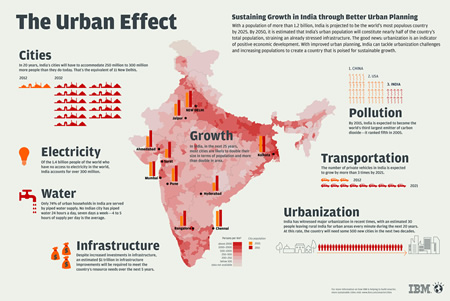
Photo: India is experiencing unprecedented growth. In the next 20 years, 30 Indians will move every minute from rural India to the cities. To accommodate this massive urban migration, India will need about 500 new cities in the next 20 years. An IBM analysis of social media sentiment around transportation in India’s three largest cities - Bangalore, Mumbai and New Delhi - illustrates how cities can use public opinion to help set priorities for urban planning and prepare for future growth. (Photo © IBM).
According to IBM, the top three factors impacting traffic congestion that citizens in each city talked about most online were diverse. Delhites chattered about public transportation, weather and the stress of commuting, while Bangaloreans show more concern for their overall driving experience, construction and parking issues, and Mumbaikars are talking about private transportation, accidents and pollution more often.
By applying analytics capabilities to the area of social media sentiment, organizations are able to better understand public opinions, and city officials can gain additional insights in order to draw logical conclusions about where they should focus their attentions and resources, IBM explained.
|GlobalGiants.Com|
Edited & Posted by Editor | 7:30 AM | Link to this Post
September 7, 2012
World Economic Forum releases The Global Competitiveness Report 2012-2013
• Competitiveness gap widening among European countries
• US remains world’s innovation powerhouse despite decline in overall ranking
• People’s Republic of China most competitive among large emerging markets; India, Russia fall
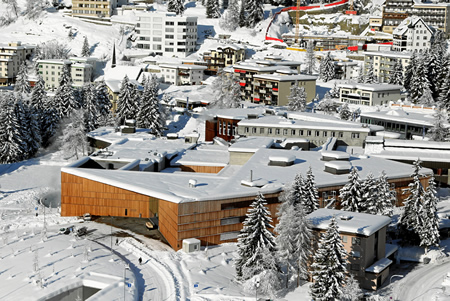
Photo: Aerial view of the congress center of Davos, Switzerland, where the World Economic Forum Annual Meeting 2012 took place January 25 - 29, 2012 (© World Economic Forum/Andy Mettler).
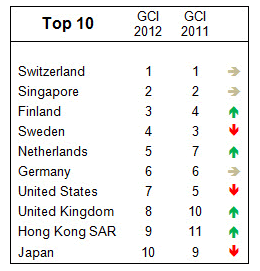
Switzerland, for the fourth consecutive year, tops the overall rankings in The Global Competitiveness Report 2012-2013, released by the World Economic Forum.
Singapore remains in second position and Finland in third position, overtaking Sweden (4th). These and other Northern and Western European countries dominate the top 10 with the Netherlands (5th), Germany (6th) and United Kingdom (8th). The United States (7th), Hong Kong (9th) and Japan (10th) complete the ranking of the top 10 most competitive economies.
The large emerging market economies (BRICS) display different performances. Despite a slight decline in the rankings of three places, the People’s Republic of China (29th) continues to lead the group. Of the others, only Brazil (48th) moves up this year, with South Africa (52nd), India (59th) and Russia (67th) experiencing small declines in rankings.
Despite growing its overall competitiveness score, the United States continues its decline for the fourth year in a row, falling two more places to seventh position. According to the report, in addition to the burgeoning macroeconomic vulnerabilities, some aspects of the country’s institutional environment continue to raise concern among business leaders, particularly the low public trust in politicians and a perceived lack of government efficiency. On a more positive note, the country still remains a global innovation powerhouse and its markets work efficiently, the report says.
The report indicates that Switzerland and countries in Northern Europe have been consolidating their strong competitiveness positions since the financial and economic downturn in 2008. On the other hand, countries in Southern Europe, i.e. Portugal (49th), Spain (36th), Italy (42nd) and particularly Greece (96th) continue to suffer from competitiveness weaknesses in terms of macroeconomic imbalances, poor access to financing, rigid labour markets and an innovation deficit.
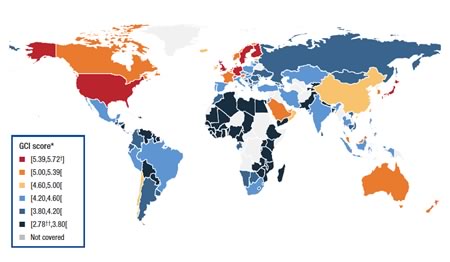
Behind Singapore, several Asian economies are performing strongly, with Hong Kong SAR (9th), Japan (10th), Taiwan, China (13th) and the Republic of Korea (19th) all in the top 20.
In the Middle East and North Africa, Qatar (11th) leads the region while Saudi Arabia remains among the top 20 (18th). The United Arab Emirates (24th) improves its performance while Kuwait (37th) slightly declines. Morocco (70th) and Jordan (63rd) improve slightly. In sub-Saharan Africa, South Africa (52nd) and Mauritius (54th) feature in the top half of the rankings.
In Latin America, Chile (33rd) retains the lead and a number of countries see their competitiveness improve, such as Panama (40th), Brazil (48th), Mexico (53rd) and Peru (61st).
“Persisting divides in competitiveness across regions and within regions, particularly in Europe, are at the origin of the turbulence we are experiencing today, and this is jeopardizing our future prosperity.” said Klaus Schwab, Founder and Executive Chairman, World Economic Forum. “We urge governments to act decisively by adopting long-term measures to enhance competitiveness and return the world to a sustainable growth path.”
|GlobalGiants.Com|
Edited & Posted by Editor | 12:24 PM | Link to this Post
June 13, 2012
Partnerships between American and Indian Institutions of Higher Education
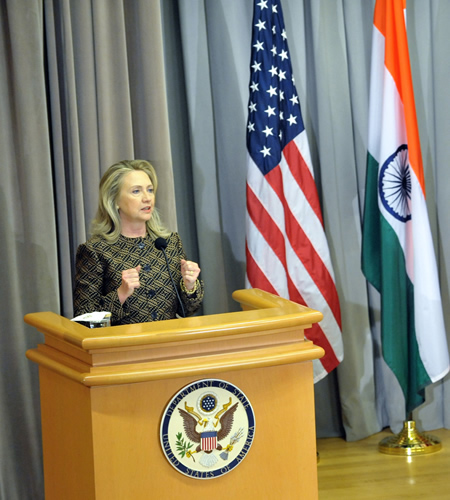
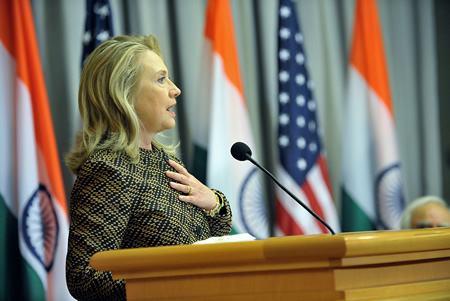
Photos: U.S. Secretary of State Hillary Rodham Clinton delivers remarks at the U.S.-India Higher Education Summit at the George C. Marshall Center in Washington, D.C. on June 12, 2012 (State Department Photos).
In a milestone in the educational partnership between India and the United States, the U.S. Department of State today announced the eight institutional partnership projects below for the first “Obama-Singh 21st Century Knowledge Initiative Awards”. The goal of the initiative is to further strengthen, through faculty exchanges, joint research, and other collaboration, partnerships between American and Indian institutions of higher education in priority fields, including food security, climate change, sustainable energy, and public health. Each project will receive an award that can be utilized over the three-year grant period.
U.S.-led Partnerships:
• Rutgers, The State University of New Jersey
Project Title: Capitalizing on the Demographic Dividend: Enhancing Talent Development Capacity for India and the U.S. in the 21st Century
Partner Institution: Tata Institute of Social Sciences, Mumbai
• University of Montana
Project Title: Impacts of Climate Change and Changes in Socio-Economic Structure on Traditional Agriculture and the Development of Sustainable Communities among Indigenous Populations
Partner Institution: Bangalore University
• Cornell University
Project Title: Implementing Reformed Curriculum in Emerging areas of Agriculture and Food Security in Two State Agricultural Universities of India
Partner Institutions: University of Agricultural Sciences, Dharwad; and Sardar Vallabh Bhai Patel University of Agriculture and Technology, Meerut
• University of Michigan
Project Title: The Joint Development of a Master’s Degree in Education for Health Professions Faculty in the United States and India
Partner Institution: Maharashtra University of the Health Sciences
Indian-led Partnerships:
• Mahatma Gandhi University
Project Title: An Interdisciplinary and Community Oriented Approach toward Sustainable Development
Partner Institutions: Brown University, Duke University and Plymouth State University
• Banaras Hindu University
Project Title: Paradigm Shift in Energy Scenario for the 21st Century toward Renewable Energy Sources required for both India and the U.S.
Partner Institution: University of Pittsburgh
• Indian Institute of Technology, Kanpur
Project Title: International Program for Sustainable Infrastructure Development
Partner Institution: Virginia Tech University
• Indian Institute of Technology, Delhi
Project Title: Resource Building for Ecosystem and Human Health Risk Assessment with Special reference to Microbial Contamination
Partner Institution: Drexel University
Prime Minister Manmohan Singh and President Barack Obama announced the Obama-Singh Initiative in November 2009 as an affirmation of their commitment to building an enhanced India-U.S. partnership in education.
To implement this initiative, the Governments of India and the United States established a bi-national Obama-Singh Initiative joint working group (JWG). The JWG provides the final approval for all grants awarded through the Obama-Singh Initiative.
• The “Proposal Submission Instructions” and the “Open Competition” for the next round of the Obama-Singh Initiative grants will be announced in July 2012 by University Grants Commission (UGC), Bahadur Shah Zafar Marg, New Delhi 110002, India.
|GlobalGiants.Com|
• UPDATE - 1
University Grants Commission (UGC), India, has invited applications for Post Doctoral Fellowships for Indian Scholars in United States for 2012 under Obama-Singh 21st Century Knowledge Initiative 2012.
Objective: The objective of the Fellowships is to provide the Indian scholars an opportunity to have international collaborative research opportunities and training in advanced techniques and technologies in emerging fields, thereby furthering their research capacity and ability to contribute to higher education with global perspective and forging long-term relationships with distinguished experts in these fields in USA. These fellowships would be called Post Doctoral Fellowships for the year 2012 to be awarded by University Grants Commission, India.
Number of Fellowships: 300
Important Date: The application must be submitted in the ‘online mode’ latest by July 11, 2012.
• [According to a communication from SECRETARY, UGC, the last date to apply has been extended to 18th August, 2012.]
Eligibility Criteria:
• The applicant should be a permanent teacher in a university/institution recognized by UGC under 2(f) and 12B of UGC Act.
• The applicant should possess at least 60% marks or equivalent in the post-graduate degree.
• The applicant should possess a PhD degree in respective academic discipline (Humanities, Social Sciences, Natural Science, Engineering, Technology, Agricultural Sciences) or MD/MS/PhD in Medical Sciences.
• UPDATE - 2
Aiming to improve the quality of education across all colleges and universities, India will soon come up with a regulation that will inform students about their academic rights and entitlements.
• According to the University Grants Commission, or UGC - the apex regulatory body for universities in India - it is working on a Students’ Entitlement Regulation. The regulation will apply to public and private universities alike.
The regulation will specify the academic rights of students, such as the minimum number of lectures to be held, access to quality laboratories, the presence of adequate books and reference material in university libraries, and sporting and accommodation facilities, among other areas.
The UGC also plans to create a portal where students can post shortcomings of their campuses and provide a real picture of different campuses in terms of academic matters.
According to the UGC chair, Professor Ved Prakash, students must have complete knowledge about their rights relating to learning, the living environment, physical activities, entertainment and sports facilities. “Once the regulation comes into effect, a student can complain if any specific right or entitlement is being violated,” Professor Prakash said.
• UPDATE - 3
US-India Institutional Partnership Grants
The United States-India Educational Foundation (USIEF) has announced an open competition for the support of projects through the Obama-Singh 21st Century Knowledge Initiative (OSI). OSI aims to strengthen collaboration and build partnerships between American and Indian institutions of higher education.
• Accredited US post-secondary educational institutions meeting the provisions described in Internal Revenue Code section 26 U.S.C. 501©(3) may submit proposals to support the program’s goals of encouraging mutual understanding, facilitating educational reform, fostering economic development, and engaging civil society through academic cooperation with Indian post secondary educational institutions.
Submission Deadline: November 1, 2012.
Exchange activities may include but are not limited to curriculum design, research collaboration, team teaching, focused series of exchanges, seminars, among other activities. Activities should be designed to develop expertise, advance scholarship and teaching, and promote reliable, long-term communication between partner institutions.
• Proposals in the following fields are eligible: Energy; Sustainable Development; Climate Change; Environmental Studies; Education and Educational Reform; Public Health; and Community Development and Innovation.
• UPDATE - 4
English language weekly magazine INDIA TODAY has ranked India’s top 50 universities, out of a total 160 surveyed.
Edited & Posted by Editor | 6:34 AM | Link to this Post
December 20, 2011
Smarter Cities Exploration Center — Created by IBM and the University of Guadalajara, Mexico

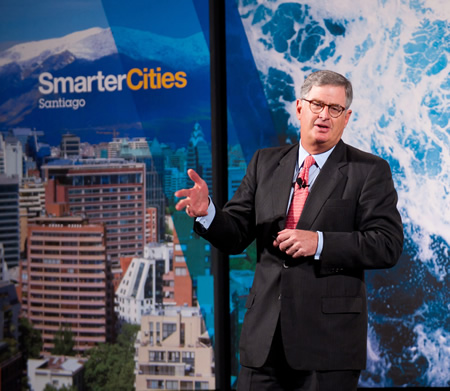
Photo: IBM Chairman and CEO, Samuel J. Palmisano, addresses Chile’s most forward-thinking leaders - governors, mayors, urban experts from academia and community leaders - at the Smarter Cities forum in Santiago, Chile, November 23, 2010. Palmisano underscored the passion and momentum that exists across cities in Chile in support of urban transformation. (Graham Carlow/Feature Photo Service)
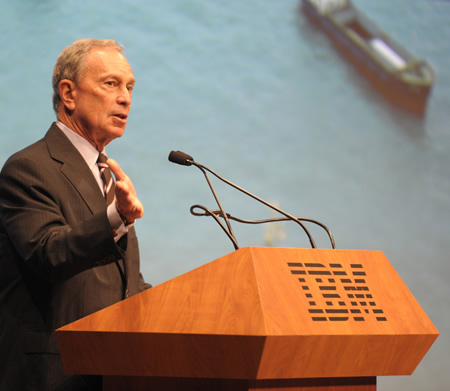
Photo: In New York City, Michael Bloomberg, Mayor, City of New York, spoke to 700 leaders from world government, business, academia and science at IBM’s THINK Forum held at Lincoln Center, Tuesday, September 20, 2011. As part of IBM’s 100-year anniversary, the forum examined the implications of leadership on organizations and societies and the deep structural changes required to drive progress. (Feature Photo Service)
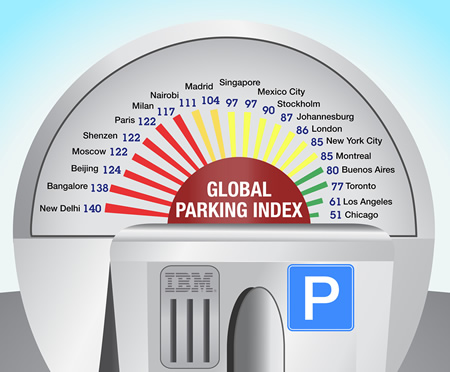
Photo: Global Parking Survey — To better understand consumer attitudes around the daily struggles that drivers face in finding a parking spot and traffic congestion, IBM conducted the 2011 global parking survey. The IBM Parking Index looks at issues such as longest amount of time spent looking for a parking spot, inability to find parking, arguments with fellow motorists over parking and more to rank parking difficulty in 20 international cities. From left to right, cities are plotted from the most difficult parking issues (New Delhi) to the least difficult (Chicago). (Feature Photo Service)
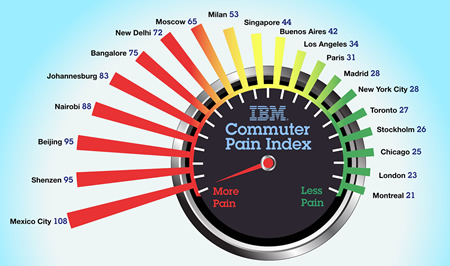
Photo: Global Commuter Pain Survey — Drivers in Mexico City have the most painful commute of the 20 cities in IBM’s 2011 Global Commuter Pain survey. Studying the emotional toll associated with driving, the annual survey reveals that, overall, commuters have gotten a lot more stressed out and angry in the past year. On the positive side, New York, Chicago and Los Angeles have less painful commutes when compared to most other cities. And Montreal has the least painful of all. (Foto IBM/Dennis Champlain)
In order to respond intelligently to the needs of their growing populations, city infrastructures that deliver vital services such as transportation, healthcare, education, public safety, energy and water, must rely on a wealth of new information and technologies.
IBM today announced that it has created a Smarter Cities Exploration Center in collaboration with the University of Guadalajara, Mexico.
The Center will design solutions to tackle infrastructure challenges faced by Guadalajara and other cities around the world.
Guadalajara is Mexico’s second largest city and the University of Guadalajara is an educational community with more than two hundred years of history.
According to IBM, the center has already started the development of a transportation pilot that could reduce commuting time in the city by 15%, representing approximately US$ 90 million in savings per year by enabling citizens to use their time more productively and decrease carbon emissions.
The company and the University will share knowledge through the exchange of intellectual property among doctoral students and researchers. The use of IBM’s data analytics, supercomputing and cloud computing capabilities would drive the development of new pilots and solutions, IBM said.
• Meanwhile, Meredith Hannon, IBM’s spokesperson at its headquarters in Armonk, New York, has explained to the GlobalGiants.Com Publisher that IBM does business with and works on a number of efforts with universities and diverse other academic institutions all around the globe. But the establishment of this Smarter Cities Exploration Center in Mexico is its first such collaboration with any university in the world.
|GlobalGiants.Com|
Edited & Posted by Editor | 10:44 AM | Link to this Post
December 15, 2011
G20 Postal Services Report

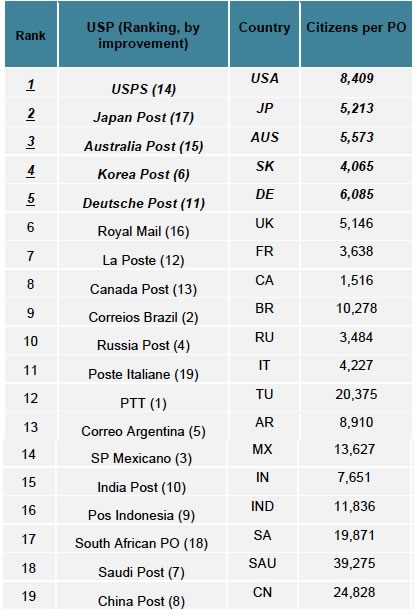
A review of the performance of universal postal service providers (USPs) in the world’s G20 group of nations, published today by Oxford Strategic Consulting (OSC), has found that the United States Postal Service (USPS) achieved the best overall ranking among operators.
The benchmark examines performance over three years against three key metrics - access to vital services, resource efficiency, and performance and public trust. Universal providers are seeing strong competition from private companies and a continual slide in mail volumes, with the move towards digital communications. Volumes have fallen in many countries - as much as 17% in the US since 2006.



The United States Postal Service (USPS) came top due to its high operating efficiency and public faith in its performance. The government agency handles over five times more letters per full-time delivery employee than Germany’s privatized provider, Deutsche Post (5th).
Report author William Scott-Jackson, director of Oxford Strategic Consulting, and Associate Research Fellow, SKOPE, University of Oxford, said: “People tend to think the internet has made the postman redundant but postal services still provide the backbone for e-commerce deliveries.”
For many remote customers, especially in emerging markets, the post office is the only viable means of receiving or sending goods.
Japan Post (2nd) and Korea Post (4th) performed well on all counts, while Australia Post (3rd) was strong on both efficiency and access. The UK’s cost-cutting Royal Mail (6th) edged out France’s La Poste (7th) with double the efficiency in letter delivery.
Italy’s Poste Italiane (11th) saw declines in performance and efficiency, causing it to fall behind Russia Post (10th) - which improved its performance faster than any developed country operator. India’s India Post made slight improvement while Turkey’s PTT was the most improved.
|GlobalGiants.Com|
Edited & Posted by Editor | 11:39 AM | Link to this Post