















August 1, 2010
UN Academic Forum calls on Businesses to Balance Social and Economic Objectives
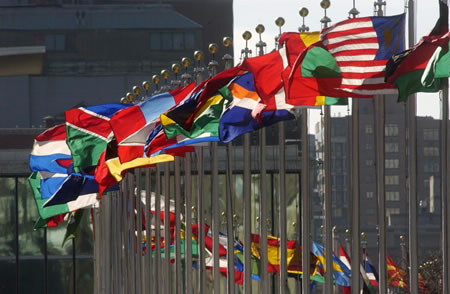

Photo: Outside the United Nations Headquarters, flags fly in the north end of the building, on a sunny fall day. UN Photo/Mark Garten.
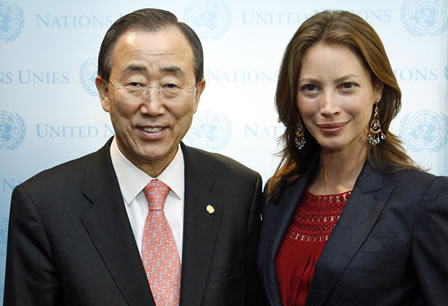
Photo: Secretary-General Ban Ki-moon (left) meets with Christy Turlington, model and maternal health advocate, at a documentary film forum entitled "Envision: Addressing Global Issues through Documentaries". This Millennium Development Goals-focused forum is the result of collaboration between the non-profit Independent Filmmaker Project (IFP) and the Department of Public Information. New York, United States. UN Photo/Mark Garten.
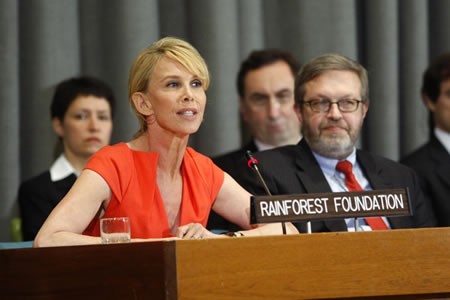
Photo: Trudie Styler, Co-founder of the Rainforest Foundation, addresses the General Assembly's informal meeting on climate change and the status of intergovernmental negotiations. Ms. Styler discussed the work of her foundation in protecting tropical rainforests and their indigenous populations. United Nations, New York. UN Photo/Evan Schneider.

Educators and administrators from 37 countries, meeting at the second UN Global Forum on Responsible Management Education, recently held in New York, called on business leaders to better balance social and economic objectives and encouraged management education to prepare future leaders for this challenge.
• At the end of the conference, participants representing business schools and other academic institutions exhorted business to emphasize societal value just as much as its commitment to shareholder return.
Assuring their support for researchers, task forces and associations dedicated to the globalization of business education and development of effective leaders, academic leaders participating in the forum reaffirmed their commitment to the Principles for Responsible Management Education (PRME). The UN-backed initiative was launched in 2007 to better prepare current and future organizational leaders for their dual roles as economic developer and societal servant.
The Global Forum for Responsible Management Education, was organized by the PRME Secretariat and hosted by Fordham University Schools of Business.
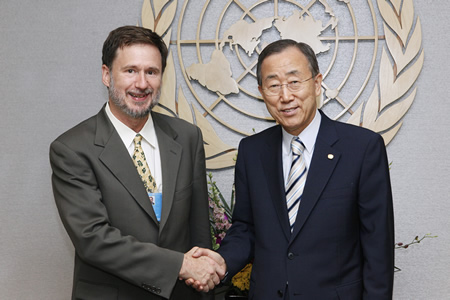
Photo: Secretary-General Ban Ki-moon (right) meets with Michael Doyle, Harold Brown Professor of U.S. Foreign and Security Policy at Columbia University. 28 July 2010. United Nations, New York . UN Photo/John McIlwaine.
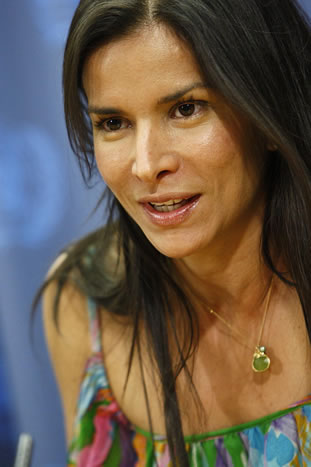
Photo: Actress and fashion model Patricia Velasquez addresses a press conference on the "Fashion for Development" project in Colombia and its implementation in the context of achieving the Millennium Development Goals. The project aims at applying traditional techniques in manufacturing goods for the fashion industry. United Nations, New York. UN Photo/Mark Garten.
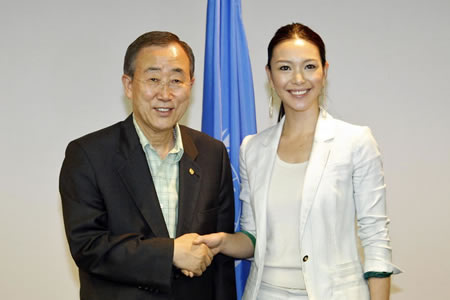
Photo: Secretary-General Ban Ki-moon meets with Kurara Chibana, United Nations World Food Programme Celebrity Partner and 2006 Miss Universe from Japan. Tokyo, Japan. UN Photo/Mark Garten.
• Following is the Declaration of the 2nd Global Forum for Responsible Management Education, New York, NY.
"For more than 100 years, management education has sought to provide business leaders with the tools to invigorate economic growth. Yet economic gain is no longer a solitary end in the hearts and minds of the globe's six billion people. Business must emphasize societal and environmental value just as much as its commitment to shareholder return. Management education must also enhance its curricula, pedagogy, research and incentives, as well as lead by example, to prepare organizational leaders who will balance economic and social development.
We support the numerous business schools and universities, companies, governments, civil society groups and associations dedicated to the globalization of business education and development of effective leaders. These initiatives inspire us to make management education the hallmark for responsible leadership.
The Principles for Responsible Management Education (PRME), written in 2007 and now endorsed by over 300 business schools from 62 countries, serve as guidelines for management education providers to better prepare current and future organizational leaders for their dual roles as economic developer and societal steward. Yet with more than 12,000 business degree granting institutions worldwide, our job has just begun. We aspire to the goal of 1,000 PRME schools by 2015. We urge business schools to adopt the Principles and organizations to balance their economic and social objectives.
-- Endorsed by the participants of the 2nd Global Forum for Responsible Management Education."
• Launched in 2007, the Principles for Responsible Management Education (PRME) provide framework for academic institutions to advance corporate social responsibility through the incorporation of universal values into curricula and research. The PRME is coordinated by a Steering Committee constituted of the Association to Advance Collegiate Schools of Business (AACSB International), the European Foundation for Management Development (EFMD), the Aspen Institute's Business and Society Program, the European Academy for Business in Society (EABIS), the Graduate Management Admission Council (GMAC), the Globally Responsible Leadership Initiative (GRLI), Net Impact, and the United Nations Global Compact.
|GlobalGiants.Com|
"You are not here merely to make a living. You are here in order to enable the world to live more amply, with greater vision, with a finer spirit of hope and achievement. You are here to enrich the world, and you impoverish yourself if you forget the errand."
-- Woodrow Wilson (28th President of the United States. President of Princeton University from 1902 to 1910).

"Riches do not consist in the possession of treasures, but in the use made of them."
-- Napoleon Bonaparte.
"There must be, not a balance of power, but a community of power; not organized rivalries, but an organized peace."
-- Woodrow Wilson (28th President of the United States. President of Princeton University from 1902 to 1910).


Edited & Posted by Editor | 7:28 AM | Link to this Post
July 28, 2010
Seoul gets UNESCO City of Design Designation
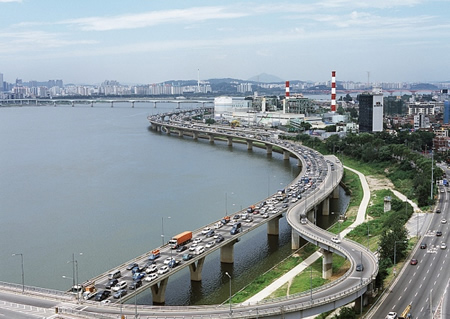


Photos: City of Seoul, South Korea.
Seoul has been made a UNESCO City of Design as of July 20, 2010. This designation is in appreciation of the city's abundant cultural heritage and creative potentials as well as its strong pursuit of diverse design policies. The U.N. agency also highly evaluated the city's potential to help developing countries with its creative urban development programs.
UNESCO launched the Creative Cities Network in 2004 to enhance the social, economic and cultural development of cities in the world, to promote their local creative scenes, and to fulfill the UNESCO's mission towards cultural diversity.
UNESCO appoints the cities network members in seven fields -- literature, film, music, crafts and folk art, design, media arts, and gastronomy. Eight cities including Seoul have been selected as members in the field of design. The others are Buenos Aires, Berlin, Montreal, Nagoya, Kobe, Shenzhen and Shanghai.
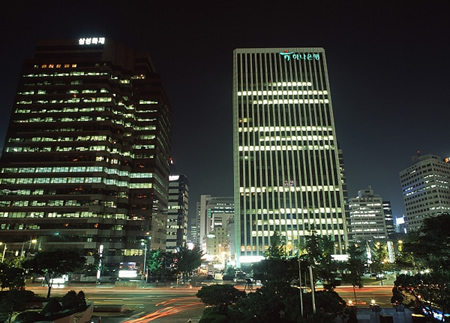


Photos: City of Seoul, South Korea.
Appointed to the network as a City of Design, Seoul will enjoy a variety of benefits.
Seoul is expected to report its national and international activities as a City of Design to the U.N. agency every year and to maintain close relationship with the Korean National Commission for UNESCO.
Mayor Oh Se-hoon said Seoul's appointment as a UNESCO City of Design reflects the international recognition of the city's design policy.
|GlobalGiants.Com|
Edited & Posted by Editor | 2:27 PM | Link to this Post
July 27, 2010
2011 Chevrolet Caprice Police Patrol Vehicle (PPV)





General Motors today announced the final package specifications for the 2011 Chevrolet Caprice Police Patrol Vehicle (PPV).
"This vehicle is 'Unique to the Police Market' and is designed and built to law enforcement specifications," said the company. "The rear-wheel-drive Caprice PPV joins the front-wheel-drive Chevrolet Impala and the Chevrolet Tahoe PPV, making Chevrolet the only brand to offer a full line of police vehicles."


"When we began designing our latest police vehicle, we went directly to our customers and found that they were looking for a rear-wheel, large sedan with a V-8 engine," said Brian Small, general manager, GM Fleet and Commercial Operations. "By announcing the available specs and ordering information now, we're following through with our promise to provide them with the advanced technologies that best serve their needs for comfort, performance and safety."
"Chevrolet's history with law enforcement spans across almost as many years as the brand itself and we're ready to see the Caprice PPV report for active duty," Small said.
• Chevrolet is the leading brand of General Motors. GM is headquartered in Detroit and its largest national market is the United States, followed by China, Brazil, Germany, the United Kingdom, Canada, and Italy. GM does business in some 157 countries.
|GlobalGiants.Com|
Edited & Posted by Editor | 11:42 AM | Link to this Post
July 16, 2010
U.S. POSTAL SERVICE SUNDAY FUNNIES: COMIC STRIPS DEBUT ON STAMPS

The U.S. Postal Service celebrated five newspaper comic strips by dedicating the Sunday Funnies stamps today. The 44-cent First-Class stamps honor comic strips: Archie, Beetle Bailey, Dennis the Menace, Garfield and Calvin and Hobbes.
"The strips, as well as their characters, may have changed over the years, yet each remains an enduring classic," said U.S. Postal Service. "Like stamps, comic strips often tell a story through humor, adventure, fantasy and sometimes even drama."
Source: U.S. Postal Service
|GlobalGiants.Com|
Edited & Posted by Editor | 1:39 PM | Link to this Post
June 30, 2010
G-8 Summit Concludes in Muskoka, Canada

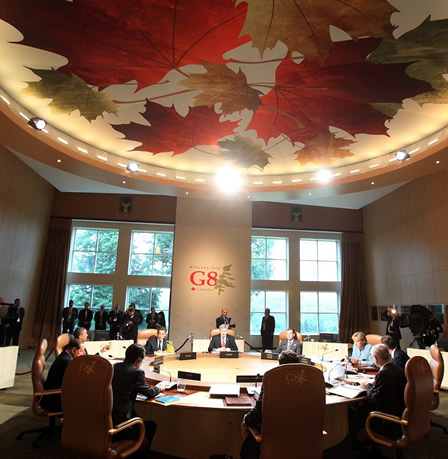
Photo: G-8 leaders gather around the table at the working session at the G-8 Summit in Huntsville, Ontario. (Photo © DFAIT Canada.)
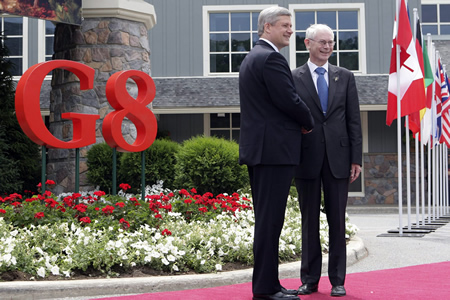
Photo: Canadian Prime Minister Stephen Harper welcomes Herman Van Rompuy, President of the European Council to the Muskoka G-8 Summit at the Deerhurst Resort in Huntsville, Ontario. (Photo © DFAIT Canada.)
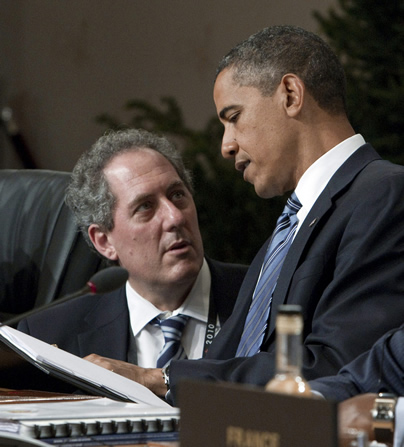
Photo: An aide talks to United States President Barack Obama at the leaders' working session at the G-8 Summit in Huntsville, Ontario. (Photo © DFAIT Canada.)
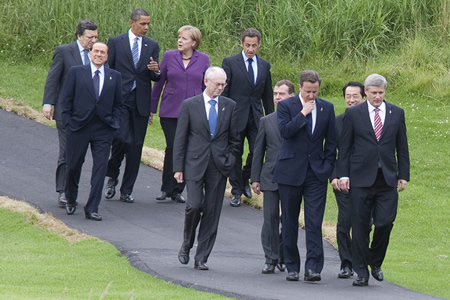
Photo: G-8 leaders walk down a path to pose for a leaders' group photo at the G-8 Summit in Huntsville, Ontario.
From the left:
• President of the European Commission: Jose Manuel Barroso,
• President of the Council of Ministers of the Republic of Italy: Silvio Berlusconi,
• President of the United States of America: Barack Obama,
• Chancellor of the Federal Republic of Germany: Dr. Angela Merkel,
• President of the European Council: Herman Van Rompuy,
• President of the French Republic: Nicolas Sarkozy,
• President of the Russian Federation: Dmitry Medvedev,
• Prime Minister of the United Kingdom: David Cameron,
• Prime Minister of Japan: Naoto Kan,
• Prime Minister of Canada: Stephen Harper.
(Photo © DFAIT Canada.)
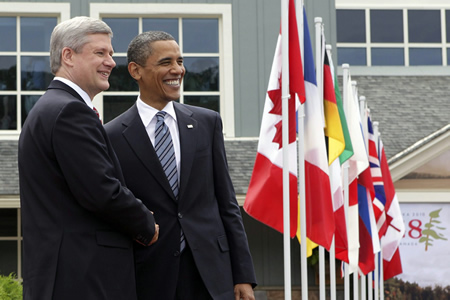
Photo: Canadian Prime Minister Stephen Harper welcomes United States President Barack Obama to the Muskoka G-8 Summit at the Deerhurst Resort in Huntsville, Ontario. (Photo © DFAIT Canada.)
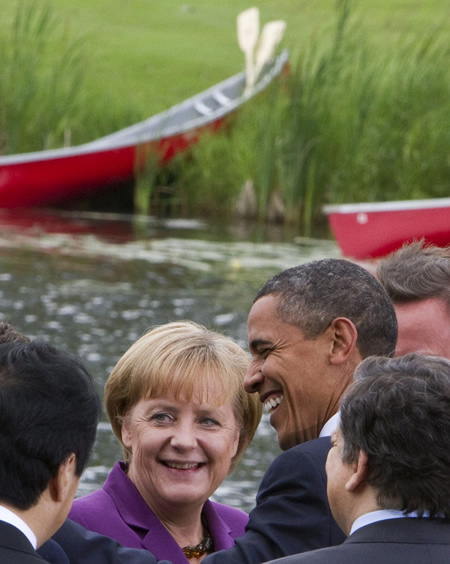
Photo: German Chancellor Angela Merkel and US President Barack Obama share a laugh as G-8 leaders pose for the leaders' group photo at the G-8 Summit in Huntsville, Ontario. (Photo © DFAIT Canada.)
• Canada hosted this year's G-8 summit on June 25-26 in Canada's Muskoka region.
The Group of Eight (G-8) brings together the world's major advanced economies--Canada, France, Germany, Italy, Japan, Russia, the United Kingdom and the United States.
The G-8 plays a leading role in international affairs. In partnership with the global community, it has helped establish concrete responses and gather significant resources to address critical global challenges in such areas as health, education and peace and security.
• G8 Summit 2010 Accountability Report: GET IT HERE
Source: Department of Foreign Affairs and International Trade, Government of Canada.
|GlobalGiants.Com|

Edited & Posted by Editor | 5:31 AM | Link to this Post
June 25, 2010
First Lockheed Martin C-130J Super Hercules for India in Full Color


Photo: The first Lockheed Martin C-130J Super Hercules for India has completed painting at the company's Marietta, Georgia, facility. The aircraft now enters flight test in preparation for delivery at the end of the year. The program for India includes six C-130Js, training of aircrew and maintenance technicians, spare parts, ground support, and test equipment. Also included is India-unique operational equipment designed to increase Special Operations capabilities.
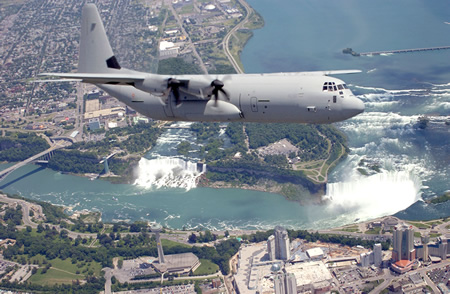
Photo: The Lockheed Martin C-130J Super Hercules airlifter pictured here flies over Niagara Falls on a test flight.

Photo: This aircraft is a Lockheed Martin C-130J, operated by the U.S. Coast Guard at Elizabeth City, N.C.
• Headquartered in Bethesda, Maryland, USA, Lockheed Martin is a global security company that employs about 136,000 people worldwide and is principally engaged in the research, design, development, manufacture, integration and sustainment of advanced technology systems, products and services.
Source: Lockheed Martin
|GlobalGiants.Com|
Edited & Posted by Editor | 12:57 PM | Link to this Post
June 23, 2010
Global CEO Study by IBM Pinpoints Most Crucial Factor for Future Success -- CREATIVITY


• According to a major new IBM survey of more than 1,500 Chief Executive Officers from 60 countries and 33 industries worldwide, chief executives believe that -- more than rigor, management discipline, integrity or even vision -- successfully navigating an increasing complex world will require creativity.
Conducted through in-person interviews with consultants from IBM's Institute for Business Value, less than half of global CEOs believe their enterprises are adequately prepared to handle a highly volatile, increasingly complex business environment.

• CEOs are confronted with massive shifts - new government regulations, changes in global economic power centers, accelerated industry transformation, growing volumes of data, rapidly evolving customer preferences - that, according to the study, can be overcome by instilling "creativity" throughout an organization.
• More than 60 percent of CEOs believe industry transformation is the top factor contributing to uncertainty, and the finding indicates a need to discover innovative ways of managing an organization's structure, finances, people and strategy.

Managing Complexity
The CEOs interviewed told IBM that today's business environment is volatile, uncertain and increasingly complex.
Eight in ten CEOs expect their environment to grow significantly more complex but only 49 percent believe their organizations are equipped to deal with it successfully - the largest leadership challenge identified in eight years of research.
The CEOs said that the complexity of an interconnected world is aggravated by a number of factors. For example, CEOs expect revenue from new sources to double over the next five years and 76 percent of CEOs foresee the shift of economic power to rapidly developing markets.
Over the last four studies, the expected impact of technology on organizations has risen from 6th to 2nd place in importance, revealing that CEOs understand that technology and the interconnection of the world's infrastructures is contributing to the complexity they face, and also reveals that they need more technology-based answers to succeed in a world that is massively interconnected.

One World, Diverging Views
Vast complexity is further intensified by regional differences. The study noted that perspectives varied with geography - differences of opinion about what changes to make, what new skills will be needed and how to succeed in the new economic environment. These regional variations also compound the complexities with which CEOs must contend.
China proved much more resilient than the developed nations during the economic downturn. So, CEOs in China are, understandably, less concerned about volatility than CEOs in other regions. In fact, they are becoming increasingly confident of their place on the world stage.
But if China is to fulfill its global aspirations, it will need a new generation of leaders with creativity, vision and international management experience. Many of the country's CEOs recognize this; 61 percent believe "global thinking" is a top leadership quality.

• In North America, which faced a financial crisis that led to governments becoming major stake-holders in private enterprise, CEOs are more wary of "big government" than CEOs elsewhere. A full 87 percent anticipate greater government intervention and regulation over the next five years, compounding their sense of uncertainty.
In Japan, 74 percent of CEOs expect the shift of economic power from mature to rapidly developing markets to have a major impact on their organizations. By contrast, the European Union is less concerned about this shift, with only 43 percent of CEOs expecting to be impacted.
Understanding these and other sharp differences emerging by region is increasingly important as economies and societies become more closely linked. Organizations confront these differences as they increasingly operate across boundaries and across different regions.

• This study is the fourth edition of IBM's biennial Global CEO Study series. To better understand the challenges and goals of today's CEOs, IBM consultants met face-to-face with the largest-known sample of these executives. Between September 2009 and January 2010, IBM interviewed 1,541 CEOs, general managers, and senior public sector leaders who represent different sizes of organizations in 60 countries and 33 industries.
Source: IBM
|GlobalGiants.Com|
"I have only one counsel for you -- Be Master."
-- Napoleon Bonaparte to his brother, King Joseph of Spain.
Edited & Posted by Editor | 1:01 PM | Link to this Post
June 17, 2010
Global Peace Index 2010
• World Less Peaceful in 2010.
• Violence Impacting Global Economy $7 Trillion Annually.
• New Zealand tops rankings for second consecutive year.
• 4-year trends show Middle East and Africa with most gains in peacefulness.
• South Asia sees sharpest fall in peace.
• Military spending as a % of GDP reaches its lowest point in 4 years.

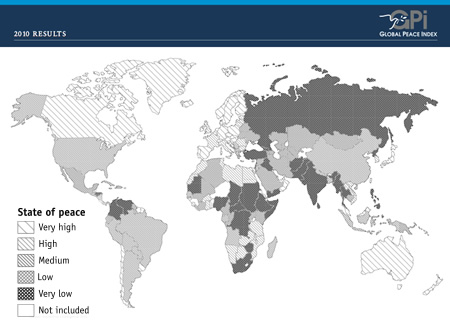
The world became less peaceful for the second consecutive year, according to the just published fourth annual Global Peace Index (GPI). As the global economy continues to falter, this year's data shows an intensification of conflicts and growing instability linked to the downturn that began in 2008, with several countries seeing sharp increases in homicides, violent demonstrations and fear of crime.
The increase in violence is depriving the global economy of assets when they are needed most. A 25 percent reduction in global violence would free up $1.8 trillion USD annually -- enough to pay off Greece's debt, fund the achievement of the Millennium Development Goals (MDGs) and meet the EU's 20-20-20 climate and energy targets.

The only study to quantify global peacefulness, the GPI is produced by the Institute for Economics and Peace (IEP). This year it has expanded to rank 149 independent states. Composed of 23 qualitative and quantitative indicators, it combines internal and external factors ranging from military expenditure to relations with neighboring countries and levels of violent crime.
• Global Peace Index (GPI) 2010: Rankings for 149 Countries
"The research carried out by the IEP based on 4 years of GPI data provides a quantifiable demonstration that improving peace can transform the global economy and unleash the wealth needed to tackle debt, fund economic expansion and create a more sustainable environment," said Steve Killelea, founder of the GPI.

Top-ranked New Zealand was one of only three countries in the top ten to improve in peacefulness in the 2010 Index. Iceland moved into the #2 spot as the country's economy stabilised after falling to #4 in last year's ranking, the improvement demonstrating the resilience of peaceful nations.
Despite the global slide, the Middle East & North Africa and Sub-Saharan Africa have made the most gains since the research began in 2007. Reasons for the improvement vary, but include more political stability and a drop in military expenditure in the Middle East & North Africa and less access to weapons, a decrease in conflicts and better relations with neighboring countries in Sub-Saharan Africa.

Conversely, South Asia saw the greatest decrease in peacefulness, as a result of increased involvement in internal conflicts. The main countries experiencing decreases in peacefulness were India, Sri Lanka and Pakistan.
The US improved its 2010 score but slipped three spots down the index due to the addition of new countries and the re-rating of the number of heavy weapons.
Western Europe continues to be the most peaceful region, with the majority of the countries ranking in the top 20. All five Scandinavian nations rank in the top ten; however, Denmark dropped five spots to #7.
Iraq, Somalia and Afghanistan were the least peaceful countries for the second consecutive year. Syria, Georgia, the Philippines, Russia and Cyprus were this year's biggest fallers.

• The GPI was founded by Killelea, an Australian international technology entrepreneur and philanthropist. It forms part of the Institute for Economics and Peace, a global think tank dedicated to the research and education of the relationship between economics, business and peace. An international panel of experts in the study of peace advises on the identification and weighting of indicators in the GPI, which is compiled by the Economist Intelligence Unit.
Source: Institute for Economics and Peace
|GlobalGiants.Com|
"These six things doth the LORD hate: yea, seven are an abomination unto him:
A proud look, a lying tongue, and hands that shed innocent blood,
A heart that deviseth wicked imaginations, feet that be swift in running to mischief,
A false witness that speaketh lies, and he that soweth discord among brethren."
-- Proverbs of Solomon 6:16-19.
"There be three things which go well, yea, four are comely in going:
A lion which is strongest among beasts, and turneth not away for any;
A greyhound; A he-goat also;
And a king, against whom there is no rising up."
-- Proverbs of Solomon 30:29-31.
[A lion marches on and does not alter his pace or quit his path when other animals come in his way. A greyhound (fastest hunting dog) remains ready for his course and performs it with swiftness. A he-goat walks in front of the flock, as one careful about it, and attentive to its safety. And a king goes gracefully when he reigns in the hearts of his people, and commands a unanimous, victorious army (visible or invisible), whom none dare oppose.]
Edited & Posted by Editor | 2:23 AM | Link to this Post
June 3, 2010
International Space Station Expedition 23 Crew Lands Safely

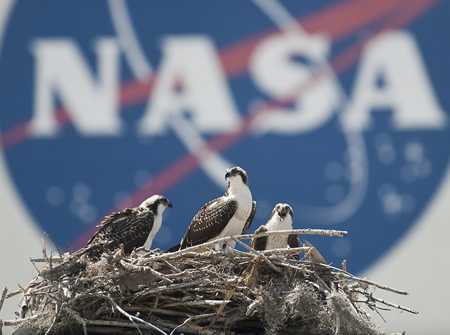
Photo: A family of Osprey are seen outside the NASA Kennedy Space Center Vehicle Assembly Building (VAB) in Cape Canaveral, Fla. on Thursday, May 13, 2010. Photo Credit: (NASA/Bill Ingalls)
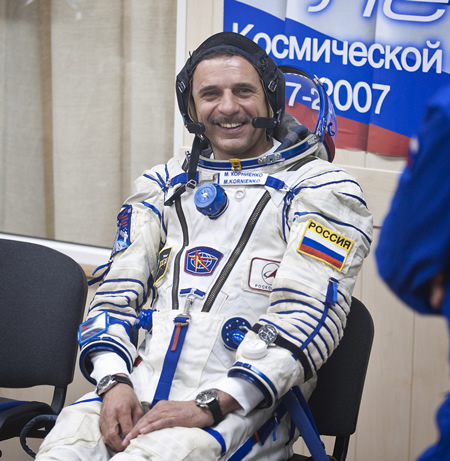
Photo: Russian cosmonaut Expedition 23 Flight Engineer Mikhail Kornienko smiles as he awaits to have his Sokol suit pressure checked prior to launch, Friday, April 2, 2010, in Baikonur, Kazakhstan. Kornienko and fellow Expedition 23 crew members Soyuz Commander Alexander Skvortsov and NASA Flight Engineer Tracy Caldwell Dyson launched in their Soyuz TMA-18 rocket from the Baikonur Cosmodrome in Kazakhstan on Friday, April 2, 2010. Photo Credit: (NASA/Bill Ingalls)
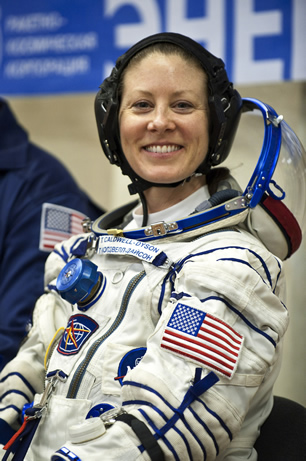
Photo: Expedition 23 NASA Flight Engineer Tracy Caldwell Dyson of the U.S. prepares to have her Russian Sokol suit pressure checked at the Baikonur Cosmodrome in Baikonur, Kazakhstan, Friday, April 2, 2010. Caldwell Dyson and fellow Expedition 23 crewmembers Soyuz Commander Alexander Skvortsov and Flight Engineer Mikhail Kornienko of Russia launched in their Soyuz TMA-18 rocket from the Baikonur Cosmodrome in Kazakhstan on Friday, April 2, 2010. Photo Credit: (NASA/Carla Cioffi)
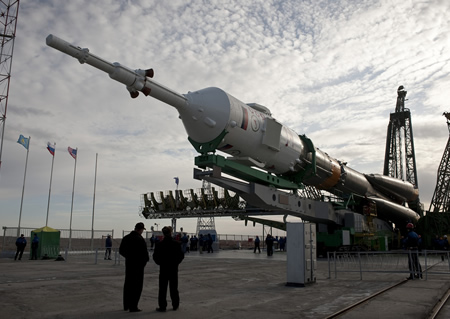
Photo: The Soyuz TMA-18 spacecraft is rolled out by train to the launch pad at the Baikonur Cosmodrome, Kazakhstan, Wednesday, March, 31, 2010. Photo Credit: (NASA/Carla Cioffi)
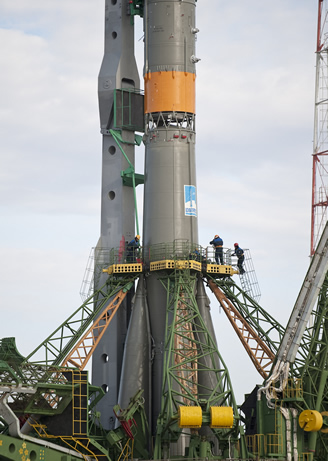
Photo: Pad technicians secure the Soyuz TMA-18 spacecraft shortly after it was rolled out by train to the launch pad at the Baikonur Cosmodrome, Kazakhstan, Wednesday, March, 31, 2010. Photo Credit (NASA/Bill Ingalls)
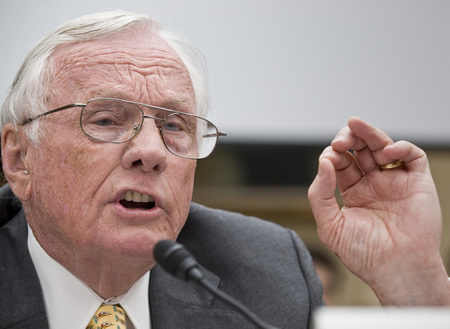
Photo: Apollo 11 Commander Neil Armstrong (first person to set foot on the Moon) makes a point as he testifies during a hearing before the House Science and Technology Committee, Tuesday, May 26, 2010, at the Rayburn House office building on Capitol Hill in Washington. The hearing was to review proposed human spaceflight plan by NASA. Photo Credit: (NASA/Paul E. Alers)

Photo: Expedition 23 Flight Engineer Tracy Caldwell Dyson performs the traditional door signing Friday, April 2, 2010 at the Cosmonaut Hotel in Baikonur, Kazakhstan. Caldwell Dyson was launched onboard the Soyuz rocket later that day with Expedition 23 Soyuz Commander Alexander Skvortsov and Flight Engineer Mikhail Kornienko on a mission to the International Space Station (ISS). Photo Credit: (NASA/Carla Cioffi)
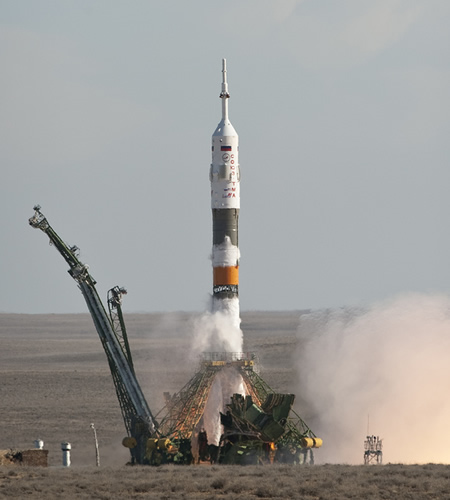
Photo: The Soyuz TMA-18 rocket launches from the Baikonur Cosmodrome in Kazakhstan on Friday, April 2, 2010 carrying Expedition 23 Soyuz Commander Alexander Skvortsov of Russia, Flight Engineer Mikhail Kornienko of Russia and NASA Flight Engineer Tracy Caldwell Dyson of the U.S. to the International Space Station. (Photo Credit: NASA/Carla Cioffi)
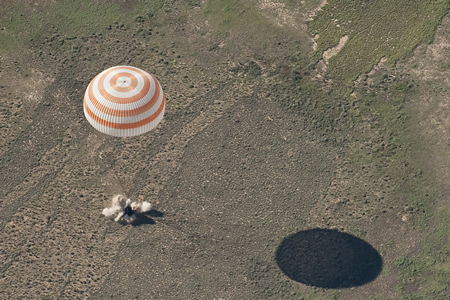
Photo: The Soyuz TMA-17 spacecraft is seen as it lands with Expedition 23 Commander Oleg Kotov and Flight Engineers T.J. Creamer and Soichi Noguchi near the town of Zhezkazgan, Kazakhstan on June 1, 2010. NASA Astronaut Creamer, Russian Cosmonaut Kotov and Japanese Astronaut Noguchi are returning from six months onboard the International Space Station where they served as members of the Expedition 22 and 23 crews. Photo Credit: (NASA/Bill Ingalls)
Expedition 23 Commander Oleg Kotov and Flight Engineers T.J. Creamer and Soichi Noguchi landed their Soyuz-17 spacecraft in Kazakhstan Tuesday, June 1, wrapping up a five-and-a-half-month stay aboard the International Space Station.
Kotov, the Soyuz commander, was at the controls of the spacecraft as it undocked from the aft port on the station's Zvezda module. The crew landed on June 1 at 11:25 p.m., east of Dzhezkazgan, Kazakhstan.
Russian recovery teams were on hand to help the crew exit the Soyuz vehicle and adjust to gravity after 163 days in space. Kotov will return to the Gagarin Cosmonaut Training Center in Star City, outside of Moscow. NASA astronaut Creamer and Japan Aerospace Exploration Agency astronaut Noguchi will return to Houston.
The trio launched aboard the Soyuz TMA-17 spacecraft from the Baikonur Cosmodrome in Kazakhstan on Dec. 21, 2009. As members of the Expedition 22 and 23 crews, they spent 161 days on the station. They supported three space shuttle missions that delivered the U.S. Tranquility module and its cupola; put the finishing touches on U.S. laboratory research facilities; and attached the Russian Rassvet laboratory and storage module.
Kotov has logged 360 total days in space on his two missions, and Creamer has 163 days. Noguchi, who also flew on the STS-114 shuttle mission, has compiled 177 days in space.
A new trio of Expedition 24 flight engineers, Douglas Wheelock, Shannon Walker and Fyodor Yurchickhin, will launch from the Baikonur Cosmodrome at 4:35 p.m. on June 15.
Source: NASA
|GlobalGiants.Com|
Edited & Posted by Editor | 4:00 AM | Link to this Post
May 31, 2010
Everybody's Business: Strengthening International Cooperation in a More Interdependent World
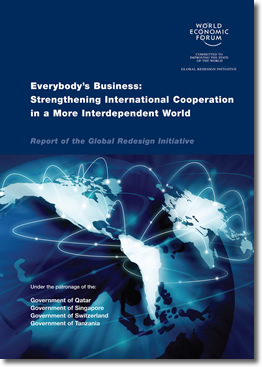
The World Economic Forum today issued one of the most extensive sets of proposals to strengthen international cooperation and governance ever assembled.
• The product of a year-long dialogue and group of task forces involving over 1,500 academic, business, governmental and civil society experts and decision-makers from around the world, the Forum's Global Redesign Initiative report contains 58 specific proposals and nine thematic essays by some of the international community's leading authorities on international economic, environmental and security cooperation.
Entitled Everybody's Business: Strengthening International Cooperation in a More Interdependent World, the Forum's report warns that serious global risks and challenges are accumulating in many areas, and international institutions and arrangements are often ill-equipped to provide a proactive response.
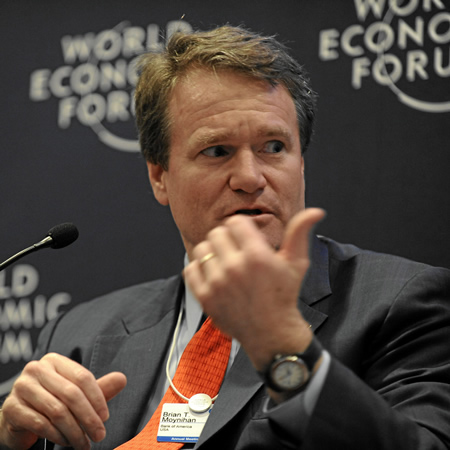
Photo: Brian T. Moynihan, President and Chief Executive Officer, Bank of America, USA, captured during the session 'Redesigning Capital Markets' at the Congress Centre of the Annual Meeting 2010 of the World Economic Forum in Davos, Switzerland, January 29, 2010. (© World Economic Forum. Photo by Michael Wuertenberg).
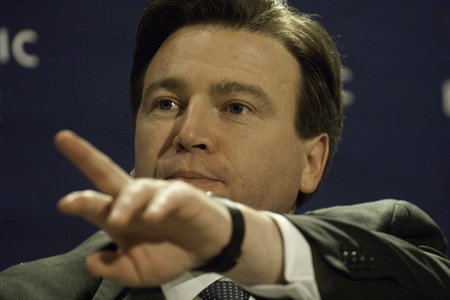
Photo: Geoff Cutmore (Anchor, CNBC, United Kingdom) captured at the World Economic Forum on Europe held in Brussels, Belgium, May 10, 2010. (© World Economic Forum. Photo by Youssef Meftah).
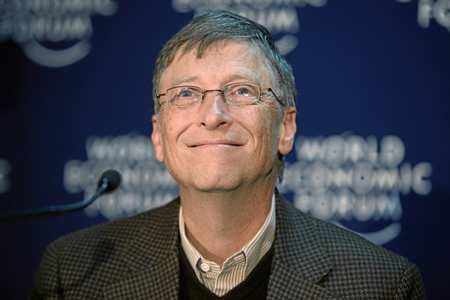
Photo: William H. Gates III, Co-Chair, Bill & Melinda Gates Foundation, USA, smiles during the 'Bill & Melinda Gates Foundation Pledge' in the Congress Centre of the Annual Meeting 2010 of the World Economic Forum in Davos, Switzerland, January 29, 2010. (© World Economic Forum. Photo by Sebastian Derungs).
Reminding the international community that in the midst of the financial crisis in late 2008 and early 2009 it "was seized with the transformational nature of our times," the report calls on it to "hold on to that moment of possibility, consolidate its considerable accomplishment in containing the crisis and renew its earlier commitment to renovate the international system."
Drawing a parallel to the 1944 Dumbarton Oaks and Bretton Woods conferences that designed much of the post-war international security and economic architecture over a year before World War II ended, the report concludes that the time has come for governments, companies and other civil society institutions to "rise above their immediate, parochial interests and consider more seriously their long-term stake in a properly structured and resourced global cooperation system for the 21st century."
Writing in the report's overview chapter, Forum Managing Director Richard Samans, Executive Chairman and Founder Klaus Schwab and Vice-Chairman Lord Malloch-Brown conclude: "Even as governments develop their exit strategies from fiscal and monetary stimulus measures applied during the crisis, they should engage in an effort to absorb the larger meaning of the changes that have transformed the international community during the past generation and rendered much of its cooperative architecture not fully fit for purpose."
The Forum report proposes a "blueprint for renovating international cooperation in an era of increasingly complex interdependence, rendering it both more effective and legitimate" based on the many proposals that have emerged from the Global Redesign process.
In particular, it proposes a more results-oriented "multidimensional" approach to international governance and cooperation. Arguing that the international community's increasing interconnectedness and interdependence creates new modes and means of accelerating progress on many global challenges, it demonstrates how pragmatic strategies that take advantage of these additional tools and capacities can be combined to achieve breakthroughs on such issues as climate change, fisheries depletion, unemployment and poverty, public health, proliferation of weapons of mass destruction and educational access and illiteracy, even when new multilateral agreements appear to be diplomatically beyond reach.
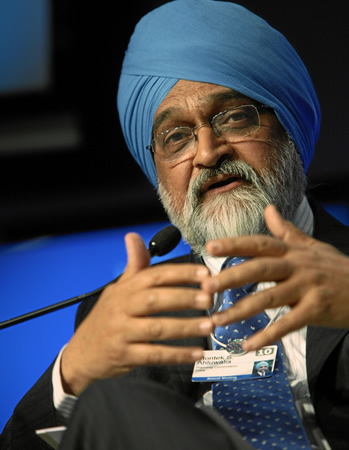
Photo: Montek S. Ahluwalia, Deputy Chairman, Planning Commission, India, speaks during the session 'Rethinking Government Assistance' in the Congress Centre of the Annual Meeting 2010 of the World Economic Forum in Davos, Switzerland, January 29, 2010. (© World Economic Forum. Photo by Remy Steinegger).
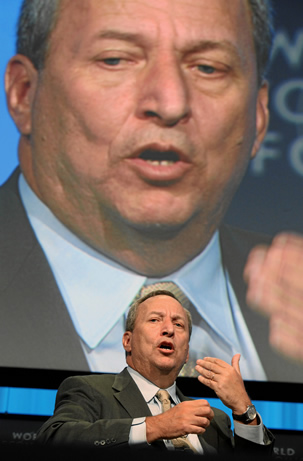
Photo: Lawrence H. Summers, Director, National Economic Council (NEC), Executive Office of the President, USA, is captured during the session 'The US Economic Outlook' at the Annual Meeting 2010 of the World Economic Forum in Davos, Switzerland, January 29, 2010. © World Economic Forum. Photo by Monika Flueckiger).
The report calls for the "state-based core of the international system to be adapted to our more complex, bottom-up world in which non-governmental actors have become a more significant force." To this end, it urges governments and international organizations to conceive of themselves more explicitly as constituting part of "a much wider global cooperation system that has the potential to overcome the limitations of scale, information and coherence from which they currently suffer by anchoring the preparation and implementation of their decisions more deeply in processes of interaction with interdisciplinary and multi-stakeholder networks of relevant experts and actors."
In parallel, the report calls for a stronger sense of ownership and responsibility - a shift in values - on the part of these non-governmental institutions and their leaders regarding the underlying health of the international system.
• Criticizing the "severe price the international community has paid for its complacency about systemic financial and macro-economic risks that were well publicized but nevertheless allowed to accumulate for too long," it calls on "those who educate and select business, scientific, academic, religious, media as well as political leaders - particularly graduate education programs and boards of directors and human resources departments - to redesign their curricula and senior talent development and promotion policies to reflect that they are cultivating not only leaders of functional organizations but also stewards of the international system and the contribution of their professional disciplines thereto."
In addition to making proposals to strengthen international cooperative structures on problems as diverse as financial stability, international trade, water scarcity, prevention of mass atrocities, Internet security, malnutrition, energy security and many others, the report of the Global Redesign Initiative includes a number of broader proposals for the international community. For example, it:
• Urges the Group of 20 Leaders' process to clarify soon its ongoing purpose and relationship with the United Nations and specialized international organizations, making a number of specific proposals in this regard. In addition, it challenges these leaders to reach a package deal on the currently deadlocked UN climate, WTO trade, Millennium Development Goal funding, IMF and World Bank reform, and global macro-economic rebalancing negotiations, arguing that this kind of systemic leap forward in international cooperation would yield large net benefits for developing, emerging and advanced countries alike and could only be brokered by G20 leaders.
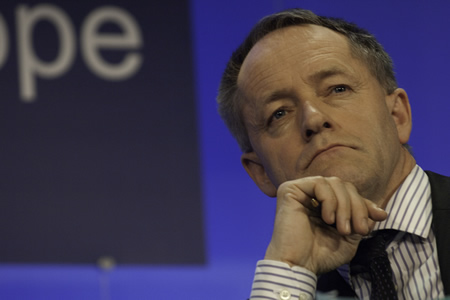
Photo: Peter Westaway (Chief European Economist, Nomura International Plc, United Kingdom) captured at the World Economic Forum on Europe held in Brussels, Belgium, May 10, 2010. (© World Economic Forum. Photo by Youssef Meftah).
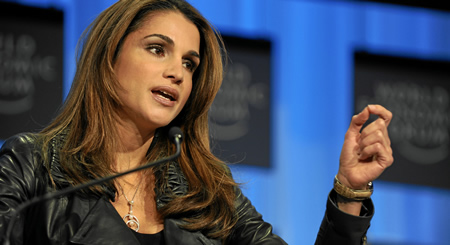
Photo: H.M. Queen Rania Al Abdullah of the Hashemite Kingdom of Jordan; Member of the Foundation Board of the World Economic Forum; Global Agenda Council on Education Systems captured during the session 'Rebuilding Education for the 21st Century' at the congress centre at the Annual Meeting 2010 of the World Economic Forum in Davos, Switzerland, January 30, 2010. (© World Economic Forum. Photo by Michael Wuertenberg).
The proposals were developed by the Forum's Global Agenda Councils of leading experts and decision-makers from academia, business, civil society, international organizations and government as well as its Industry Partner communities and Young Global Leader Task Forces.
The proposals were reviewed by the following distinguished rapporteurs, who have written nine thematic summary chapters that set them in broader context and provide additional proposals:
1. Creating a Values Framework - John J. DeGioia, President, Georgetown University, USA.
2. Building Sustained Economic Growth - Robert Z. Lawrence, Albert L. Williams Professor of Trade and Investment, John F. Kennedy School of Government, Harvard University, USA.
3. Strengthening the International Monetary and Financial System - David Daokui Li, Director and Mansfield Freeman Professor of Economics, Center for China in the World Economy (CCWE), Tsinghua University, People's Republic of China; and Suzanne Nora Johnson, Trustee, Carnegie Institution for Science, USA.
4. Creating Employment, Eradicating Poverty and Improving Social Welfare - John McArthur, Chief Executive Officer, Millennium Promise, USA; and Dennis J. Snower, President, Kiel Institute for the World Economy, Germany.
5. Managing and Mitigating Global Risks - Ian Goldin, Director, James Martin 21st Century School, and Professorial Fellow, Balliol College, University of Oxford, United Kingdom.
6. Ensuring Health for All - Peter Piot, Professor and Director, Institute of Global Health, Imperial College London, United Kingdom; David E. Bloom, Clarence James Gamble Professor of Economics and Demography, Harvard School of Public Health, USA; and Peter C. Smith, Professor, Health Policy, Imperial College London, United Kingdom.
7. Enhancing Global Security - Lilia Shevtsova, Senior Associate, Carnegie Endowment for International Peace, Carnegie Moscow Center, Russian Federation; and Jean-Marie Guéhenno, Senior Non-resident Fellow, Brookings Institution, USA.
8. Ensuring Sustainability - Ashok Khosla, Chairman, Development Alternatives, India; and Caio Koch-Weser, Vice-Chairman, Deutsche Bank Group, Deutsche Bank, United Kingdom.
9. Building Effective Institutions in an Empowered Society - Ngaire Woods, Professor of International Political Economy, University of Oxford, United Kingdom; and Kishore Mahbubani, Dean, Lee Kuan Yew School of Public Policy, Singapore.
"If we do not want to be caught in a continuous vicious cycle of crisis fighting, we have to analyze the fundamental forces changing our world and formulate policies which take into account the manifold structural changes in geopolitics and geo-economics," said Professor Klaus Schwab, Founder and Executive Chairman of the World Economic Forum.
• Global Redesign Initiative Report: GET IT HERE
Source: World Economic Forum
|GlobalGiants.Com|
"Commendable work though. The report is wanting.
It fails to recognize that its objectives cannot be met without the full-scale involvement of the Principal Catalyst -- The Mainstream Media.
Let the World Economic Forum set up a "Global Agenda Council" on "The Role and the Responsibility of the Media", obtain that council's proposals, and add them to the report.
Is "The Role and the Responsibility of the Media" not crucial, Professor Schwab?"
© GlobalGiants.Com. All Rights Reserved.


Edited & Posted by Editor | 4:35 AM | Link to this Post
May 28, 2010
Tackling City Challenges: IBM Unveils New 'Serious Game'
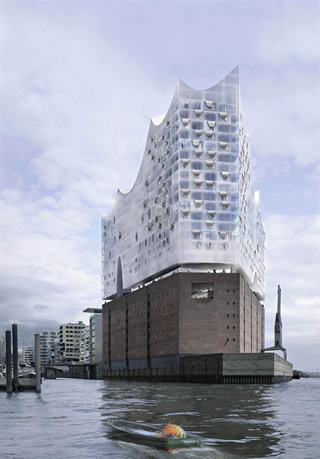
Photo: Elbphilharmonie -- Hamburg's New Landmark: During a Roofing ceremony on May 28 & 29, the northern German metropolis Hamburg presents with the "Elbphilharmonie" its new concert house to the public. More than 5,000 guests gain an insight into the making of this unique concert house. Designed by Swiss architects Herzog & de Meuron, this magnificent building is to become Hamburg's new landmark. (Foto © Hamburg Marketing GmbH).


IBM has announced CityOne, a new "serious game" that can help customers, business partners and students discover how to make cities and their industries smarter by solving real-world business, environmental and logistical problems.
Based on decades of experience in solving business challenges in creative ways, IBM "serious" games are designed to train the workforce of tomorrow.
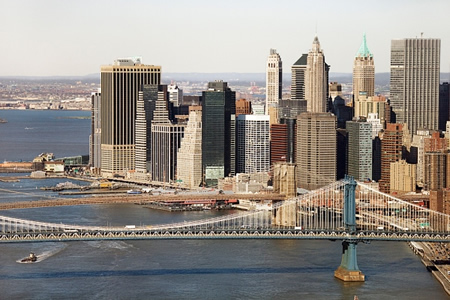
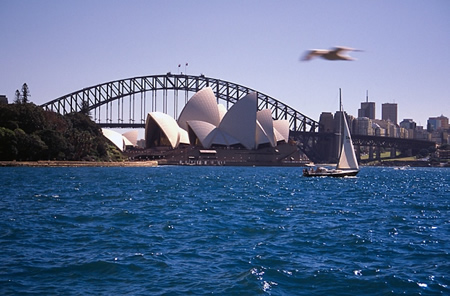
With an estimated one million people around the world moving into cities each week, experts predict population in the world's cities will double by 2050. Today cities consume an estimated 75 percent of the world's energy, emit more than 80 percent of greenhouse gases, and lose as much as 20 percent of their water supply due to infrastructure leaks. As their urban populations continue to grow and these metrics increase, civic leaders will face an unprecedented series of challenges as they modify their infrastructures to meet these challenges.
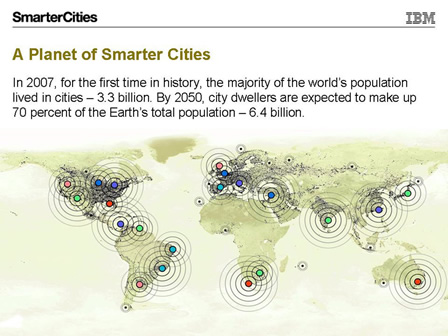
• In order for urban centers to sustain growth and play a positive and central role in the global economy, cities must grow smart.
With CityOne, IBM is providing a virtual environment that will help tomorrow's leaders learn how to apply advances in technology and better understand how these systems work.
• According to IBM, CityOne will be a no charge, "sim-style" game in which the player is tasked with guiding the city through a series of missions that include the Energy, Water, Banking and Retail industries.
For example, one mission involves a city where water usage has increased at twice the rate of population growth, supplies are becoming strained (and possibly polluted); the municipality is losing as much as 40 percent of its water supply through leaky infrastructure; and energy costs are steadily increasing. To complete this mission, the player would be challenged to institute a Water Management System that would include accurate real time data to make decisions on delivering the highest water quality in the most economical way.

Players who promote a more customer-centric business model to the banks represented in their city will discover how mobile payments, dynamic invoicing, and micro-lending can impact business goals. In all of the missions represented in the game, the player will need to determine the best way to invest to meet the financial, environmental and sociological goals of the city's industries while balancing their budgets and the needs of the citizenry. In parallel, players will learn how the components of service reuse, process management, cloud and collaborative technologies make business models more agile.
"Serious games allow professionals to inherently comprehend system interactions, and accurately model the potential business outcomes that can result, in a way that no other medium can do," said Nancy Pearson of IBM. "CityOne will simulate the challenges faced in a variety of industries so that businesses can explore a variety of solutions and explore the business impact before committing resources."
Source: IBM
|GlobalGiants.Com|
"Running a metropolis is different from but as tough, as vital, and as honorable as running a country."
© GlobalGiants.Com. All Rights Reserved.
Edited & Posted by Editor | 12:46 AM | Link to this Post
May 22, 2010
SOS LINK Signs Blackboard Content Network Agreement and Launches CAMPUS SOS LINK
• Delivering Automated Enhanced Physical Security Alerts, From Students to Their Helpers or Security Personnel.



SOS LINK(TM) announces it has signed on with Blackboard Inc. as a Content Network Provider. For this agreement, Campus SOS LINK(TM) has been custom designed and launches today adding to the physical safety and security needs of millions of students within global Blackboard communities.

Photo: New "City of Learning" Campus. Print Courtesy of American University in Cairo.
Campus is a software application that runs on selected smartphones. It is now available for download on Apple iTunes for iPhone and Blackberry App World for selected models. Campus retails for $14.99/year per person for a one year membership. The agreement between SOS LINK and Blackboard further results in students being able to access Campus from their Tools menu after they sign in to their Blackboard operated educational facility website.

Using SOS LINK's patented process, students can quickly and automatically issue alerts to their chosen friends, family members or security personnel, who may receive them in as little as 15 seconds.
These alerts include: numerous emailed photos of what the student sees, along with their GPS location, as well as a follow up phone call and text message that is sent to up to four chosen helpers. End-to-end encryption enhances the potential of using these photos as legal evidence, resulting in a new deterrent for perpetrators.
"There is published government research and many news stories documenting the tens of thousands of reported threats, stalking, assaults and other crimes on campus facilities annually," said Chris Rush, Vice President of SOS LINK. "Smartphones are in widespread use and are usually readily at hand. They are a natural device to use for issuing an alert, notifying those that care about you, and capturing valuable evidence. We believe Campus will contribute significantly to crime prevention. After all, no one wants to get caught in the act."

Campus SOS LINK runs on many smartphones and provides an added layer of security to students when they are commuting, walking between classes, exercising, or traveling - wherever wireless coverage is in place.
SOS LINK provides personal portable security and develops innovative patent-based software solutions for smartphones and other smart-wireless devices that take advantage of their portability and increasing global use.
Source: SOS LINK
|GlobalGiants.Com|
Edited & Posted by Editor | 4:13 AM | Link to this Post
May 19, 2010
International Trade: The Global Enabling Trade Report 2010
• Singapore and Hong Kong are the most open economies to international trade in 2010.
• Vietnam gains 18 positions among 125 countries in The Global Enabling Trade Report 2010.
• Turkey, India and Russia drop in the rankings.
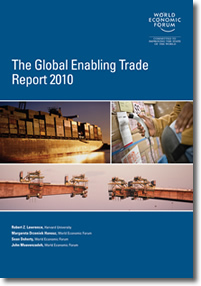
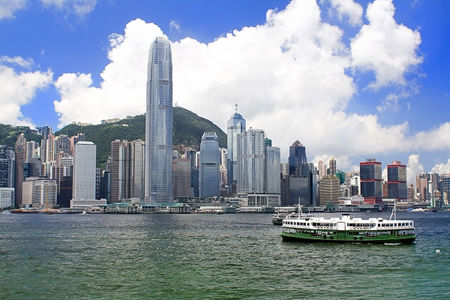
Photo: Victorial Harbour, Hong Kong.
East Asian economies - Singapore and Hong Kong SAR - continue to occupy the top two positions in the Enabling Trade Index ranking, followed by Denmark, Sweden and Switzerland, according to The Global Enabling Trade Report 2010, released today by the World Economic Forum in Geneva.
New Zealand moves by five ranks to 5th place. Norway, Canada, Luxembourg and the Netherlands complete the top-10 list. Iceland enters the ranking for the first time at 11th position, and Finland drops out of the top 10 to 12th place.
Among the large economies, Germany is the best performer at 13th, ahead of the United States, which drops by three places to 19th. China (48th) and Brazil (87th) remain stable, while Turkey (62nd), India (84th) and Russia (114th) drop in the ranking.

The results mirror the resilience against the threat of protectionism during the economic crisis. International agreements such the WTO framework and pledges by the G20 have contributed to limiting the effect of protectionist pressures on trade barriers. Despite fears of rising protectionism, the report confirms that a large majority of countries did not raise trade barriers.


"Just as trade was a key force spreading the growth slowdown internationally, so can trade be an important driver in diffusing the benefits of recovery across the globe. When individual countries enable trade, they provide benefits not only to themselves but also to other nations with which they trade. Improved market access, more efficient customs, and better infrastructure and business environments offer enhanced opportunities for both importers and exporters. Thus, granting Aid for Trade to help nations implement such measures reflects enlightened self-interest, because it enhances welfare in recipient countries and their trading partners," said Robert Z. Lawrence, Albert L. Williams Professor of Trade and Investment at the John F. Kennedy School of Government at Harvard University, USA. Professor Lawrence is also academic adviser and co-editor of the report.
• Published for the third year in a row and covering 125 economies worldwide, the report presents a resource for dialogue and provides a yardstick of the extent to which economies have in place the necessary attributes for enabling trade and where improvements are most needed.
• Get The Global Enabling Trade Report 2010
Source: The World Economic Forum, Geneva, Switzerland.
|GlobalGiants.Com|
Edited & Posted by Editor | 11:56 PM | Link to this Post
May 12, 2010
CARE's 2010 Conference

Photo: U.S. Secretary of State Hillary Clinton speaks about the importance of empowering women and girls to nearly 1,000 CARE advocates at CARE's Conference in Washington, D.C., May 11, 2010. CARE is one of the world's largest private international humanitarian organizations.
|GlobalGiants.Com|
Edited & Posted by Editor | 1:11 PM | Link to this Post
May 10, 2010
"We will do anything to defend the Euro"
• If Europe wants a monetary union, it must promote an economic union.
• Europe cannot afford its social model without economic growth and increased competitiveness.
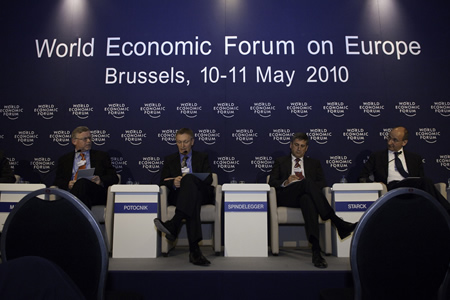
Photo: Participants captured at the World Economic Forum on Europe held in Brussels, Belgium, May 10, 2010. © World Economic Forum. Photo by Youssef Meftah.
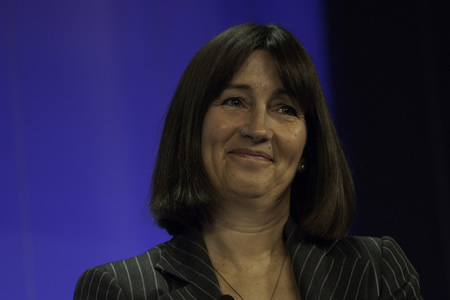
Photo: Annette Court (Member of the group Executive Committee and Chief Executive Officer, Europe General Insurance Zurich Financial Services, Switzerland) captured at the World Economic Forum on Europe held in Brussels, Belgium, May 10, 2010. © World Economic Forum. Photo by Youssef Meftah.
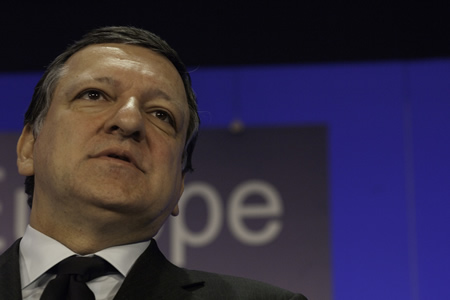
Photo: José Manuel Barroso (President, European Commission, Brussels) captured at the World Economic Forum on Europe held in Brussels, Belgium, May 10, 2010. © World Economic Forum. Photo by Youssef Meftah.
• The World Economic Forum on Europe opened today (May 10, 2010) in Brussels, Belgium. Over 400 leaders from business, government, academia and civil society from over 40 countries are participating. The meeting is being held from 10 to 11 May under the theme Renewed Leadership, New Vision.
In less than 48 hours, Europe took "a historic decision" to provide an unprecedented rescue package in an effort to combat the debt crisis that has swept across Europe and threatened markets globally.
"We have stated that we will do anything to defend the euro. We completed an agreement to respond in a coordinated, fast and effective manner to any difficulties in Member States. Any attempt to weaken the stability of the euro will fail," said José Manuel Barroso, President, European Commission, Brussels, at the opening plenary of the World Economic Forum on Europe.
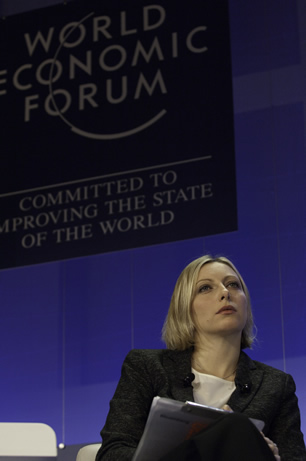
Photo: Francine Lacqua (Anchor and Business Reporter, Bloomberg TV, United Kingdom) captured at the World Economic Forum on Europe held in Brussels, Belgium, May 10, 2010. © World Economic Forum. Photo by Youssef Meftah.
After a meeting in Brussels lasting more than 11 hours, the Economic and Finance Council, comprising the EU's economic and finance ministers, reached an agreement in the early hours of Monday morning on a loan package of more than 720 billion euros over three years to defend the euro and to cover the needs of European Member States that, according to Barroso, are "living beyond their means". Stock markets, which fell to near three-month lows last week over rising concerns about debt contagion from Greece, rallied on Monday in response to the substantial emergency loan package from the EU and the International Monetary Fund.
Referring to the bailout package as a "consolidation pact" for the eurozone, Barroso pledged to broaden surveillance of the EU's economic imbalances, reinforce competitiveness and push for a permanent mechanism to deal with economic crises. "If there is one lesson we have learned from this crisis, it is this: if you want a monetary union, you need to promote an economic union. This means reinforced economic governance and respect of all obligations Member States have under the Stability and Growth Pact."
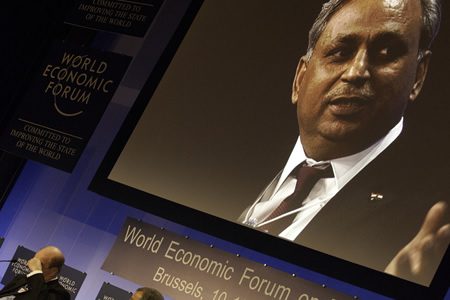
Photo: Chander P. Gurnani (Chief Executive Officer, Mahindra Satyam, India) captured at the World Economic Forum on Europe held in Brussels, Belgium, May 10, 2010. © World Economic Forum. Photo by Youssef Meftah.
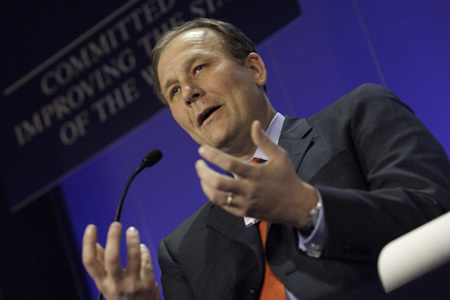
Photo: Jeffrey Joerres (Chairman and Chief Executive Officer, Manpower Inc., USA) captured at the World Economic Forum on Europe held in Brussels, Belgium, May 10, 2010. © World Economic Forum. Photo by Youssef Meftah.
Klaus Schwab, Founder and Executive Chairman of the World Economic Forum, praised European leaders for their "great act of European solidarity" and noted that this historical moment represents a "critical juncture" for the future of Europe.
Source: World Economic Forum
|GlobalGiants.Com|
Edited & Posted by Editor | 2:07 PM | Link to this Post
April 24, 2010
Fight against Malaria

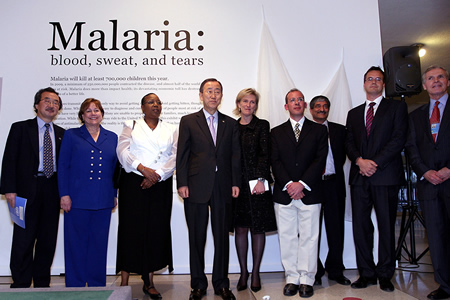
Photo: Public health leaders and dignitaries participate in a reception for the exhibit, Malaria, blood, sweat, and tears held at the United Nations to commemorate World Malaria Day on April 25.
(From left to right)
• Kiyo Akasaka, Under-secretary General, UN Department of Public Affairs;
• Anne M. Veneman, Executive Director, UNICEF;
• Professor Awa Coll-Seck, Executive Director, Roll Back Malaria Partnership;
• United Nations Secretary General Ban Ki-moon;
• HRH Princess Astrid of Belgium, Special Representative of the Roll Back Malaria Partnership;
• Adam Nadel, Exhibition Photographer;
• Sunil Mehra, Executive Director, Malaria Consortium;
• Mikkel Vestergaard Frandsen, CEO of Vestergaard Frandsen, leading producer of mosquito nets;
• Raymond G. Chambers, UN Special Envoy for Malaria.
Malaria is a preventable and curable disease. Yet nearly 850,000 people each year, mainly pregnant women and children, die from it, and half of the world's population, some 3.3 billion people in 109 countries, are at risk of contracting the disease.

• It's also widely recognized that malaria control has a positive impact on all of the United Nations' Millennium Development Goals (MDGs). Fueled by milestones set by the MDGs in 2000, there has been strong international funding and support for malaria prevention programs throughout 2009. A recent report authored by the World Health Organization (WHO) confirmed that this effort has yielded significant successes.
|GlobalGiants.Com|
Edited & Posted by Editor | 7:40 AM | Link to this Post
April 15, 2010
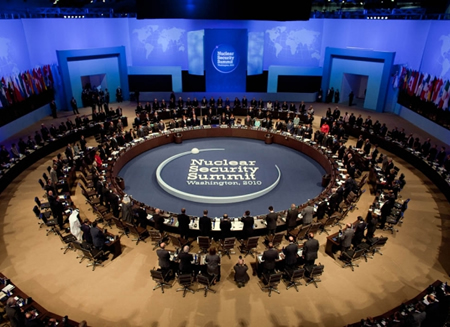
Nuclear Security Summit 2010

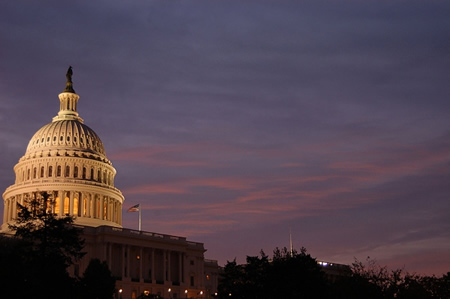
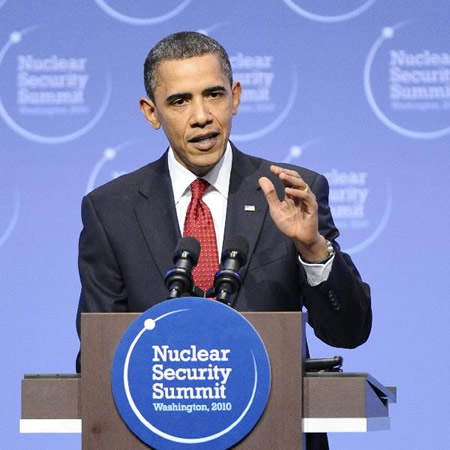
On April 12-13, 2010, President Obama hosted a Nuclear Security Summit in Washington, DC. President Obama invited over 40 nations to participate, representing a diverse set of regions and various levels of nuclear materials, energy, and expertise.
The Summit focused on the security of nuclear materials, leaving other broad topics such as nonproliferation, disarmament, and peaceful nuclear energy to different forums.
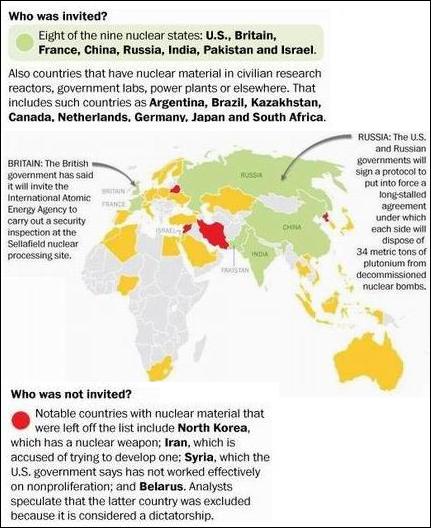
• Key Facts about the Nuclear Security Summit
• Communiqué of the Washington Nuclear Security Summit
• List of World Leaders and Heads of Delegation attending the Nuclear Security Summit
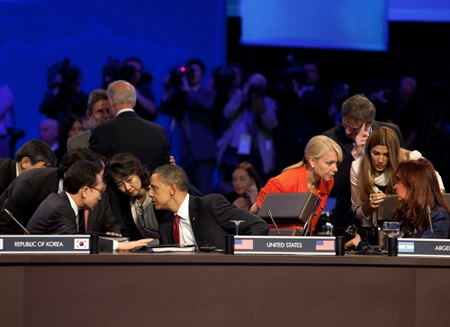
Photo: President Barack Obama talks with President Lee Myung-bak of Korea during the first plenary session of the Nuclear Security Summit at the Washington Convention Center in Washington, D.C., April 13, 2010. President Cristina Fernandez de Kirchner of Argentina works at right. (Official White House Photo by Chuck Kennedy).
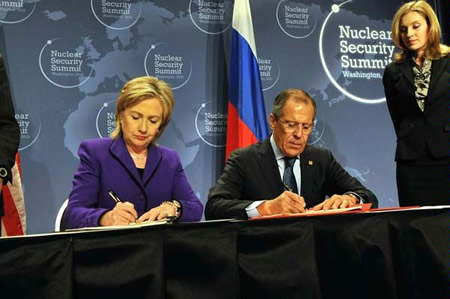
Photo: Secretary of State Hillary Rodham Clinton and Russian Foreign Minister Sergey Lavrov signed the Plutonium Disposition Protocol on Tuesday, April 13. (State Department Photo by Michael Gros).
The Plutonium Disposition Protocol represents an essential step in the nuclear disarmament process. The Protocol makes arms reductions irreversible by ensuring that United States and Russia will transparently dispose weapon-grade plutonium from their respective defense programs, thereby preventing the plutonium from ever being reused for weapons or any other military purpose.
By updating the 2000 Plutonium Management and Disposition Agreement (PMDA), each country will proceed to complete and operate facilities that will dispose of at least 34 metric tons of this plutonium by using it as fuel in civil power reactors to produce electricity. Combined, this represents enough material for approximately 17,000 nuclear weapons.
Earlier, the United States and Russia signed the New Strategic Arms Reduction Treaty (START) in Prague, reducing the number of strategic nuclear warheads in their arsenals.
Source: U.S. Department of State
|GlobalGiants.Com|
Edited & Posted by Editor | 9:34 AM | Link to this Post
March 25, 2010
Global Information Technology Report 2009-2010
• Sweden replaces Denmark as world's most networked economy in The Global Information Technology Report 2009-2010 rankings.
• United States moves down two positions to fifth place.
• China (37th) and India (43rd) lead BRIC economies and continue upward trend with a 9 and 11 place improvement respectively.
• Ninth edition of report covers 133 economies, accounting for over 98% of world's GDP.

Sweden tops the rankings of The Global Information Technology Report 2009-2010, released today (March 25, 2010) by the World Economic Forum in Geneva, Switzerland.
The report highlights the key role of ICT (Information and Communication Technology) as an enabler of a more economically, environmentally and socially sustainable world in the aftermath of one of the most serious economic crises in decades. Sweden is followed by Singapore and Denmark, which was in the number one position for the last three years.
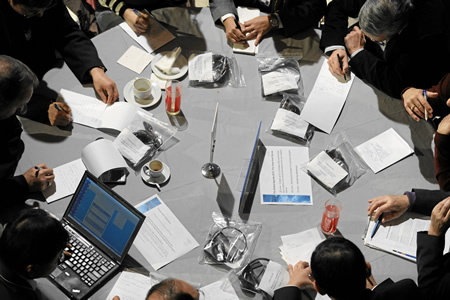
Photo: An overview captured during the session 'The Global Agenda 2010: The View from Davos' at the Congress Centre of the Annual Meeting 2010 of the World Economic Forum in Davos, Switzerland, January 31, 2010. (Copyright by World Economic Forum. swiss-image.ch/Photo by Michael Wuertenberg)
"Sweden, Singapore and Denmark's superior capacity to leverage ICT as an enabler of sustainable, long-term economic growth is built on similar premises, relating with a long-standing focus placed by governments and private sectors alike on education, innovation and ICT access and diffusion," said Irene Mia, Senior Economist of the Global Competitiveness Network at the World Economic Forum and co-editor of the report. "The success of these countries underlines the importance of a joint ICT vision, an implementation, by all the different stakeholders in a society for a country to take full advantage of ICT advances in its daily life and overall competitiveness strategy."



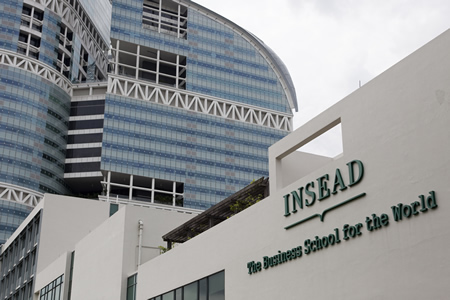
The report is produced by the World Economic Forum in cooperation with INSEAD, the leading international business school, within the framework of the World Economic Forum's Global Competitiveness Network and the Industry Partnership Program for Information Technology and Telecommunications Industries.
Published for the ninth consecutive year with an extensive coverage of 133 economies worldwide, the report remains the world's most comprehensive and authoritative international assessment of the impact of ICT on the development process and the competitiveness of nations.
Under the theme ICT for Sustainability, this year's report explores the many and diverse links between ICT and sustainability, in all its dimensions.
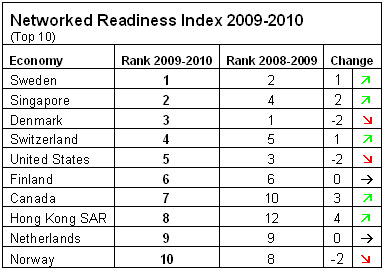
• The Networked Readiness Index: View the Rankings of All Countries
The Networked Readiness Index (NRI), featured in the report, examines how prepared countries are to use ICT effectively on three dimensions:
1. The general business, regulatory and infrastructure environment for ICT.
2. The readiness of the three key stakeholder groups in a society -- individuals, businesses and governments -- to use and benefit from ICT.
3. The actual usage of the latest information and communication technologies available.
The NRI uses a combination of data from publicly available sources, as well as the results of the Executive Opinion Survey, a comprehensive annual survey conducted by the World Economic Forum with its network of partner institutes (leading research institutes and business organizations) in the countries included in the report. The survey provides unique data on many qualitative dimensions important to assess national networked readiness.

• The cross-country analysis of the drivers of networked readiness provides useful comparative information for making business decisions and additional value to governments wishing to improve their ICT preparedness.
The report contains detailed country profiles for the 133 economies featured in the study, providing a snapshot of each economy's level of ICT penetration and usage. Also included is an extensive section of data tables, as well as each indicator used in the computation of the Index.
The editors of the report are Soumitra Dutta, Roland Berger Professor of Business and Technology, INSEAD, France, and Irene Mia, Director and Senior Economist, Global Competitiveness Network, World Economic Forum.
• Get the Entire Global Information Technology Report 2009-2010
Source: The World Economic Forum, Geneva, Switzerland.
|GlobalGiants.Com|
Edited & Posted by Editor | 1:15 PM | Link to this Post
March 20, 2010
From Russia with Love: That's the Theme of The Netherlands International Flower Exhibition



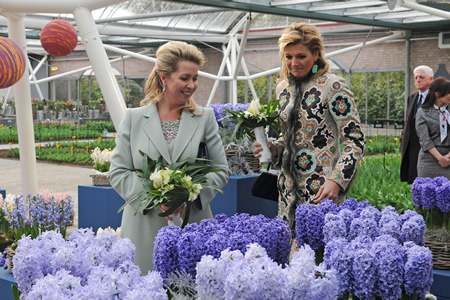
Photo: Accompanied by HRH Princess Máxima der Nederlanden, Mrs Svetlana Medvedeva, spouse of the president of the Russian Federation, officially opens the 61st Keukenhof international flower exhibition in Lisse, The Netherlands. She was especially invited because this year's central theme is 'From Russia with Love'.
Source: Keukenhof
|GlobalGiants.Com|
Edited & Posted by Editor | 4:55 AM | Link to this Post
March 19, 2010
Better City, Better Life: Siemens at EXPO 2010
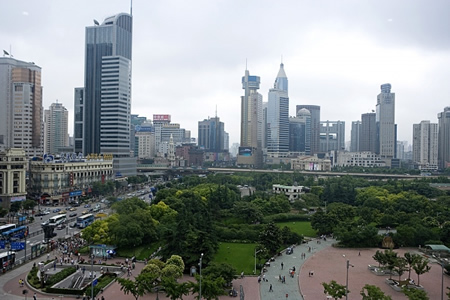

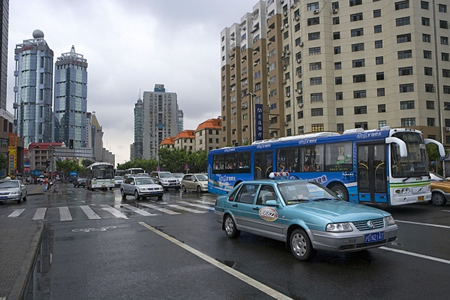
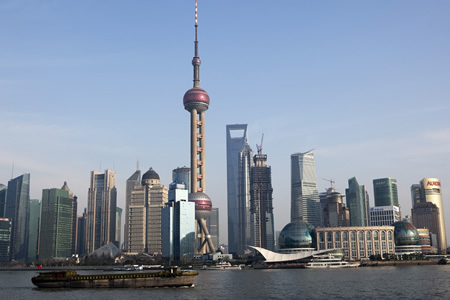
Photos: View of Shanghai
"Better City, Better Life" - that's the theme of EXPO 2010, which will take place in Shanghai from May 1 - October 31, 2010. Siemens is supporting EXPO 2010 with green infrastructure technology.
On the 1st of May, the EXPO 2010 in Shanghai will open its doors to the world. About 70 million visitors are expected in the Chinese metropolis.
It is supposed to be the first green world exhibition in EXPO history.
As a global EXPO partner, Siemens has supplied technology used in more than 40 projects on the exhibition grounds. In addition, Siemens supplied infrastructure including technology for rapid mass transit, clean air, cleaner water and ultra-modern health care in Shanghai.
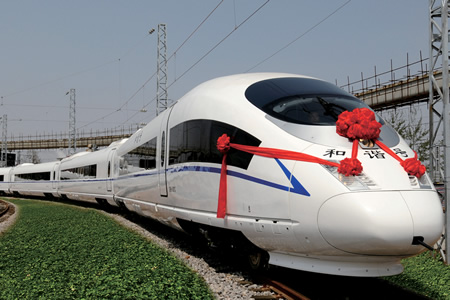
Photo: Siemens won contracts related to the EXPO. These include high-speed trains at a speed of 300 kph from Beijing to Tianjin.
"Our green technology will continue to upgrade the city's infrastructure well after the EXPO. Thus, it is a triple win for EXPO visitors, for the host city of Shanghai and for Siemens," said Richard Hausmann, CEO Siemens Northeast Asia and President and CEO of Siemens Ltd., China.
Siemens was awarded contracts in connection with the Expo with a total value of more than one billion euros. About 90 percent of this amount is related to environmentally friendly products and solutions.
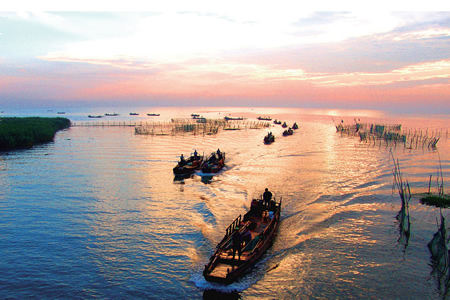
Photo: In China, ensuring a supply of clean water is a pressing problem. Shanghai, which is naturally rich in water, suffers from polluted springs. Siemens water treatment solutions help clean up Taihu Lake not far from Shanghai.

Photo: Shanghai buildings in the evening.
More than 50,000 energy-saving light-emitting diodes (LEDs) produced by Siemens' lighting subsidiary Osram will illuminate the pavilions and boulevards. LEDs consume 80 percent less electricity than conventional incandescent bulbs.
The China Pavilion, with a total surface area of 160,000 square meters, is one of the largest Siemens projects at the Expo.
In addition to solutions for reduced energy consumption, Siemens also supplied infrastructure in advance of the Expo that will assure adequate power supply to the city of Shanghai both during and after the event.
Source: Siemens AG, Berlin
|GlobalGiants.Com|
Edited & Posted by Editor | 2:20 AM | Link to this Post