

















March 11, 2010
U.S. Postal Service Honors Abstract Expressionists
Ten Revolutionary Works of Art Make Debut as Postage Stamps.

The U.S. Postal Service today honored the artistic innovations and achievements of a group of artists who moved the United States to the forefront of the international art scene with the release of the Abstract Expressionists commemorative postage stamps.
The vibrant stamps feature works by Hans Hoffmann, Mark Rothko, Clyfford Still, Barnett Newman, Robert Motherwell, Adolph Gottlieb, Arshile Gorky, Willem de Kooning, Jackson Pollock and Joan Mitchell.
"These bold artists used art to express complicated ideas and primitive emotions in simplified, abstract form," said Linda Kingsley, USPS senior vice president, Strategy and Transition. "Although these stamps can't compare in size to their real-life canvases, they bring the passion and spirit of abstract expressionism to an envelope near you. The Postal Service is proud to pay tribute to the legacy and unique perspectives of these revolutionary artists."
Abstract expressionists believed that art no longer depicted experience but became the experience itself. They emphasized spontaneous, free expression and allowed personal intuition and the unconscious to guide their choice of imagery. Other shared traits include the use of large canvases and an emphasis on paint texture and distinctive brushstrokes.
"The abstract expressionists began one of the most important art movements in the last century, placing New York and American art at the very center of the art world for the first time," noted Louis Grachos, director of the Albright-Knox Art Gallery in Buffalo, NY, home of four of the works featured on the stamps.
Source: U.S. Postal Service
|GlobalGiants.Com|


Edited & Posted by Editor | 7:07 PM | Link to this Post
February 3, 2010
World Economic Forum Annual Meeting 2010: Rebuilding the Global Economy
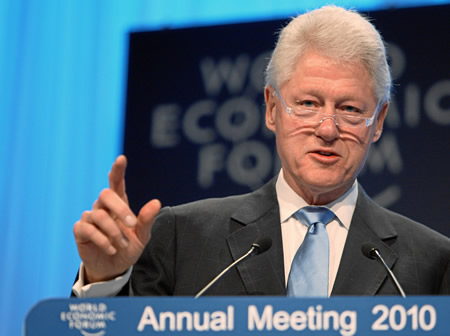
Photo: William J. Clinton, Founder, William J. Clinton Foundation; President of the United States (1993-2001); UN Special Envoy to Haiti speaks during the 'Special Session on Haiti' at the Congress Centre at the Annual Meeting 2010 of the World Economic Forum in Davos, Switzerland, January 28, 2010. (Copyright by World Economic Forum. swiss-image.ch/Photo by Remy Steinegger)
• At the 40th World Economic Forum Annual Meeting 2010, participants found that the global recovery is fragile, and now is the moment to rethink values as the world rebuilds prosperity.
• All countries in the G20 and beyond should find new pathways to sustainable growth and job creation.
• Concretely, Bill and Melinda Gates, Co-Chairs of the Bill and Melinda Gates Foundation, which is a founding partner of the GAVI Alliance, pledged US$ 10 billion to vaccinate over 8 million children in the next decade.
• Former US President William J. Clinton announced a joint initiative between the World Economic Forum, the Clinton Global Initiative and the UN to support Haiti's long-term reconstruction.
• Canadian Prime Minister Stephen Harper, South Korean President Lee Myung-Bak, Mexican President Felipe de Jesus Calderon Hinojosa and French President Nicolas Sarkozy all set forth agendas for global engagement to prevent future crises and to promote sustainability and principled growth.
• Since its launch 10 years ago, the Global Alliance for Vaccines and Immunisation (GAVI) has saved over 4 million lives and has immunized an additional 256 million children in the world's poorest countries.
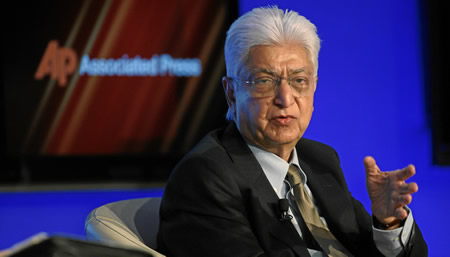
Photo: Azim H. Premji, Chairman, Wipro, India; Co-Chair of the World Economic Forum Annual Meeting 2010 captured during the session 'A Roadmap for a Sustainable Recovery' of the Annual Meeting 2010 of the World Economic Forum in Davos, Switzerland, January 31, 2010 at the Congress Centre. (Copyright by World Economic Forum. swiss-image.ch/Photo by Sebastian Derungs)
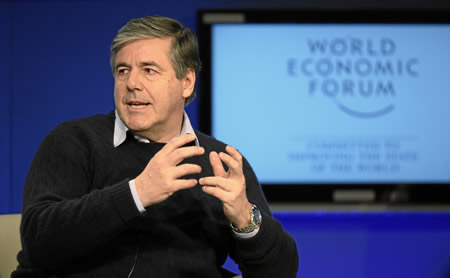
Photo: Josef Ackermann, Chairman of the Management Board and the Group Executive Committee, Deutsche Bank, Germany; Member of the Foundation Board of the World Economic Forum; Chair of the Governors Meeting for Financial Services 2010; Co-Chair of the World Economic Forum Annual Meeting 2010 captured during the session 'A Roadmap for a Sustainable Recovery' of the Annual Meeting 2010 of the World Economic Forum in Davos, Switzerland, January 31, 2010 at the Congress Centre. (Copyright by World Economic Forum. swiss-image.ch/Photo by Sebastian Derungs)
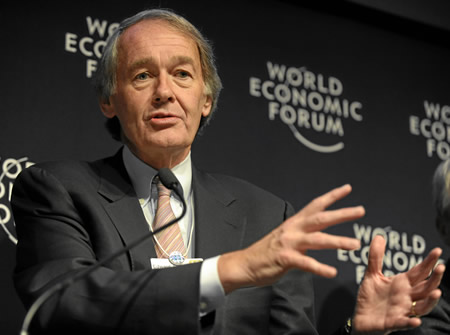
Photo: Edward J. Markey, Congressman from Massachusetts (Democrat), 7th District, Chairman, Select Committee on Energy Independence and Global Warming, USA, speaks during the session 'The US Legislative Agenda: A Global Perspective' in the Congress Centre of the Annual Meeting 2010 of the World Economic Forum in Davos, Switzerland, January 30, 2010. (Copyright by World Economic Forum. swiss-image.ch/Photo by Michael Wuertenberg)
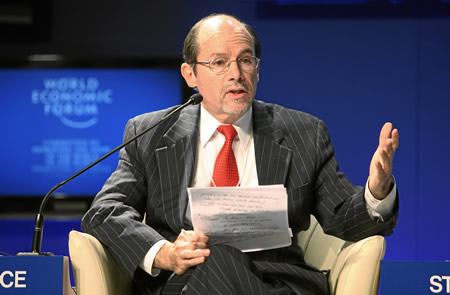
Photo: Robert Z. Lawrence, Albert L. Williams Professor of Trade and Investment, John F. Kennedy School of Government, Harvard University, USA; Global Agenda Council on Trade is captured during the session 'Rethinking Trade and Climate Change' at the congress centre during the Annual Meeting 2010 of the World Economic Forum in Davos, Switzerland, January 30, 2010. (Copyright by World Economic Forum. swiss-image.ch/Photo by Sebastian Derungs)
At the conclusion of the 40th World Economic Forum Annual Meeting in Davos, Switzerland, participants pledged to rethink, rebuild and redesign the global economy based on sustainable principles.
The sense of the Meeting, echoed by Lawrence H. Summers, Director of the US National Economic Council (NEC), was that the world was experiencing "a statistical recovery and a human recession." "We are not out of the woods yet," said Michael Oreskes, Senior Managing Editor of the Associated Press. "The recovery is still very fragile in many developed economies." Principled leadership is key to stabilization.
"At the end, it's an interdependent system," said Josef Ackermann, Chairman of the Management Board and the Group Executive Committee of Deutsche Bank; Member of the Foundation Board of the World Economic Forum; and Co-Chair of the World Economic Forum Annual Meeting 2010. "If you lose the support of society, you are not going to achieve your corporate objectives."
Job creation is critical to sustainable recovery. There is a role for all to play in job creation, underscored Patricia A. Woertz, Chairman, President and Chief Executive Officer of Archer Daniels Midland (ADM), and Co-Chair of the World Economic Forum Annual Meeting 2010. "And retaining jobs is as important as creating new ones." The recession also demonstrated that the world must hear better the voices outside of the G8.
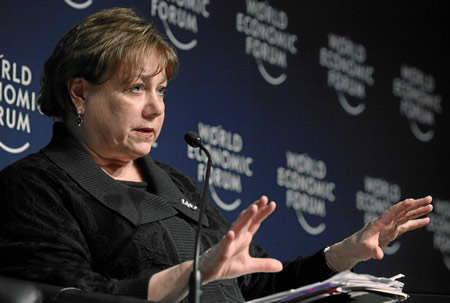
Photo: Ann M. Veneman, Executive Director, United Nations Children's Fund (UNICEF), New York; Global Agenda Council on the Welfare of Children is captured during the session 'Redesign Your Cause' of the Annual Meeting 2010 of the World Economic Forum in Davos, Switzerland, January 30, 2010. (Copyright by World Economic Forum. swiss-image.ch/Photo by Monika Flueckiger)
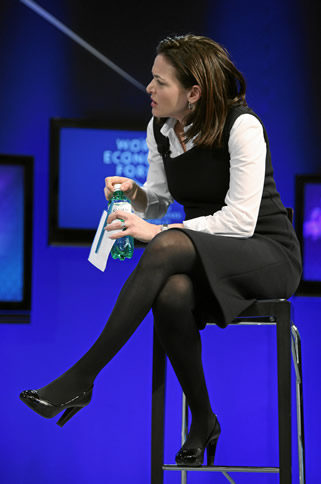
Photo: Sheryl Sandberg, Chief Operating Officer, Facebook Inc., USA captured during the session 'The Gender Agenda: Putting Parity into Practice' at the Annual Meeting 2010 of the World Economic Forum in Davos, Switzerland, January 30, 2010. (Copyright by World Economic Forum. swiss-image.ch/Photo by Sebastian Derungs)
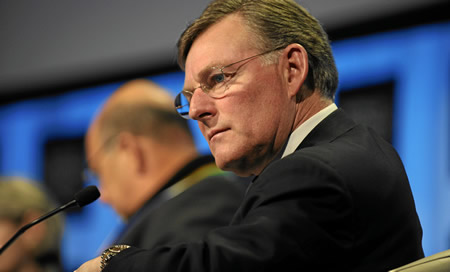
Photo: Harold McGraw III, Chairman, President and Chief Executive Officer, The McGraw-Hill Companies, USA during the session 'Rebuilding Education for the 21st Century' at the congress centre at the Annual Meeting 2010 of the World Economic Forum in Davos, Switzerland, January 30, 2010. (Copyright by World Economic Forum. swiss-image.ch/Photo by Michael Wuertenberg)
"The self-confidence of emerging nations is completely different," said Azim H. Premji, Chairman of Wipro, and Co-Chair of the World Economic Forum Annual Meeting 2010. He warned that in India and China "if services are put under severe, unreasonable restrictions, you will get tariffs overnight."
"If you have lost the trust of societies, you cannot just respond technically, you have to respond morally," said Ackermann. Rowan D. Williams, Archbishop of Canterbury, United Kingdom, urged participants to take collective responsibility for the future by being individually responsible now. Living responsibly in the present means living within ecological limits to ensure the security of work and food. "Responsibility for the future means being responsible for a vision of humanity which excites and enlarges us," he added.
Earlier, addressing participants in a session on "The US Legislative Agenda: A Global Perspective" at the World Economic Forum Annual Meeting 2010, US congressmen and senators confirmed that despite bipartisan differences, there is agreement that financial regulation is imperative. So, this spring, expect an energy package and "tough regulation" on financial services from the Obama Administration.
Source: World Economic Forum, Davos, Switzerland
|GlobalGiants.Com|


Edited & Posted by Editor | 7:04 AM | Link to this Post
February 2, 2010
Made in China or Swiss Made?

Advertising that a toy is made in China can be as successful as saying a watch is "Swiss Made", if the marketing is done right, a Queensland University of Technology researcher says.
Professor Brett Martin found that promoting a product's country of manufacture could help it to sell, even if it was made in a country associated with lower quality.
"It is standard advertising practice to market a product's country of origin if the country is perceived as a high quality producer and not mention the country if it is not," Professor Martin said.
"However, my research has found consumers can easily be persuaded to think positively about a 'low quality' country."

Professor Martin said the trick was to get consumers to imagine positive thoughts when reading product information.
"This is because getting people to use their imagination weakens the stereotypes people use about goods from different countries," he said.
His study tested 516 young adults after they viewed product information for digital cameras made in Germany, which is seen as a manufacturer of high quality products, and Poland, which is regarded as a maker of lower quality products.

Measuring their purchase intentions and emotions, the study found that sparking the consumers' imaginations about Poland created a lasting positive response towards the Polish-made camera which equalled the positive response felt towards the German-made camera.
"These findings form an interesting consideration for marketers," he said.
"Having a strong country of manufacture can be effective for advertising, but if you get people to imagine how good a supposedly weaker country is, the advantage for the high quality country drops substantially.
"This is because many people form a quick impression when they find out where a product is from, like a t-shirt from Hawaii.
"Getting them to imagine the islands' great beaches and surf culture interrupts that thinking and lets a product sell on its merits, rather than being dismissed without consideration."

Professor Martin said his research which is forthcoming in the Journal of Consumer Behaviour meant companies which manufactured their products in countries associated with lower quality should rethink their marketing strategies and not just compete on price.
He said that a strong country of manufacture was not necessarily the great advantage that many advertisers think and cautioned against resting on the laurels of a country's good reputation.
Source: Queensland University of Technology, Australia
|GlobalGiants.Com|
Edited & Posted by Editor | 8:18 AM | Link to this Post
January 18, 2010
IBM CORPORATION INVENTOR
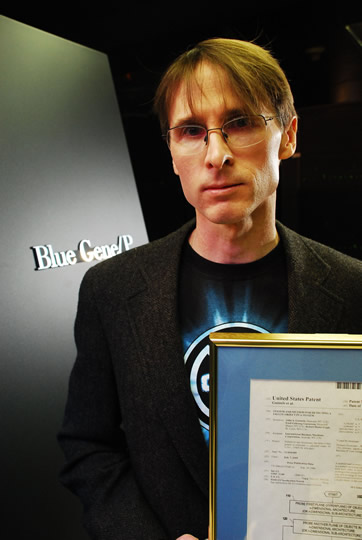
Photo: IBM inventor, John Gunnels, holds U.S. Patent #7,506,196, one of 4,914 patents IBM received from the United States Patent and Trademark Office in 2009 -- the 17th consecutive year IBM topped the annual list of patent holders. Gunnels received patent #7,506,196 for an invention that enables IBM's Blue Gene supercomputer to run with the assurance that its internal communications network is functioning properly.
|GlobalGiants.Com|
Edited & Posted by Editor | 9:35 AM | Link to this Post
January 8, 2010
Thomson Reuters to work with Times Higher Education: Data-Driven Profiles of World's Leading Universities & Research Institutions to be Created



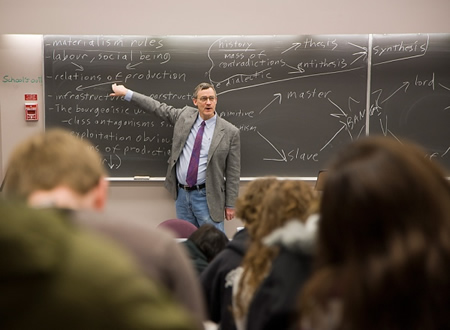
Thomson Reuters, the authority on research analytics and decision support citation data for more than half a century, announced today in PHILADELPHIA and LONDON that it has begun working with thousands of institutions and research facilities to produce a one-of-a-kind resource.
This initiative, the "Global Institutional Profiles Project", will create data-driven portraits of globally significant universities and research institutions - combining peer review, scholarly outputs, citation patterns, funding levels, and faculty characteristics in one comprehensive database.

"There is a need for robust, dynamic, and above all transparent and verifiable data on scholarly performance to reshape how administrators approach institutional comparisons," said Keith MacGregor, executive vice president at Thomson Reuters. "Thomson Reuters has the proven history of bibliometric expertise and analysis to provide the foundational data and consultative elements needed to create this tool."

The dataset can be packaged and analyzed to different specifications, allowing organizations to receive custom information for their specific needs. The Times Higher Education, a London-based weekly newspaper that covers higher education issues, is the first to request a customized dataset to produce an improved version of their annual World University Rankings. The publication will work closely with Thomson Reuters to create a balanced, transparent methodology to support their influential rankings.

The Global Institutional Profiles Project has already begun with a worldwide survey of opinion leaders at key research institutions. The advice they provide will inform the project both in terms of data collected and methodologies used. According to Thomson Reuters, its goal is to be fully transparent in approach and verifiable in outcomes, so the results of the opinion survey will be published in Q1 of 2010.

• Following is the Thomson Reuters' Open Letter to University & Higher Education Institution Administrators Worldwide:

"Dear Friend:
We are writing to update you on major developments within academic rankings. As 2010 unfolds, your institution's researchers will likely receive multiple survey requests from various ranking initiatives. However, only one seeks to fundamentally change the way data is collected and analyzed.
As you're well aware, institutional rankings play an increasingly powerful and controversial role within the academic landscape. Yet many of the existing efforts have been largely criticized for being based on questionable data and flawed methodology. In response to heated industry debate, Times Higher Education, a global authority on higher education, recently announced plans to work with Thomson Reuters on revamping its popular World University Rankings. We are proud to have been chosen by Times Higher Education and believe this development underscores a major breakthrough within the rankings dialogue.
Our aim with the GLOBAL INSTITUTIONAL PROFILES PROJECT, which includes our work with Times Higher Education, is to develop a data source that provides the best informed and most effective resource to build profiles of universities and research-based institutions around the world.
As part of this initiative, some of your researchers may be contacted soon to complete our reputational survey. Their engagement is critical to ensuring this new initiative delivers what the industry has long been asking for -- an accurate representation of the institutional landscape, from the source. And we firmly believe your support is essential to notifying researchers and encouraging their participation.
We are excited to be a part of such a widespread initiative and look forward to working with you and your institution on bringing greater depth and transparency to institutional assessment."

• Thomson Reuters is the world's leading source of intelligent information for businesses and professionals. With headquarters in New York and major operations in London and Eagan, Minnesota, Thomson Reuters employs more than 50,000 people and operates in over 100 countries.
Source: Thomson Reuters
|GlobalGiants.Com|
Edited & Posted by Editor | 12:28 PM | Link to this Post
December 16, 2009
TIME Names United States Federal Reserve Chairman Ben Bernanke 2009 Person of the Year
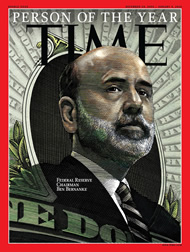
TIME has named United States Federal Reserve Chairman Ben Bernanke the 2009 Person of the Year.
TIME's Person of the Year issue has the first full, on-the-record print interview with Bernanke since he became Chairman of the Federal Reserve.
IN A SERIES OF THREE INTERVIEWS, BERNANKE TELLS TIME:
• On the financial crisis:
"We came very, very close to a depression...The markets were in anaphylactic shock. I'm not happy with where we are, but it's a lot better than where we could be...Of course there were things we could have done better, but this was a perfect storm."
• On unemployment:
"The additional steps aren't as obvious or clear as the ones we've already taken. It's an enormous problem. There aren't easy solutions."
• On questions about his handling of Lehman, AIG and Bear Stearns:
"It's the price of success: people start to think you're omnipotent. We say we didn't have the authority, and it's 'Oh, you're the Fed. You could've come up with something.'"
• Bernanke tells TIME that major financial crises generally cost nations 5% to 20% of their national output. This panic seems likely to cost the U.S. a fraction of 1%. "How much would you pay to avoid a second Depression?" Bernanke asks. "I mean, this is a pretty good return on investment."
• On his background:
"I'm not one of those people who look at this as some kind of video game. I come from Main Street, from a small town that's really depressed. This is all very real to me."
• On banker pay:
"I think that bankers ought to recognize that the government and the taxpayer saved the financial system from utter collapse last year. And in recognizing that, I would think that bankers ought to look in the mirror and decide that perhaps there should be some more restraint in how much they pay themselves, given what the government and the taxpayer did to protect the system."
Source: TIME
|GlobalGiants.Com|
Edited & Posted by Editor | 10:24 AM | Link to this Post
December 4, 2009
World Bank: Majority of People Want Action on Climate Change, Even if it Entails Costs
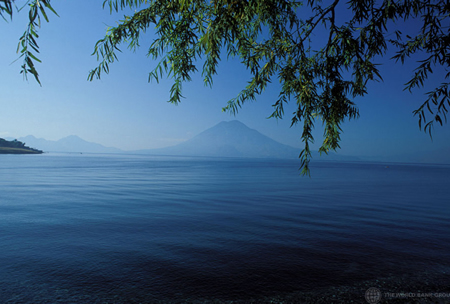
Photo: View of lakes and mountains. Photo © Curt Carnemark / World Bank.
A new poll of 15 nations, most of them in the developing world, finds that majorities of the people canvassed want their governments to take steps to fight climate change, even if that entails costs. People signaled they would support public measures to limit greenhouse gas emissions and step up adaptation measures. For example, respondents would support higher fuel efficiency standards for cars, preserving or expanding forests, and extending funding to vulnerable countries so they can develop hardier crops suited to more severe climates.
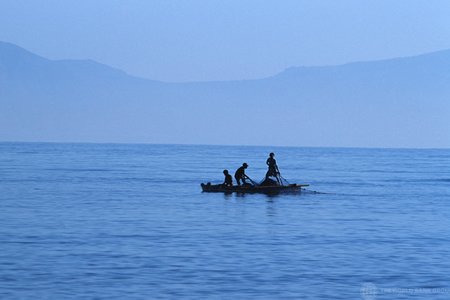
Photo: Fishing. Photo © Alex Baluyut / World Bank.
"The poll's findings shed light on global attitudes at a particularly important moment: the run-up to the conference on climate change to be held December 7-18 in Copenhagen. Hearing from people in the developing world offers a new lens on this issue," says Katherine Sierra, World Bank Vice President for Sustainable Development.
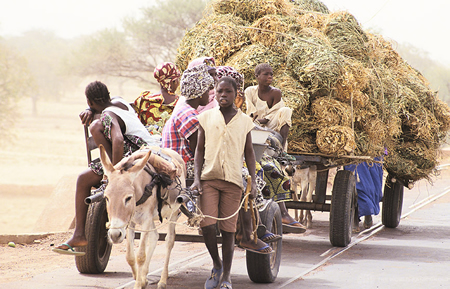
Photo: Horse-drawn cart. Mali. Photo © Curt Carnemark / World Bank.

Photo: Mali. Photo © Curt Carnemark / World Bank.
Carried out by WorldPublicOpinion.org and commissioned by the World Bank, the poll questioned 13,518 respondents in 15 nations -- Bangladesh, China, Egypt, France, India, Indonesia, Iran, Japan, Kenya, Mexico, Russia, Senegal, Turkey, the United States, and Vietnam.
Other key findings include:
• Public concern about climate change is high worldwide, but it's generally higher in developing countries.
• Publics, particularly in developing countries, believe climate change is already having negative effects.
• In most countries, wealthy and poor alike, large majorities are willing to pay to fight climate change.
• Support for increased adaptation funding to poor countries is widespread worldwide.
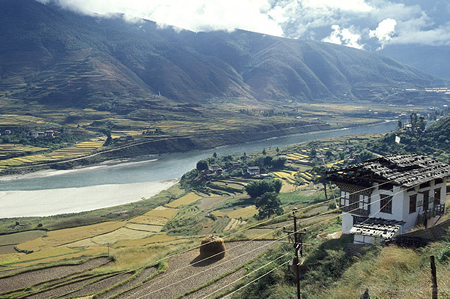
Photo: View of river and mountains. Bhutan. Photo © Curt Carnemark / World Bank.
"It is encouraging indeed to see strong across-the-board support for committing to emissions limits in both developed and developing nations, since behavior change and attitudes will help determine whether we succeed or fail in addressing this global issue," says Marianne Fay, World Bank Chief Economist for Sustainable Development and Co-Director of the World Development Report 2010: Development and Climate Change.
Ms. Fay explained that the poll was commissioned as a follow-up to the recently released WDR. The aim was to gain a better understanding of how the recommendations of the Report to invest substantially and immediately to manage climate change ("Act now, act together, and act differently") resonate in a cross-section of countries.
In the low-income country of Vietnam, for example, 98% say their government should commit to limiting emissions as part of a deal, and 93% support the same course in the absence of a deal. At the other end of the wealth spectrum, the people of France express 97% support if an agreement is reached at Copenhagen, and 87% if no agreement emerges.
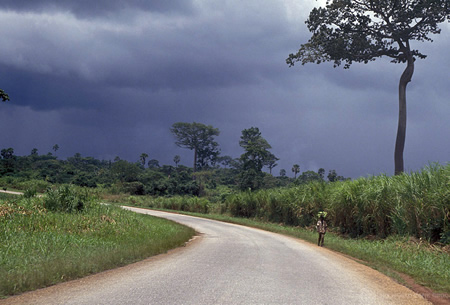
Photo: View of road before storm. Ghana. Photo © Curt Carnemark / World Bank.
Majorities in 14 of 15 countries are willing to pay to fight global climate change.
Majorities in most countries also support measures that would raise costs for energy and transportation.

Photo: Portrait of children. India. Photo © World Bank / Curt Carnemark.
Similarly, majorities in 12 countries support "gradually increasing the requirements for fuel efficiency in automobiles, even if this raises the cost of cars and bus fares." Majorities in 11 countries support "gradually reducing government subsidies that favor private transportation, even if this raises its cost." Majorities in all countries polled support "preserving or expanding forested areas, even if this means less land for agriculture or construction."
WorldPublicOpinion.org operates as a collaborative project involving research centers from around the world that is managed by the Program on International Policy Attitudes (PIPA) at the University of Maryland. The margins of error for each country range from +/-3 to 4 percentage points. The surveys were conducted across the different nations in September and October 2009.
Source: World Bank
|GlobalGiants.Com|
"We, the Heads of the MDBs and the IMF, appeal to the Parties to the United Nations Framework Convention on Climate Change (UNFCCC) to agree in Copenhagen the foundations for an ambitious, comprehensive, and equitable global climate change regime that enables all countries to achieve sustainable development along climate-resilient and low greenhouse gas emission-intensive paths. We recognise the primacy of the UNFCCC, whose principles and process we have supported from the start. We endeavour, in accordance with our organizations' respective mandates, expertise, and resources, to further coordinate our financing and analyses of climate change actions and enable our client partners to maximise the effective use of new financial flows."
-- Joint statement by the heads of the African Development Bank, Asian Development Bank, European Bank for Reconstruction and Development, European Investment Bank, Inter-American Development Bank, World Bank Group and International Monetary Fund.

The International Climate Science Coalition (ICSC) has released the names of over 140 leading climate experts from 17 countries who are asking the United Nations and other supporters of this month's Climate Change Conference to produce convincing OBSERVATIONAL EVIDENCE for their claims of dangerous human-caused global warming (AGW) and other changes in climate.
• "With revelations that critical temperature data used by the UN's Intergovernmental Panel on Climate Change appear to have been intentionally distorted to increase warming trends, national representatives to the Copenhagen Climate Change Conference must demand a thorough re-examination of the scientific evidence supporting proposed mitigation actions. This should not be limited to simple temperature data auditing but must also include a re-evaluation of many of the climate-related assertions uncritically accepted by politicians and media worldwide."
-- Dr. Tim Patterson, ICSC Chair and Professor of Earth Sciences at Carleton University, Ottawa, Canada.
• "While policies designed to conserve energy, reduce pollution and help vulnerable peoples adapt to climate change are important to pursue, proposals to severely curtail GHG emissions in an effort to control climate make no sense, given the current state of scientific knowledge. Instead we need to focus on environmental issues we know we can positively impact - air, land and water pollution being primary examples."
-- Dr. Wibjörn Karlén, Professor Emeritus, Physical Geography, Stockholm University, Sweden.
Edited & Posted by Editor | 8:32 AM | Link to this Post
November 30, 2009
U.S. Crude Oil Production in 2009 Poised To Show Big Jump: Platts Analysis


Photo: Platts' new 100-year anniversary global branding ad for oil rolled out in February issue of UK's Energy Risk Magazine; first in a series of Platts' 2009 ads to highlight the commodities it covers: Oil, Petrochemicals, Electricity, Natural Gas, Metals and Renewable Fuels.
• United States crude oil production for 2009 is on target to have its biggest one-year jump since 1970, according to a Platts analysis of industry data.
Platts, a division of The McGraw-Hill Companies, is a leading global provider of energy and commodities information.
With U.S. oil production averaging 5.268 million barrels per day (b/d) through October, the gain in U.S. output will be the most since the country produced 9.637-million b/d in 1970, which turned out to be the peak year of U.S. crude output, according to Platts' analysis of data published by the U.S. Energy Information Administration (EIA). If that 5.268 million b/d figure holds through December, this year would show a 6.4% boost from the 4.95 million b/d average of 2008 and rank as the best U.S. oil production year since 2004, when output averaged 5.419 million b/d.
Projections from the U.S. Minerals Management Service (MMS) indicate that the primary driver for this year's U.S. oil production resurgence is actually just getting started. That driver is the Gulf of Mexico, where operators have begun launching a group of new fields, fulfilling what has been a decade-long focus on unlocking the promise of deepwater exploration there.
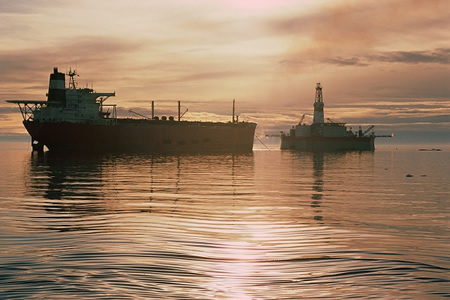
Photo: Oil tanker and offshore drill on ocean.
In its reporting, Platts concluded that with the jump in the Gulf of Mexico, combined with the emergence of two other new oil-production trends, it appears the U.S. has a chance of at least maintaining oil output in the range of five million to six million b/d for some years to come.
The Gulf posted its biggest oil production year in 2002 with 1.556 million b/d, but only 61% of that total came from deepwater. In contrast, this year the MMS projects oil output of 1.213 million b/d with 76% from deepwater as the Gulf ramps toward an expected new oil production record of 1.635 million b/d by 2011.
Besides growth in the Gulf, those other trends involve further development of the Bakken Shale oil play in North Dakota and success by a group of operators now training their onshore exploration sights toward new oil targets at the expense of natural gas.
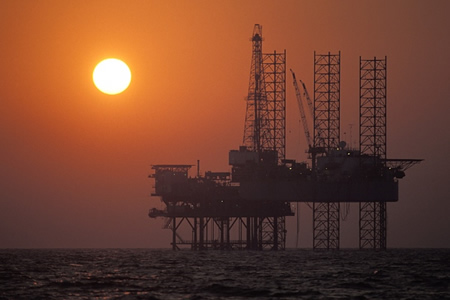
Photo: Oil Rig at Sunset.
As for companies shifting their strategies, that group includes large Houston independent and Bakken pioneer EOG Resources, which has set a goal of shifting from a 70% gas production share to a 50:50 oil and gas mix by 2011 with a comprehensive review of additional potential North American shale oil targets.
This rise in output has helped the U.S. reduce its net imports -- defined as imports less exports, both crude and petroleum products -- by a substantial amount. While there are many factors that go into the United States' net import figure, the decline has been striking, according to EIA data.
And while the drop in U.S. consumption can be seen as accounting for much of that decline, the U.S. also has put more than 140 million barrels of crude oil and products into inventory since the beginning of October 2008, something made possible in part by the rise in crude oil output.
Source: Platts
|GlobalGiants.Com|
Edited & Posted by Editor | 3:39 AM | Link to this Post
November 26, 2009
Vancouver 2010 Olympic Winter Games: Panasonic to Deliver Full Lineup of HD Equipment

Photo: Vancouver 2010 Olympic Winter Games Mascots Quatchi, Sumi and Miga (© VANOC/COVAN).
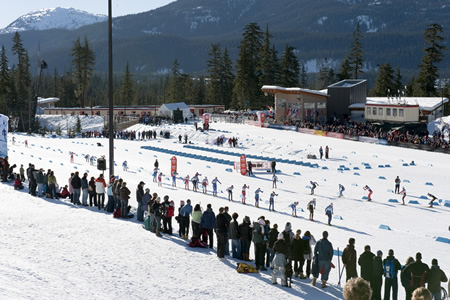
Photo: Vancouver 2010 Olympic Winter Games Whistler Olympic Park (© VANOC/COVAN).
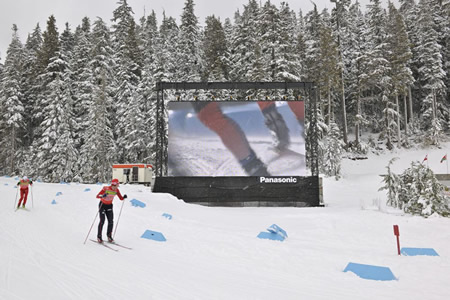
Photo: Panasonic to Deliver Full Lineup of HD Equipment to Vancouver 2010 Olympic Winter Games.
Panasonic Corporation, the Official Worldwide Olympic Partner in the Audio and Visual Equipment category for the Vancouver 2010 Olympic Winter Games, announced it is providing a full lineup of High-Definition (HD) equipment to support the broadcast of the Olympic Games; delivering the largest supply of AV equipment for any Winter Games in the company's history.
Through cooperation with the International Olympic Committee (IOC), the Vancouver Organizing Committee for the 2010 Olympic and Paralympic Winter Games (VANOC) and Olympic Broadcasting Services Vancouver (OBSV), Panasonic will supply its HD video equipment to the competition venues and broadcasting locations, making the Vancouver Games the first Olympic Winter Games to be broadcast completely in HD format.

Following Beijing 2008, all international video signals for the 2010 Winter Games will be produced and distributed in HD format from the International Broadcasting Center (IBC) to rights-holding broadcasters around the world. In addition, the HD video signals will also be used for the first time for display on the LED Large Screen Display Systems in the competition venues and BC Place Stadium where the Opening and Closing Ceremonies will take place; making the 2010 Winter Games the first "HD Olympic Winter Games" with all the Olympic videos to be delivered completely in HD.
In addition, Panasonic will support a safe and secure Olympic operation by providing high-quality picture and high-sensitivity surveillance camera systems for the indoor and outdoor Olympic facilities, the surrounding areas and highways.
Sources: Panasonic Corporation; Vancouver Organizing Committee for the 2010 Olympic and Paralympic Winter Games (VANOC).
|GlobalGiants.com|
"Vancouver 2010 Olympic Winter Games will take place in February 2010. Relevant consumer-oriented businesses targeting audiences in participating countries (especially those in North America) may timely explore this advertising opportunity."
© GlobalGiants.Com. All Rights Reserved.

Edited & Posted by Editor | 8:02 AM | Link to this Post
November 20, 2009
Every GM Vehicle Sold Costs Taxpayers $12,200, Says National Taxpayers Union

The American taxpayer has put up $12,200 for every General Motors vehicle sold through the beginning of 2011, and $7,600 for every Chrysler vehicle sold as well, according to a new report issued by the 362,000-member National Taxpayers Union (NTU).

The report, The Auto Bailout - A Taxpayer Quagmire, is authored by NTU Adjunct Scholar Thomas D. Hopkins, Professor of Economics at Rochester Institute of Technology. Hopkins held senior management positions in two White House agencies during the Ford, Carter and Reagan Administrations. In the early 1980's, he served as Deputy Administrator, Office of Information & Regulatory Affairs, in the Office of Management & Budget.
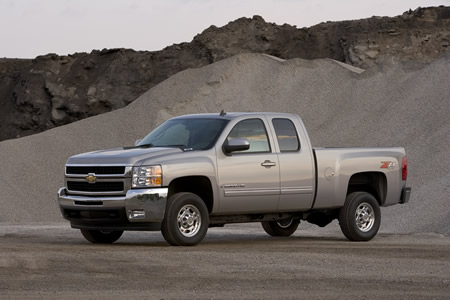
Photo: 2010 Chevrolet Silverado 2500 HD LTZ Extended Cab.
"Every time someone in your neighborhood drives home in a shiny new Chevy Silverado, remember that it cost American taxpayers more than $12,000," said Pete Sepp, NTU Vice President for Policy and Communications.

The study found that the average American taxpaying family has invested roughly $800 in the auto bailouts so far. Moreover, the study found, the government support poured into General Motors, Chrysler, and GMAC - the financing subsidiary that supports sales at both - now stands at $78.9 billion. Given that figure, and an estimate of how many vehicles GM and Chrysler will sell through the end of 2010, the study finds that each vehicle one of the bailed-out companies sells costs taxpayers $10,700.
Finally, breaking down the costs by company, the study reports that every Chrysler vehicle sold costs taxpayers $7,600, and every GM vehicle sold costs taxpayers $12,200.
The research is based upon a November study released by the Government Accountability Office (GAO), entitled "Continued Stewardship Needed as Treasury Develops Strategies for Monitoring and Divesting Financial Interests in Chrysler and GM," a follow-up report on the "Troubled Asset Relief Program," as well as statements and reports released from the U.S. Treasury.
The study also found that during the first ten months of 2009, GM and Chrysler sales fell further than other major auto producers, down 33.4 percent and 38.9 percent, respectively.
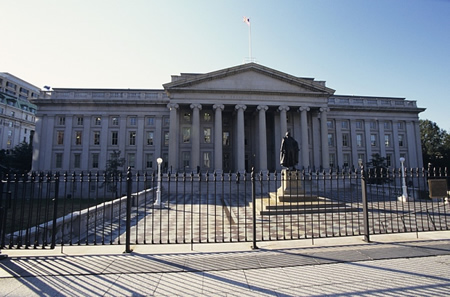
Photo: US Treasury Department, Washington, DC, USA.
"While the prospect of repayment of GM and Chrysler loans might be expected, after bankruptcy the vast majority of the bailout funds are no longer legal obligations of the newly-structured GM and Chrysler," the study concludes. "If Americans are to believe public officials' claims that the government will eventually reprivatize the auto industry, the necessity of a thoughtful exit plan is essential. However, at this time no such plan exists, making it likely that the Treasury will not recover its investment."
Source: National Taxpayers Union, 108 North Alfred St., Alexandria, VA 22314, USA.
|GlobalGiants.Com|
"The names 'GM' and 'General Motors' continue to take a beating.
But the value of the name 'Chevrolet' (as well as that of 'Cadillac' and 'Buick') remains unaffected. It is the same it was 20 or 30 years ago.
If GM had projected 'Chevrolet' as its flagship brand (it may do so even today!), it would have boosted the buyers' confidence in all its brands and nameplates and would have restored the investors' confidence in the company."
© GlobalGiants.Com. All Rights Reserved.
Edited & Posted by Editor | 8:16 AM | Link to this Post
November 14, 2009
PRINCETON HEALTHCARE SYSTEM
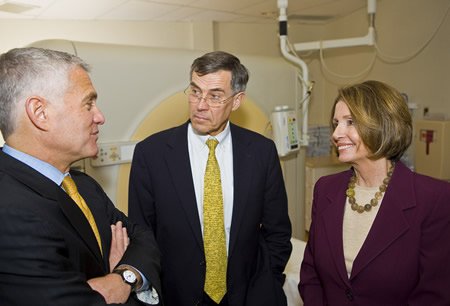
Photo: Speaker of the U.S. House of Representatives Nancy Pelosi and New Jersey Congressman Rush Holt (center) visit a diagnostic imaging suite during a tour of University Medical Center at Princeton today. Speaker Pelosi and Rep. Holt held a press conference at the hospital to discuss the need for healthcare reform in America. Pictured at left is Barry S. Rabner, president and CEO of Princeton HealthCare System. (Photo Credit: Princeton HealthCare System. Photographer: Richard Titus)
|GlobalGiants.Com|
Edited & Posted by Editor | 11:10 PM | Link to this Post
October 28, 2009
Students from Top Academic Institutions Choose The World's Top 50 Most Attractive Employers

Compiled from 11 out of the 12 leading economies, nearly 120,000 students from top academic institutions chose their ideal companies to work for.


Google is the world's most attractive employer, followed closely by its rival, Microsoft. This is the only global index of employer attractiveness and highlights the world's most powerful employer brands, i.e., those companies that are the most successful in talent attraction and retention.
The study has been conducted by Universum. Universum is a global Employer Branding company. It is headquartered in Sweden and has presence in more than 28 countries.
Employers today are faced with a shrinking global workforce, a lack of skilled workers and an increasingly demanding generation of new talent. To secure talent under these conditions, employers must develop true and differentiating employer brands. The employers that feature in this Top 50 all have one thing in common: they successfully appeal to current and future talent, and they are aware of how scarce talent is.

The global ranking is based on the national rankings that Universum conducts annually all over the world. The companies that are featured in at least eight out of the twelve leading economies were included in the global ranking, and the 50 most attractive employers were identified. The countries represented in the Global Top 50 rankings are the US, Japan, China, Germany, France, UK, Italy, Russia, Spain, Canada and India.


• Despite it being one of the toughest years for car manufactures, BMW and Daimler appear in the Global Top 50 rankings.


The Big Four accountancy and professionals service firms; financial services companies and management consultancies, still remain strong. In spite of this year being one of worst recessions since the Second World War, they remain globally attractive employers and are especially popular with business students. IT employers are highly placed in the engineering ranking, which can be expected, with Google, Microsoft and IBM in the top three.


The fast moving consumer goods companies and employers in the retail sector are also attractive employers, recognised for their universal appeal as employers in the graduate recruitment market, attracting students from both a business and engineering background.


"These companies in the Top 50 really work with employer branding strategically. The Big Four, for example, are all in the top 10 business ranking, as they have employer branding as part of their business strategy. Many associate their corporate brands to people. This is normal for the service industry, but it is a new approach for other companies" says Michal Kalinowski, Universum CEO. "These companies are in the Top 50 because they are focused, consistent and differentiate themselves in their communication."
Irrespective of rank, the Top 50 Global Employers for business and engineering students are very similar, showing strong employer brands transcend many skill and industry groups. Conversely, Oracle and Philip Morris make it to the Top 50 for business students, but not for engineering students. GlaxoSmithKline and Alcatel-Lucent appear in the engineering ranking, yet not in the business ranking.
What the rankings most certainly reveal is that the big multinational brands are favored. Due to the globalization of the talent market, multinational companies are generally recognized as being attractive employers. Findings from Universum's various student surveys show that students would like a good career reference, an international career and an employer that can offer secure employment. Lovisa Öhnell, head of research and consulting at Universum, comments, "These multinational brands are globally well-known, they offer relocation opportunities and business travel, interaction with clients and colleagues in various countries, and due to their size and economic strength, they are also seen as being the safest choice."

• GLOBAL TOP 50 - ACCORDING TO BUSINESS STUDENTS
Company - Ranking 2009
Google - 1
PricewaterhouseCoopers - 2
Microsoft - 3
Goldman Sachs - 4
Ernst & Young - 5
Procter & Gamble - 6
J.P. Morgan - 7
KPMG - 8
McKinsey & Company - 9
Deloitte - 10
The Boston Consulting Group - 11
BMW - 12
Coca-Cola - 13
L'Oréal - 14
Morgan Stanley - 15
Sony - 16
IBM - 17
Johnson & Johnson - 18
Deutsche Bank - 19
General Electric - 20
Citigroup - 21
HSBC - 22
Accenture - 23
Nestlé - 24
Credit Suisse - 25
Bain & Company - 26
Unilever - 27
UBS - 28
Nokia - 29
Intel - 30
Esso/ExxonMobil - 31
Kraft Foods - 32
Shell - 33
Hewlett-Packard - 34
Mars (Masterfoods) - 35
Pfizer - 36
Siemens - 37
Philips - 38
Oracle - 39
Bayer - 40
Philip Morris - 41
DHL - 42
BP - 43
Bosch - 44
Cisco - 45
Daimler - 46
Ericsson - 47
ABB - 48
Novartis - 49
Schlumberger - 50



• GLOBAL TOP 50 - ACCORDING TO ENGINEERING STUDENTS
Company Ranking 2009
Google - 1
Microsoft - 2
IBM - 3
BMW - 4
Intel - 5
General Electric - 6
Sony - 7
Siemens - 8
Shell - 9
Procter & Gamble - 10
Johnson & Johnson - 11
Hewlett-Packard - 12
Cisco - 13
Esso/ExxonMobil - 14
McKinsey & Company - 15
Schlumberger - 16
BP - 17
L'Oréal - 18
Nokia - 19
Accenture - 20
Coca-Cola - 21
Philips - 22
Goldman Sachs - 23
Nestlé - 24
Pfizer - 25
Bosch - 26
The Boston Consulting Group - 27
J.P. Morgan - 28
Deloitte - 29
Morgan Stanley - 30
GlaxoSmithKline - 31
Ericsson - 32
Ernst & Young - 33
ABB - 34
Bayer - 35
Unilever - 36
PricewaterhouseCoopers - 37
Deutsche Bank - 38
HSBC - 39
Kraft Foods - 40
Bain & Company - 41
Citigroup - 42
Alcatel-Lucent - 43
Daimler - 44
Novartis - 45
Mars (Masterfoods) - 46
KPMG - 47
Credit Suisse - 48
DHL - 49
UBS - 50
The Global Top 50 rankings are based on the employer preferences of nearly 120,000 final year students, who were surveyed at the top academic institutions in the world's 11 largest economies. The global rankings are based on the annual surveys conducted on a global level in 2009. Each student is presented with a list of 130 to 150 national and international employers, chosen by university students through an independent and structured nomination and assessment process. On a global level, this represents 800 considered employers. Students acknowledge those companies they would consider working for. Out of the companies selected as 'considered employers', each student then selects his or her five Ideal Employers. The Global Top 50 is based on the frequency of being selected as an Ideal Employer overall within 11 markets: US, Japan, China, Germany, France, UK, Italy, Russia, Spain, Canada and India.
• The Global Top 50 is the most comprehensive study ever conducted on employer attractiveness.
• This Practical Global Business Study is being presented for the First Time.
|GlobalGiants.com|

Edited & Posted by Editor | 6:34 AM | Link to this Post
October 10, 2009
The Nobel Peace Prize for 2009 Awarded to President Barack Obama for Diplomacy
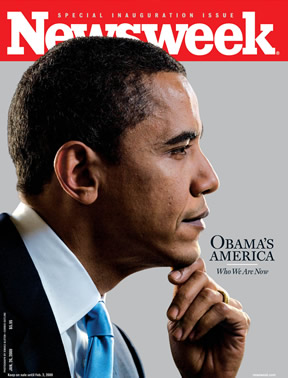
Photo: Newsweek Magazine January 26, 2009 Special Inauguration Issue with President Barack Obama on the cover.
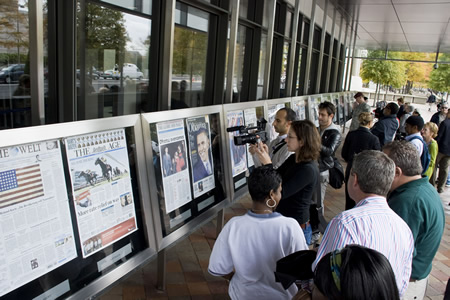

Photo: Visitors crowd outside the Newseum on Pennsylvania Avenue to read a display of newspaper front pages announcing Sen. Barack Obama's election as the 44th U.S. president, November 5, 2008. (Credit: Maria Bryk/Newseum).
• ANNOUNCEMENT FROM THE NORWEGIAN NOBEL COMMITTEE
Oslo, October 9, 2009
The Norwegian Nobel Committee has decided that the Nobel Peace Prize for 2009 is to be awarded to President Barack Obama for his extraordinary efforts to strengthen international diplomacy and cooperation between peoples. The Committee has attached special importance to Obama's vision of and work for a world without nuclear weapons.
Obama has as President created a new climate in international politics. Multilateral diplomacy has regained a central position, with emphasis on the role that the United Nations and other international institutions can play. Dialogue and negotiations are preferred as instruments for resolving even the most difficult international conflicts. The vision of a world free from nuclear arms has powerfully stimulated disarmament and arms control negotiations. Thanks to Obama's initiative, the USA is now playing a more constructive role in meeting the great climatic challenges the world is confronting. Democracy and human rights are to be strengthened.
Only very rarely has a person to the same extent as Obama captured the world's attention and given its people hope for a better future.
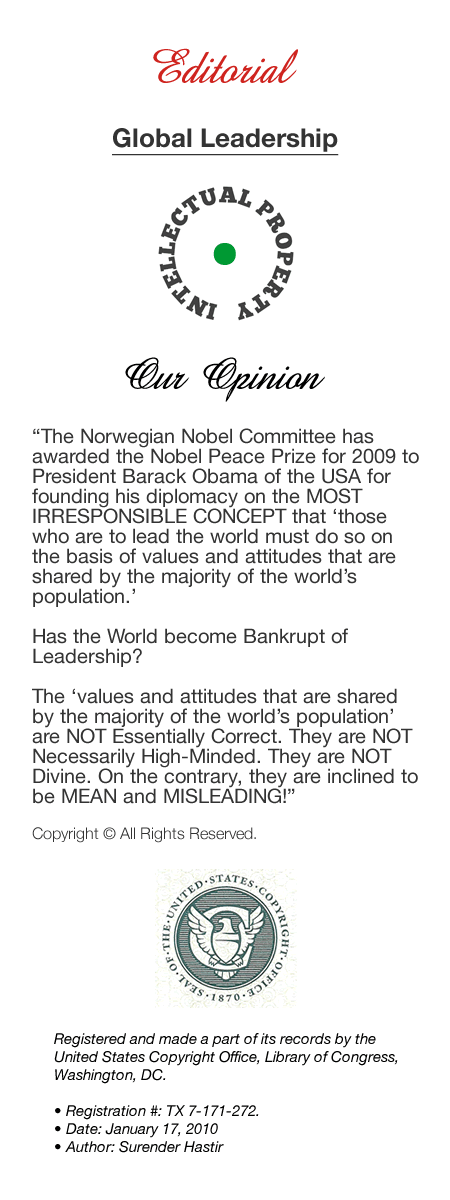
• His diplomacy is founded in the concept that those who are to lead the world must do so on the basis of values and attitudes that are shared by the majority of the world's population.
For 108 years, the Norwegian Nobel Committee has sought to stimulate precisely that international policy and those attitudes for which Obama is now the world's leading spokesman. The Committee endorses Obama's appeal that "Now is the time for all of us to take our share of responsibility for a global response to global challenges."
....................
|GlobalGiants.com|
"The heaven for height, and the earth for depth, and the heart of kings is unsearchable."
-- Proverbs of Solomon: 25:3
"if we desire to secure peace, one of the most powerful instruments of our rising prosperity, it must be known, that we are at all times ready for War."
-- George Washington
"Observe good faith and justice toward all nations. Cultivate peace and harmony with all."
-- George Washington
"My first wish is to see this plague of mankind, war, banished from the earth."
-- George Washington
Edited & Posted by Editor | 9:58 AM | Link to this Post
October 8, 2009
World Economic Forum's Financial Development Report shows global financial centres' lead is weakening
• Signs of weakness emerge among many global financial centers following crisis.
• Developing countries show comparative financial stability, but also potential for improvement in other areas.
• Report analyses 55 financial systems and capital markets around the world.
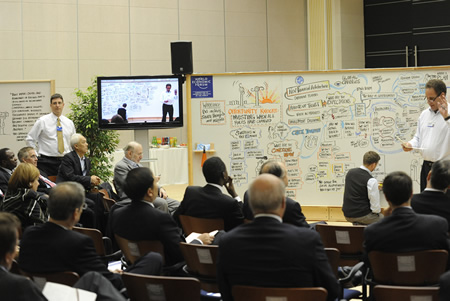
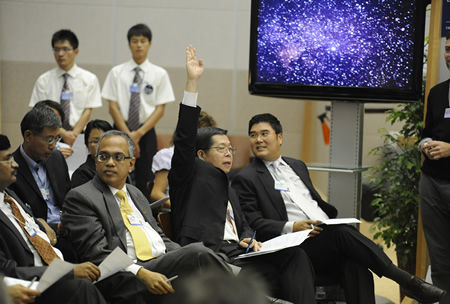
Photos: Participants captured during the Dalian WorkSpace 2009 at the World Economic Forum's Annual Meeting of the New Champions in Dalian, China.
• Financial Development Report 2009 -- New York, USA, 8 October 2009 - The world's largest economies took the biggest hit in the World Economic Forum's second annual Financial Development Report released today.
Global financial centers still lead in the report's Index, but the effects of financial instability have pulled down their scores compared to last year. The United Kingdom, buoyed by the relative strength of its banking and non-banking financial activities, claimed the Index's top spot from the United States, which slipped to third position behind Australia largely due to poorer financial stability scores and a weakened banking sector.
The Financial Development Report ranks 55 of the world's leading financial systems and capital markets. It analyses the drivers of financial system development and economic growth in developed and developing countries to serve as a tool for countries to benchmark themselves and establish priorities for reform.
• Download the 2009 rankings in PDF
• Download the full Report (PDF)
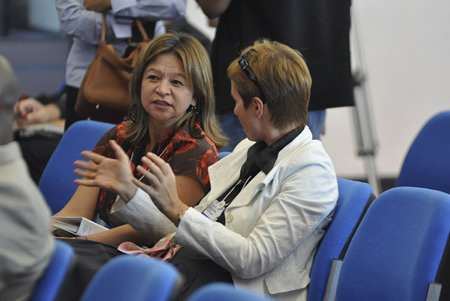
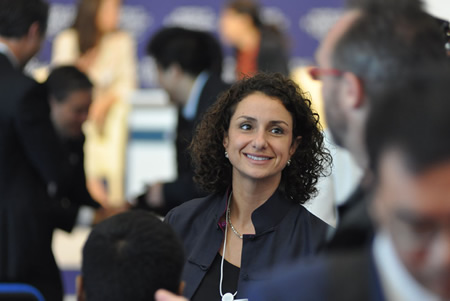
Photos: Participants captured during a session at the Young Global Leaders Summit 2009 in Dalian, China.
The rankings are based on over 120 variables spanning institutional and business environments, financial stability, and size and depth of capital markets, among other factors.
The financial crisis was acutely felt in most global financial systems and caused most countries' scores to drop significantly compared to 2008.
"The change in scores does demonstrate the implications of the downturn on our assessment of the long-term development of financial systems," said Nouriel Roubini of New York University and Chairman, RGE Monitor who is the lead academic on the report.
Germany and France suffered a heavy fall in overall scores that pulled them out of the top 10. They dropped in the rankings but demonstrated financial stability scores that were significantly higher than the United Kingdom and US. Australia showed particular strength this year, a trend that is echoed in many Asia Pacific economies.
The breadth of factors covered in the report means that countries with high financial instability scores like the United Kingdom and US could still achieve a high relative ranking in the Index due to other strengths.
"We hope this report will provide some insight as to how the financial crisis has affected the world's major financial systems. It draws attention to the diversity of factors beyond financial stability that must be addressed to support the role of financial systems in driving economic growth. The United Kingdom and US may still show leadership in the rankings, but their significant drops in score show increasing weakness and imply their leadership may be in jeopardy." said Kevin Steinberg, Chief Operating Officer, World Economic Forum USA.
Some developing countries performed well in the financial stability section of the Index. Chile came in third while Malaysia, Mexico and Brazil are all in the top 15. Norway and Switzerland took the top two spots in this category.
"Developing countries exhibited a relatively strong showing in the financial stability pillar of the Index. For some, this is the result of learning from the mistakes of past financial crises, while for others it may reflect the relative lack of complexity and global integration of their financial systems," said Co-Author Nouriel Roubini.
Developing countries also earned many of the top spots with respect to commercial access, which measures the availability of capital through such means as commercial loans, IPOs and venture capital.
The Industry Partnership Programme of the World Economic Forum, under whose auspices this work was undertaken, provides a platform for the world's leading companies to define and address critical issues. The Financial Development Report benefited from the guidance and support of its Industry Partners with particular contributions from Barclays Capital, EFG Hermes, JPMorgan, Standard Chartered Bank and Troika Dialog.
The report draws on data taken from a variety of publicly available sources such as the World Bank.
Source: World Economic Forum
|GlobalGiants.com|
Edited & Posted by Editor | 10:32 AM | Link to this Post
October 7, 2009
IBM Receives National Medal of Technology and Innovation
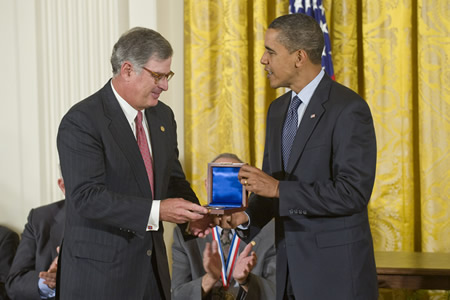
Photo: President Obama recognizes IBM and its Blue Gene family of supercomputers with the National Medal of Technology and Innovation, the most prestigious award of its kind. IBM CEO Sam Palmisano is shown here accepting the award on IBM's behalf on Wednesday, Oct. 7, 2009, in the East Room of the White House in Washington, DC. IBM Blue Gene is one of the world's fastest, most energy-efficient computers, solving challenges in science, medicine, mathematics, astronomy, defense and finance. (Photo Credit: IBM).
|GlobalGiants.com|
Edited & Posted by Editor | 9:59 PM | Link to this Post
September 30, 2009
All-Electric Navistar Truck Unveiled on Capitol Hill
• Navistar Developing Clean Transportation Technologies.

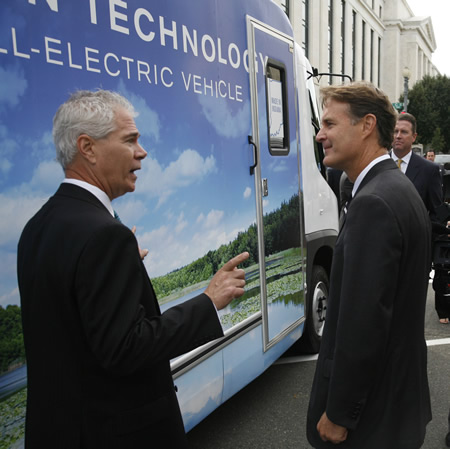
Photo: At the U.S. Capitol today, U.S. Senator Evan Bayh (D-IN), on right, inspects Navistar Inc.'s zero emissions, all-electric delivery truck designed for maximum efficiency in urban environments. With help from a $39 million grant from the U.S. Department of Energy, Navistar Inc. initially will build 400 of these clean technology trucks at its facility in Elkhart, Indiana, and expects to be producing several thousand trucks annually within a few years.
Today, members of the U.S. Congress were shown an all-electric commercial truck from Navistar, Inc. that does not depend on oil.
With the help of a $39 million U.S. Department of Energy grant announced by President Obama in August, Navistar will build these high technology trucks, designed for maximum efficiency in urban environments.
Navistar intends to build 400 all-electric delivery trucks in 2010 at its facility in Elkhart County, Indiana, and expects within a few years to be producing several thousand vehicles annually as the market grows.
"The all-electric commercial truck is a concrete example of advanced technology that will be swiftly brought to market with government incentives, just like diesel-hybrid trucks and school buses," said Greg Elliott, senior vice president, Navistar. "We must continue to invest together for the next generation of advanced vehicles with innovative aerodynamic design and greater hybrid and electric market penetration across the nation."
This zero tailpipe emission electric commercial truck is the latest of Navistar's green vehicle advancements.
Navistar International Corporation is a holding company whose subsidiaries and affiliates produce International brand commercial and military trucks, MaxxForce brand diesel engines, IC Bus™ brand school and commercial buses, Monaco RV brands of recreational vehicles, and Workhorse brand chassis for motor homes and step vans.
|GlobalGiants.com|
Edited & Posted by Editor | 9:30 PM | Link to this Post
September 25, 2009
New York City Green Buildings Program Launch: Building Owners, Union Leader Joined By Mayor Bloomberg
Labor-Management Program to Train 1,000 Building Supers.

Photo: New York Mayor Bloomberg, along with union president Mike Fishman, launched a green building worker training program at an apartment building in Manhattan on Friday, September 25, 2009. The One Year, One Thousand Supers program, said the mayor, "is a smart, practical, effective way to help make the Big apple green.".
New York City Mayor Michael Bloomberg joined Realty Advisory Board President Jim Berg and 32BJ President Mike Fishman today in launching an ambitious green buildings program to train one thousand superintendents and resident managers in one year in the latest energy efficient practices.
The launch of One Year, One Thousand Green Supers, which took place at a downtown apartment building, was attended by Jeff Brodsky, President of Related Management, and James O'Connor, President of Douglas Elliman, two of the first companies to have their employees participate in this labor-management green buildings program.
"By working together, 32BJ and New York's building owners have put into place a smart, practical and effective way to help make the Big Apple green," said Mayor Bloomberg. "One Year, One Thousand Green Supers provides a low-cost way to make our buildings more energy and cost efficient, and our environment cleaner, all while saving our city millions of dollars."
"With 77 percent of our city's greenhouse gas emissions generated by buildings, we must all work together to protect the environment," said Mike Fishman. "Making the Big Apple green starts with recognizing the vital role of building service workers."

• With more than 85,000 members in six states and Washington, DC, SEIU Local 32BJ is the largest property service workers union in the country. The union represents window cleaners, doormen, building maintenance workers, cleaners, porters, and security officers in New York, New Jersey, Philadelphia, Connecticut, Maryland, and Virginia.
• One Year, One Thousand Green Supers is part of the Thomas Shortman Training Fund. The program is a 40 hour class that provides building service workers with the latest, state-of-the-art practices in energy efficient operations. The curriculum trains workers to identify and address wasted energy, create a green operating plan and perform cost-benefit analysis for building owners and managers.
"By learning how to air seal a building, improve heating and air conditioning performance and reduce overall energy use in a building's common areas, graduates can achieve substantial savings at their buildings," said Linda Nelson, Director of the Thomas Shortman Training Fund. The third and final pilot class of building service workers in the program is set to graduate next week.
• The Fund's programs provide 150,000 hours of industry, academic, and computer courses at over 20 locations in New York, New Jersey, Connecticut, Pennsylvania, Virginia, Maryland, and the District of Columbia.
• The One Year, One Thousand Supers curriculum combines classes and field exercises with elective courses, including renewable technologies, green roofs and water reuse.
With a growing demand for greener buildings, smarter management practices could reduce energy use in buildings by twenty to forty percent, according to a report from the U.S. Department of Energy.
Source: SEIU Local 32BJ
|GlobalGiants.com|

Edited & Posted by Editor | 10:46 PM | Link to this Post
September 22, 2009
Clinton Global Initiative: President Barack Obama and President Bill Clinton Address the Opening Plenary Session of the Fifth Annual Meeting

Among others, following are joining President Clinton in Panel Discussion on Global Challenges:
• Michelle Bachelet, President of the Republic of Chile.
• Mike Duke, CEO of Wal-Mart Stores.
• Muhtar Kent, Chairman of the Board and CEO of Coca-Cola.
• Kevin Rudd, Prime Minister of the Commonwealth of Australia.
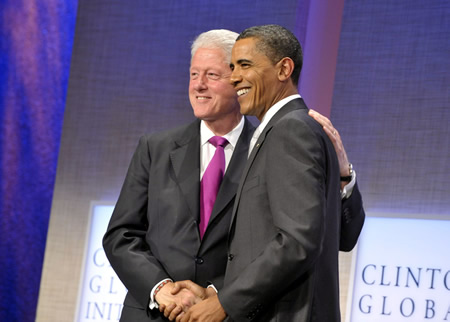
Photo: President Barack Obama and President Bill Clinton Greet Each Other on Stage at the Opening Plenary Session of the Fifth Annual Meeting of the Clinton Global Initiative.
Today, in New York, President Barack Obama joined President Bill Clinton to open the Fifth Annual Meeting of the Clinton Global Initiative.
The meeting is bringing together leaders from the political, corporate, and civil sectors to develop and implement innovative solutions to the world's most pressing problems.
Established in 2005 by President Bill Clinton, the Clinton Global Initiative (CGI) brings together a community of global leaders to devise and implement innovative solutions to some of the world's most pressing challenges.
"This week, even as we gather at the United Nations to discuss what governments can do to confront the challenges of our time, even as we're joined tonight by so many presidents and prime ministers - this Global Initiative reminds us what we can do as individuals: that you don't have to hold public office to be a public servant," President Obama said, adding: "That's the beauty of service - anyone can do it and everyone should try."
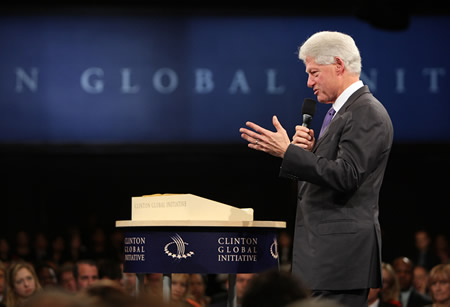
"In the midst of a global financial crisis, I don't think it's a coincidence that more people are attending this meeting than ever before," President Clinton said. "Since 2005, it has become clear that CGI has found an effective model for addressing challenges around the world. Our members have made more than 1,400 commitments affecting more than 200 million people around the world. Because of their efforts, more than 10 million children have access to a better education, 48 million people have better health care, and more than 12 people million have safe drinking water. But there is still work to be done."
President Clinton announced that more than 60 current and former heads of state, 500 business leaders, and 400 leaders from nongovernmental and philanthropic organizations will be attending the meeting, representing 84 countries.
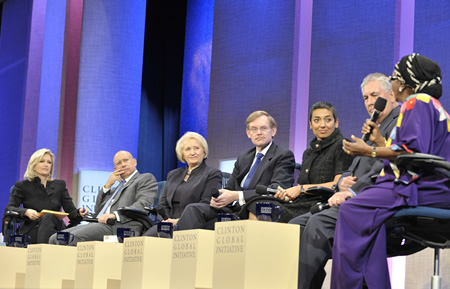
Photo (Added Sep 23): From left: Diane Sawyer moderates panel including Lloyd Blankfein, chairman and CEO of The Goldman Sachs Group, Merlanne Verveer, ambassador-at-large for global women's issues at the U.S. Department of State, Robert Zoellick, president of The World Bank Group, Zainab Salbi, founder and CEO of Women for Women International, Rex Tillerson, chairman and CEO of ExxonMobil, and Edna Adan, director and founder of the Edna Adan Maternity and Teaching Hospital (speaking).
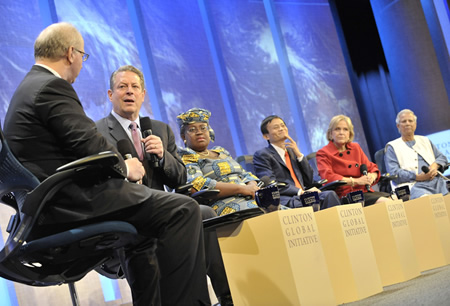
Photo (Added Sept 23): From left to right, Matthew Bishop, New York Bureau Chief and American Business Editor, The Economist, Al Gore, Chairman, The Alliance for Climate Protection, Ngozi Okonjo-Iweala, Managing Director, The World Bank Group, Jack Ma, Chairman and CEO, Alibaba Group, Judith Robin, President, The Rockefeller Foundation, Muhammad Yunus, Founder and Managing Director, Grameen Bank.
Source: Clinton Global Initiative
|GlobalGiants.com|
Edited & Posted by Editor | 11:44 PM | Link to this Post
September 13, 2009
New Global Reserve Currency
• The international monetary system needs reform, but so do the Asian and US economies.

According to thought leaders from the principal world economies, the current international monetary system, reliant on the US dollar, is deeply flawed, but a single viable alternative is not readily apparent.
This was the outcome from the debate at the Annual Meeting of the New Champions on September 12, 2009 at Dalian, People's Republic of China, where they discussed the global currency reserve system.
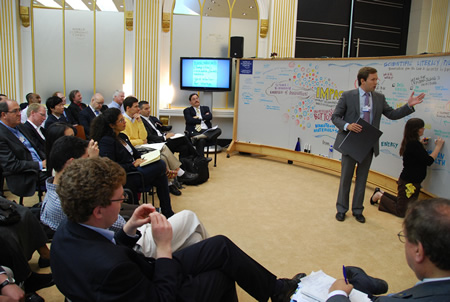
Photo: Participants captured during the Dalian WorkSpace 2009 at the World Economic Forum's Annual Meeting of the New Champions in Dalian, China 10-12 September 2009. © World Economic Forum.
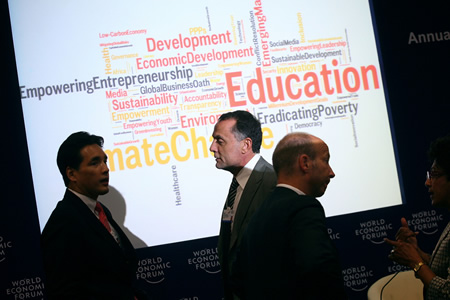
Photo: Participants gather at the Education for the Next Wave of Growth session at The World Economic Forum Annual Meeting of the New Champions in Dalian, China 10-12 September 2009. © World Economic Forum.
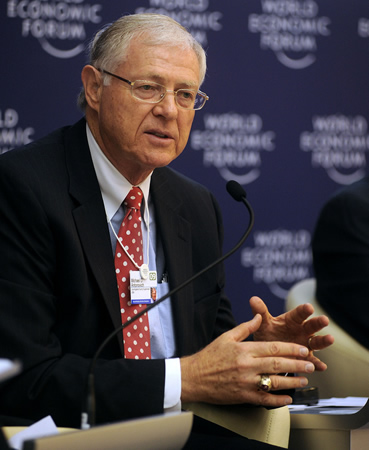
Photo: Michael D. Antonovich, Los Angeles County Supervisor, speaks during the North America's Economic Outlook session at The World Economic Forum Annual Meeting of the New Champions in Dalian, China 10-12 September 2009. © World Economic Forum.
• In March, China's Central Bank Governor Zhou Xiaochuan sparked controversy when he proposed that the International Monetary Fund create a new reserve currency - a proposal with enormous implications across Asia, which holds nearly US$ 4 trillion in foreign currency.
"I strongly supported the proposal made by Governor Zhou," said Yu Yongding, Senior Fellow, Institute of World Economics and Politics, Chinese Academy of Social Sciences (CASS), People's Republic of China and member of the Forum's Global Agenda Council on International Monetary Systems.
However, panelists agreed that the creation of a new global currency to replace the dollar and other sovereign currencies was not politically viable.
The overwhelming problems facing the Asian and US economies are not based on currency doubts. "Don't kid yourself. This crisis is not about currency problems. This problem is about the failures of policies," said Stephen S. Roach, Chairman, Asia, Morgan Stanley, Hong Kong. "We've had central banks that have just gone along for the ride, driven by ideologies, driven by politics."
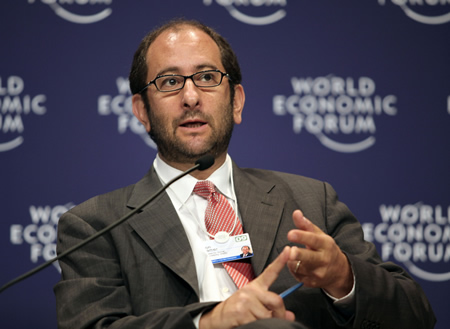
Photo: Aron Cramer, President and Chief Executive Officer, Business for Social Responsibility (BSR), speaks during the Global Redesign Series -- What Is the Basis of a New Social Compact? session at The World Economic Forum Annual Meeting of the New Champions in Dalian, China 10-12 September 2009. © World Economic Forum.
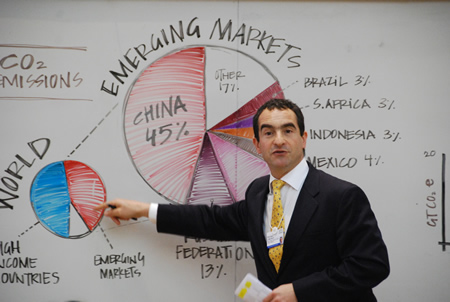
Photo: Participants captured during the Dalian WorkSpace 2009 at the World Economic Forum's Annual Meeting of the New Champions in Dalian, China 10-12 September 2009. © World Economic Forum.
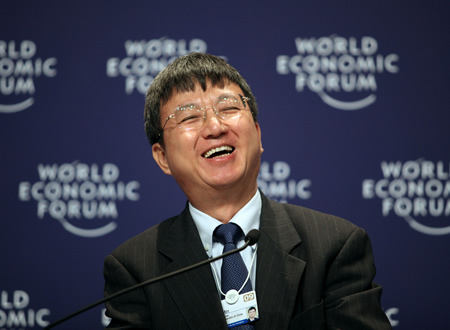
Photo: Zhu Min, Group Executive Vice-President, Bank of China, laughs during The Global Economic Outlook session at The World Economic Forum Annual Meeting of the New Champions in Dalian, China 10-12 September 2009. © World Economic Forum.
For the global financial system to steady itself, the US must increase exports and Asian economies, China's in particular, must do much more to reorient their growth away from external demand towards domestic consumption. "The most important thing for China is to speed up structural reform," agreed Yu.
When polled informally, participants preferred the yuan over the dollar as an investment but few believed it would replace the dollar as the global reserve. Among the panelists, only Oki Matsumoto, Founder and Chief Executive Officer of Japan's Monex Group, was mildly bullish on the dollar.
The World Economic Forum is an independent international organization committed to improving the state of the world by engaging leaders in partnerships to shape global, regional and industry agendas.
Source: World Economic Forum
|GlobalGiants.com|
Edited & Posted by Editor | 3:55 AM | Link to this Post
September 8, 2009
World Economic Forum's Global Competitiveness Rankings: Switzerland Replaces United States at the Top
• Switzerland leads the rankings of the World Economic Forum's Global Competitiveness Report 2009-2010.
• The United States falls to second place, with weaker financial markets and less macroeconomic stability.
• Singapore moves up to third; Brazil, China and India also post improvements.
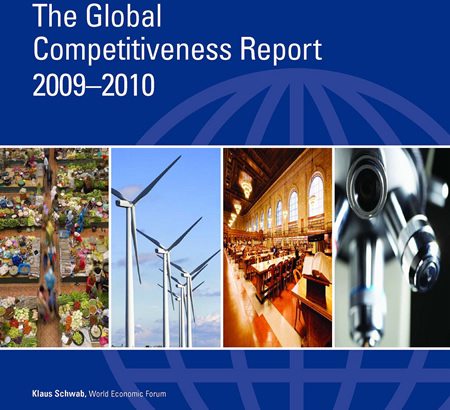
Photo: COLOGNY, SWITZERLAND - Cover of the World Economic Forum's The Global Competitiveness Report 2009-2010. © World Economic Forum.
• Download the full Report (PDF)
• Get the Highlights of the Report (PDF)
Switzerland tops the overall ranking in The Global Competitiveness Report 2009-2010, released today (September 8, 2009) by the World Economic Forum ahead of its Annual Meeting of the New Champions 2009 in Dalian, People's Republic of China.
The United States falls one place to second position, with weakening in its financial markets and macroeconomic stability. Singapore, Sweden and Denmark round out the top five. European economies continue to prevail in the top 10 with Finland, Germany and the Netherlands following suit. The United Kingdom, while remaining very competitive, has continued its fall from last year, moving down one more place this year to 13th, mainly attributable to continuing weakening of its financial markets.
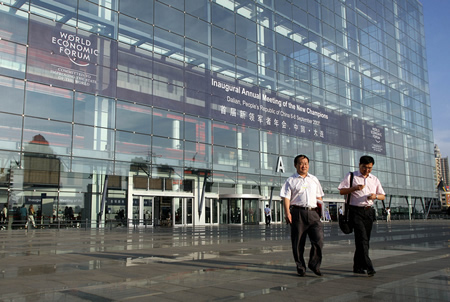
Photo: People exit the World Expo Center at the World Economic Forum's Inaugural Meeting of the New Champions in Dalian, China on 5 September 2007. (Handout Photo/World Economic Forum/Doug Kanter).
The People's Republic of China continues to lead the way among large developing economies, improving by one place this year, solidifying its position among the top 30. Among the three other large BRIC economies, Brazil and India also improve, while Russia falls by 12 places. Several Asian economies perform strongly with Japan, Hong Kong SAR, Republic of Korea and Taiwan, China also in the top 20. In Latin America, Chile is the highest ranked country, followed by Costa Rica and Brazil.
A number of countries in the Middle East and North Africa region are in the upper half of the rankings, led by Qatar, United Arab Emirates, Israel, Saudi Arabia, Bahrain, Kuwait and Tunisia, with particular improvements noted in the Gulf States, which continue their upward trend of recent years. In sub-Saharan Africa, South Africa, Mauritius and Botswana feature in the top half of the rankings, with a number of other countries from the region measurably improving their competitiveness.
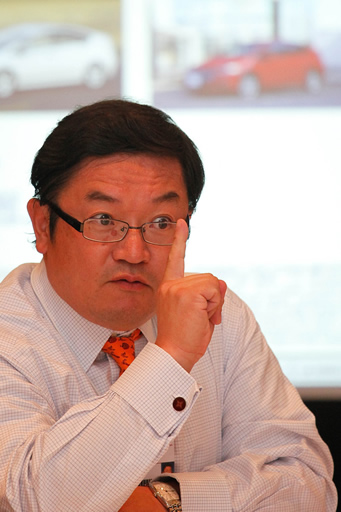
Photo: SEOUL, SOUTH KOREA - Koji Endo, Director, Equity Research, Credit Suisse Securities (Japan) Limited, Credit Suisse, Japan during the Joint Automotive and Logistics & Transport - World Economic Forum on East Asia 2009. © World Economic Forum. Photo by Oh Jaehyuk.
"The strong interdependence among the world's economies makes this a truly global economic crisis in every sense. Policy-makers are presently struggling with ways of managing these new economic challenges, while preparing their economies to perform well in a future economic landscape characterized by growing uncertainty. In a difficult global economic environment, it is more important than ever for countries to put into place strong fundamentals underpinning economic growth and development," said Klaus Schwab, Founder and Executive Chairman of the World Economic Forum.
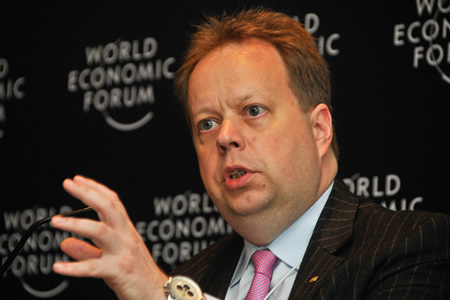
Photo: SEOUL, SOUTH KOREA - Andy Palmer, Senior Vice-President, Nissan Motor Co., Japan - captured during the World Economic Forum on East Asia in Seoul, South Korea, June 19, 2009. © World Economic Forum. Photo by Oh Jaehyuk.
The Global Competitiveness Report is based on 12 pillars of competitiveness, providing a comprehensive picture of the competitiveness landscape in countries around the world at all stages of development. The pillars include Institutions, Infrastructure, Macroeconomic Stability, Health and Primary Education, Higher Education and Training, Goods Market Efficiency, Labour Market Efficiency, Financial Market Sophistication, Technological Readiness, Market Size, Business Sophistication, and Innovation.
The Report contains a detailed profile for each of the 133 economies featured in the study, providing a comprehensive summary of the overall position in the rankings as well as the most prominent competitive advantages and disadvantages of each country/economy based on the analysis used in computing the rankings.
Source: World Economic Forum
|GlobalGiants.com|
Edited & Posted by Editor | 12:42 PM | Link to this Post