
























« March 30, 2020 | Main | April 2, 2020 »
March 31, 2020
Importance of Masks for Curbing the Spread of Coronavirus: Government of India issues a Manual on Home-made Masks.
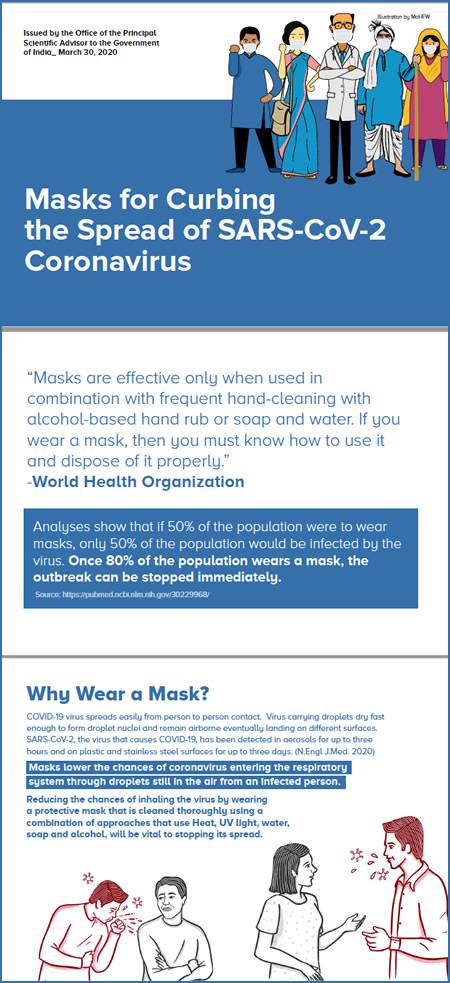

New Delhi, March 31, 2020 — The Ofï¬ce of the Principal Scientiï¬c Advisor to the Government of India has issued a detailed manual on home-made masks: “Masks for Curbing the Spread of SARS-CoV-2 Coronavirus”.
Quoting the World Health Organization, the manual states that “Masks are effective only when used in combination with frequent hand-cleaning with alcohol-based hand rub or soap and water. If you wear a mask, then you must know how to use it and dispose of it properly.”
• “Analyses show that if 50% of the population were to wear masks, only 50% of the people would get infected by the virus. Once 80% of the population wears a mask, the outbreak can stop immediately.”
On Why Wear a Mask?, it says that the “COVID-19 virus spreads easily from person to person contact. Virus carrying droplets dry fast enough to form droplet nuclei and remain airborne, eventually landing on different surfaces. The SARS-CoV-2 virus causing COVID-19 has been detected in aerosols for up to three hours and on plastic and stainless steel surfaces for three days.”
The guidebook says that Masks lower the chances of coronavirus entering the respiratory system through droplets still in the air from an infected person. According to the manual, reducing the chances of inhaling the virus by wearing a disposable mask, or a home-made protective cover cleaned thoroughly using a combination of heat, UV light, water, soap, and alcohol, will be vital to stopping its spread.
The manual provides a simple outline of best practices to make, use, and reuse masks. Wearing of masks is especially recommended for people living in densely populated areas across India.
• View or Download the Manual.
Meanwhile, the Association of State and Territorial Health Officials (ASTHO), USA, has issued the following statement on the use of face coverings by the general public to prevent the spread of COVID-19.
“Potential spread of COVID-19 by pre- and asymptomatic individuals is a significant concern as we look to prevent COVID-19 infections and reduce transmissions. Policies to adopt the widespread use of face coverings by the general public are a potential intervention to slow the spread of COVID-19.
“State and territorial health officials’ primary goal in the COVID-19 response is to mitigate and suppress the spread of COVID-19 so that communities may re-open, recover, and rebound. Despite insufficient evidence on the use of face coverings by the general public to reduce transmission of COVID-19, the widespread use of face coverings by the public as a tactic may help achieve these goals. The use of face coverings should be a complementary strategy for existing or new mitigation efforts. Covers should not be seen as a replacement for physical distancing measures and self-isolation when sick. Also, officials should ensure that the widespread use of face coverings does not adversely or unintentionally impact mask supply for healthcare, public health workers, and others on the front lines of the COVID-19 response.
“Finally, clear instructions should be provided to the public in appropriate literacy levels and multiple languages on face-covering use, as well as recommendations for cleaning and disposal.”
ASTHO is the US national nonprofit organization representing the public health agencies of the United States. It also represents more than 100,000 public health professionals these agencies employ.
|GlobalGiants.Com|

Various local administrations worldwide may contemplate making wearing a mask mandatory during the COVID-19 pandemic.
Reducing the chances of exhaling or inhaling the virus by wearing a mask is crucial to arrest its spread.


Edited & Posted by the Editor | 2:37 PM | View the original post
Researchers at Three Institutions receive COVID-19 Therapeutics Accelerator Grants to Study Drugs for Treating and Preventing COVID-19.
PURCHASE, NY - March 30, 2020 - Today, the partners in the COVID-19 Therapeutics Accelerator announced grants of $20 million to three institutions—the University of Washington, University of Oxford, and La Jolla Institute for Immunology—to fund clinical trials to identify highly potent immunotherapies for the COVID-19 pandemic.
These grants mark the first investments to come from the COVID-19 Therapeutics Accelerator, a large-scale initiative launched by the Bill & Melinda Gates Foundation, Wellcome, and Mastercard to speed the development of and access to therapies for COVID-19. Currently, there are no broad-spectrum antivirals or immunotherapies available to prevent or treat COVID-19.
“These grants to leading institutions in their fields will advance our understanding of how existing drugs and antibodies can contribute to addressing the pandemic we’re facing around the world,” said Mark Suzman, chief executive officer of the Bill & Melinda Gates Foundation. “These initial investments through the COVID-19 Therapeutics Accelerator will bring rigor to the study of these potential solutions. The way forward will be informed by sound science and shared data.”
Also, newly announced funding from government and philanthropic donors has added to the Accelerator’s initial funding. The Chan Zuckerberg Initiative committed $25 million, and the U.K. government invested £40 million last week. The additional funds will allow the Accelerator to continue making grants to study repurposed drugs and investigate biological compounds for activity against COVID-19.
The researchers will investigate two well-established drugs, hydroxychloroquine and chloroquine. Both these drugs have known antiviral properties. These drugs treat malaria and a variety of rheumatological conditions. The trials aim to determine whether the drugs are effective as pre- and post-exposure preventive therapy for COVID-19. While these drugs both show initial promise, rigorous scientific evidence is needed to make decisions on how, where, and within which populations to use them in this pandemic.
The University of Washington will conduct a multi-site clinical trial in Western Washington and the New York City area, in collaboration with New York University’s School of Medicine, investigating whether hydroxychloroquine can effectively prevent COVID-19 in people already exposed to the infection. The trial will enroll up to 2,000 asymptomatic men and women who are close contacts of persons with confirmed or pending COVID-19 diagnoses. Participants will be randomly assigned to take hydroxychloroquine or a placebo over two weeks, and samples will be collected and tested daily to confirm new COVID-19 infections across the two groups. Sandoz, a Novartis division, has donated the hydroxychloroquine doses needed to conduct the study. Participant enrollment will begin in April.
The University of Oxford will lead a study of chloroquine and hydroxychloroquine in preventing COVID-19 in at-risk health care workers, frontline staff, and other high-risk groups. More than 40,000 participants in Asia and Europe would receive the drugs as daily prophylaxis for three months. The project, known as COPCOV, aims to determine definitively whether these drugs can prevent COVID-19 and thus protect the vital health care workforce. Participant enrollment will begin in April.
Nick Cammack, COVID-19 Therapeutics Accelerator Lead at Wellcome, said: “Investment in research is the world’s only exit strategy from COVID-19. Drugs, vaccines, and diagnostics are vital for saving lives, ending this pandemic, and preventing it from happening again. Now is the time to evaluate whether existing drugs will prove to be safe and effective. We urge others to join us in this collective global effort. Investing now in the COVID-19 Therapeutics Accelerator is necessary if we are to change the course of this pandemic.”
In addition to funding drug trials, the Accelerator will provide $1.73 million to the La Jolla Institute for Immunology to establish a Coronavirus Immunotherapy Consortium, known as CoVIC. The effort will bring together scientists from around the world and enable them to share and evaluate candidate antibodies side by side in a blinded, multidisciplinary analysis to identify ideal therapeutic combinations. Antibody therapies protect frontline health care workers, contacts, and others who are exposed, as well as treat those who have already become sick.
“Today’s grants are an important next step in the Therapeutic Accelerator’s commitment to identifying and scaling treatments to combat COVID-19,” said Mike Froman, vice chairman of Mastercard. “To provide therapeutic solutions to this global pandemic, particularly for those most vulnerable, we need to speed up the research and development process through a collaborative funding effort by the private sector, philanthropic organizations, and governments. We welcome the participation of new organizations that can contribute the resources needed to help bring an end to this crisis.”
|GlobalGiants.Com|
Edited & Posted by the Editor | 2:55 AM | View the original post