























« January 23, 2021 | Main | January 26, 2021 »
January 25, 2021
Daimler Trucks unveils BharatBenz Reefer Truck for Vaccine Transportation in India.
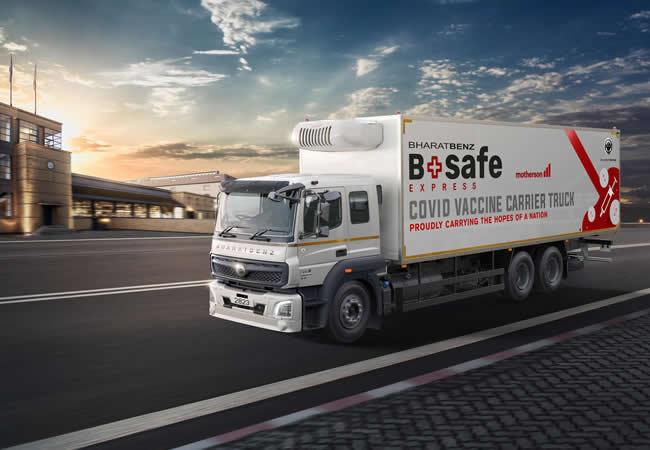
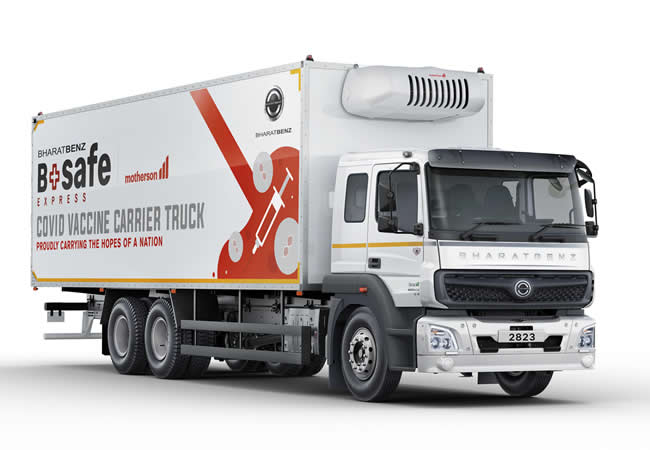

Photos: Daimler Trucks unveils BharatBenz Reefer Truck for Vaccine Transportation in India. Images provided by Daimler AG.
Chennai, India / Stuttgart, Germany, January 25, 2021 — Daimler India Commercial Vehicles (DICV) has unveiled the BharatBenz’ BSafe Express’, a specialized reefer truck designed for the safe transportation of COVID-19 vaccines. Equipped with state-of-the-art connectivity, the BSafe Express uses newly developed refrigeration units to ensure the vaccines’ temperature and stability are accurately monitored and maintained at all delivery stages. The reefer is mounted on the BharatBenz 2823R heavy-duty chassis.
Mr. Satyakam Arya, Managing Director, and CEO, Daimler India Commercial Vehicles, was present at the truck’s premiere in the Indian capital Delhi. According to him, “The combination of a strong, reliable chassis with a lightweight, insulated reefer and state-of-the-art connectivity device makes BharatBenz’s ‘BSafe Express’ the perfect solution to India’s cold-chain infrastructure challenge. With this truck, we can deliver vaccines in perfect condition to even the most remote destinations, bringing the hope of a return to normalcy to over 1.3 billion people.”
India has recently started its corona vaccination campaign to vaccinate 300 million people by July 2021. The BharatBenz BSafe Express offers a solution to Indian logistics companies to contribute to the nation’s goal of bringing COVID under control as quickly as possible. A daunting challenge in the second-most populous country in the world.
• Refrigerated container and digital solutions enable quick and safe transportation of vaccines across India.
Automotive system solutions provider Motherson Group supplies the refrigerated container. It is made from Glass Reinforced Plastic, XPS Foam, and other carefully-chosen materials that ensure the product is strong, water-resistant, and non-corrosive, yet lightweight and highly insulated. The container can be assembled locally in as little as 96 hours, making it a much more practical solution than conventional products, which can take three or more weeks to deliver.
With purpose-built IoT sensors integrated inside the container, fleet managers can monitor temperature, humidity, shock, tilt, and tamper. They can also adjust the temperature as required and sound the alarm if a problem occurs. It further integrates with QR Code tracking of all stock on board so that users can check the location, status, and history of each package. Paired with BharatBenz’s ‘Truckonnect’ telematics platform, the BSafe Express offers vaccine distributors absolute peace of mind with real-time tracking of both the vehicle and its precious cargo.
Source: Daimler AG
|GlobalGiants.Com|


Edited & Posted by the Editor | 1:17 PM | View the original post
UNCTAD Global Investment Trends Monitor: Global Investment down 42% in 2020, Further Weakness expected in 2021.
• UNCTAD has published its 38th Global Investment Trends Monitor.

Photo: Mia Mikic, speaking at UNCTAD’s Non-tariff Measures Week, held at the Palais des Nations, Geneva. 14 October 2019. Photo: Tim Sullivan (UNCTAD).
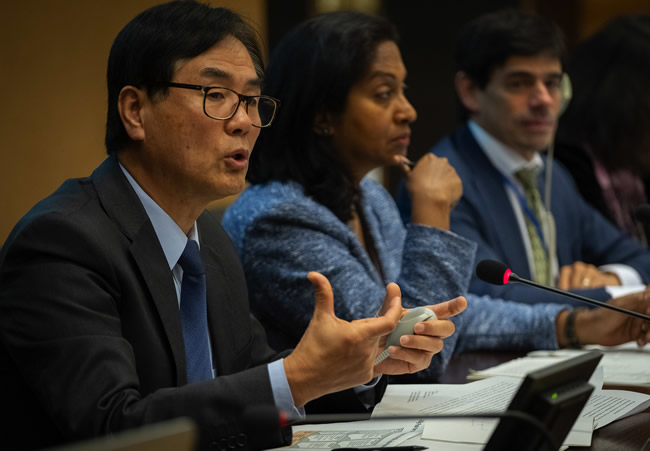
Photo: James Zhan, director of UNCTAD’s division on investment and enterprise. Speaking at the UNCTAD Investment and Enterprise Commission on 11 November 2019 in Geneva, Switzerland. Photo: Tim Sullivan (UNCTAD).
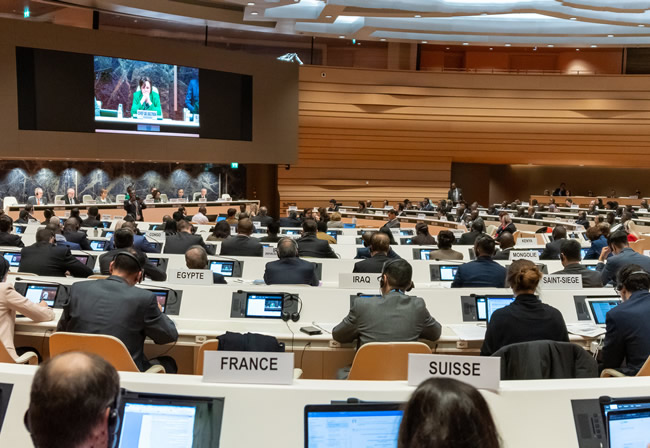
Photo: UNCTAD Debt Management Conference. UNCTAD held its 12th Debt Management Conference at the Palais des Nations in Geneva, Switzerland, from 18 to 20 November 2019. Photo: Jean-Philippe Escard (UNCTAD).
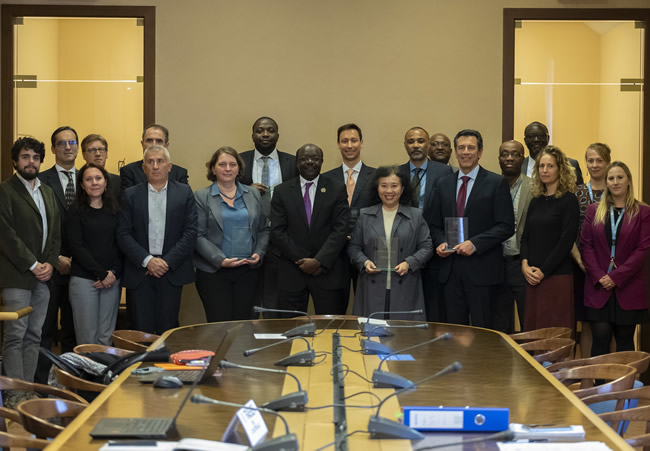
Photo: UNCTAD Centres of Excellence workshop. UNCTAD held its annual Centers of Excellence strategic meeting in Geneva, Switzerland. 29 October 2019. UNCTAD Centers of Excellence serve as network hubs for capacity building in the African and Asian regions. Photo: Tim Sullivan (UNCTAD).
Geneva, 25 January 2020 - Global foreign direct investment collapsed in 2020, falling by 42% to an estimated $859 billion from $1.5 trillion in 2019. FDI finished 2020, more than 30% below the trough after the global financial crisis in 2009 and back at a level last seen in the 1990s.
The decline was concentrated in developed countries, where FDI flows fell by 69% to an estimated $229 billion. Flows to Europe dried up entirely to -4 billion, including large negative flows in several countries. The United States recorded a sharp decrease (-49%) to $134 billion.
The relative decline in developing economies was -12% to an estimated $616 billion. The share of developing economies in global FDI reached 72% - the highest percentage on record. China topped the ranking of the largest FDI recipients.
The fall in FDI flows across developing regions was uneven, with -37% in Latin America and the Caribbean, -18% in Africa, and -4% in developing countries in Asia. East Asia was the largest host region, accounting for one-third of global FDI in 2020. FDI to transition economies declined by 77% to $13 billion.
• Trends in selected economies
FDI in China, where the early phase of the pandemic caused steep drops in capital expenditures, ended the year with a small increase (+4%).
FDI in India rose by 13%, boosted by investments in the digital sector.
FDI in ASEAN - an engine of FDI growth throughout the last decade - was down 31%.
The halving of FDI inflows to the United States resulted from sharp drops in both greenfield investment and cross-border mergers and acquisitions (M&As).
FDI in the EU fell by two thirds, with significant declines in all the largest recipients; flows to the United Kingdom decreased to zero.
• FDI trend expected to remain weak in 2021
The FDI trend may remain weak in 2021. Data on an announcement basis, an indicator of trends, provides a mixed picture and point at continued downward pressure:
Sharply lower greenfield project announcements (-35% in 2020) suggest a turnaround in industrial sectors is not yet in sight.
Upticks in the fourth quarter of 2020 dampened earlier declines in newly announced international project finance deals (-2% for the full year). Thus, international investment in infrastructure sectors could prove more decisive, also buoyed by economic support packages in developed countries.
Similarly, the 2020 decline in cross-border M&As (-10%) was cushioned by higher values in the last part of the year. Looking at M&A announcements, intense deal activity in technology and pharmaceutical industries may push M&A-driven FDI flows higher.
For developing countries, the trends in greenfield and project finance announcements constitute a significant concern.
Although overall FDI flows in developing economies appear relatively resilient, greenfield announcements fell by 46% (-63% in Africa; -51% in Latin America and the Caribbean, and -38% in Asia) and international project finance 7% (-40% in Africa).
These investment types are crucial for the productive capacity and infrastructure development and thus for sustainable recovery prospects.
Risks related to the latest pandemic wave, the pace of the roll-out of vaccination programs and economic support packages, fragile macroeconomic situations in major emerging markets, and uncertainty about the global policy environment for investment will all continue to affect FDI in 2021.
Source: UNCTAD
|GlobalGiants.Com|
Edited & Posted by the Editor | 5:09 AM | View the original post