
























« November 8, 2021 | Main | November 11, 2021 »
November 9, 2021
Audrey Azoulay Re-elected as the Head of UNESCO with Massive Support.
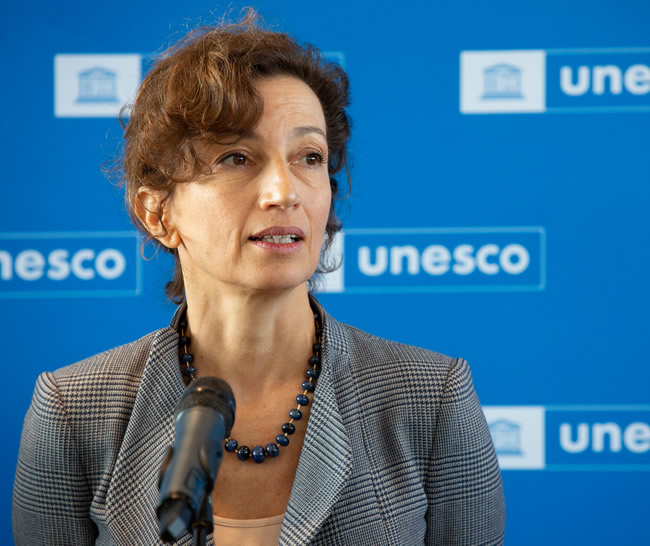
Photo: UNESCO Director-General, Audrey Azoulay. Image provided by & Copyright © UNESCO/Christelle ALIX.
Paris, November 9, 2021 — Audrey Azoulay was re-elected Tuesday to the post of Director-General of UNESCO with the massive support of the Organization’s 193 Member States.
Ms. Azoulay’s re-election took place in a spirit of consensus with the overwhelming backing of UNESCO Member States, obtaining 155 votes out of a total of 169 ballots cast.
“I see this result as a sign of regained unity within our Organization. Over the last four years, we have been able to restore confidence in UNESCO, and in some respects, this has also been about restoring UNESCO’s confidence in itself. First, we regained serenity by reducing the political tensions that stood in our way and looking for common positions on divisive subjects. We were then able to develop a shared ambition, notably by reconnecting with the tradition of leading major operations in the field,” Audrey Azoulay said.
Over the past four years, UNESCO has undergone a significant modernization process to improve the efficiency of its actions.
During the COVID-19 pandemic, while hundreds of millions of children and adolescents lost their right to learn, UNESCO once again proved its ability to establish the Global Education Coalition, which made it possible to ensure educational continuity in 112 countries.
Source: UNESCO
|GlobalGiants.Com|


Edited & Posted by the Editor | 2:56 PM | View the original post
India's Transition to a Green Economy Presents a $1 Trillion Opportunity.
A new study by the World Economic Forum presents a sectoral roadmap for India to accelerate decarbonization and drive global climate action efforts.
According to the report, India’s transition to a net-zero economy could create over 50 million jobs and contribute more than $1 trillion in economic impact by 2030.
As the economy transitions from agrarian and service-led towards manufacturing-led growth, India has an opportunity to accelerate its transition to a net-zero and green economy.
Geneva, Switzerland, 8 November 2021 - As consensus emerges on the urgency and magnitude of the transformation needed to decarbonize the global economy, India’s role and contributions will be critical if the world is to achieve current targets.
World Economic Forum today released a new report outlining how India’s path to decarbonization will have an estimated economic impact of over $1 trillion by 2030 and around $15 trillion by 2070.
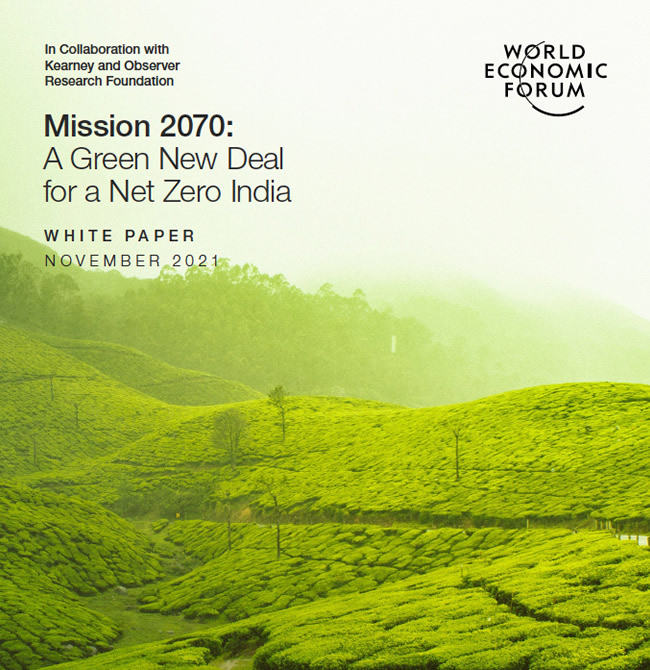
The Mission 2070: A Green New Deal for a Net-Zero India report provides a roadmap for India’s transition to a low-carbon economy as it moves from agriculture and services to manufacturing and a greener economy.
Published in collaboration with Kearney and the Observer Research Foundation, the report underlines the potential to save lives, catalyze new industries, create jobs, and boost India’s contributions to addressing climate change.
At the ongoing United Nations Climate Change Conference (COP26) in Glasgow, Prime Minister Modi has committed India to an ambitious five-part Panchamrit pledge.
“How India continues to deliver growth and energy security to its citizens while ensuring the transition to a net-zero and green economy? That will define our collective success in the global fight against climate change,” said Sriram Gutta, Deputy Head, India, and South Asia, World Economic Forum. “We are calling on the government, businesses, and civil society to work with us to accelerate climate action and ensure a future that is good for both people and the planet.”
The report highlights five sectoral pillars and four cross-sectoral enablers for India to maximize the opportunities presented by a Green New Deal, with the potential to create more than 50 million net new jobs and over $15 trillion in economic value by 2070.
The five pillars - energy, mobility, industry, infrastructure and cities, and agriculture - contribute to over 90% of India’s greenhouse gas emissions. According to the report, India will need to address these pillars, alongside four cross-sectoral enablers, as part of its green transition.
These enablers are an accelerated approach to green technology innovation, an overarching framework to catalyze green finance, an integrated approach to carbon, capture, utilization, storage, and climate adaptation plan. The five pillars and four enablers are dependent on India’s continued economic growth, driven by technological development, financial innovation, and strong political leadership.
“This report visualizes India becoming the world’s first $5 trillion and after that $10 trillion ‘off carbon economy”, said Samir Saran, President, Observer Research Foundation. “In the decade ahead, we will all need to work together on sectoral and geographical pathways to build a green subcontinent.”
“India needs to action two transformations: an economic transformation to drive prosperity and a green transformation to drive sustainability. However, our research indicates that the two need not conflict. On the contrary, India’s green transition might be the most viable way to fuel its economic aspirations,” said Viswanathan Rajendran, Partner, Kearney India.
A Green New Deal for India will need all stakeholders - government, the private sector, investors, and civil society - to step forward and catalyze the next green revolution. India has an opportunity to take bold action to achieve robust, equitable, and shared growth and avert the worst impacts of a changing climate.
The report aims to serve as a framework for a collaborative effort across the World Economic Forum, Kearney, and the Observer Research Foundation to accelerate climate action in key sectors of the Indian economy. Together, these organizations will work closely with relevant stakeholders in India to generate new insights, help inform discussions and policy frameworks, and facilitate new partnerships.
Source: World Economic Forum
|GlobalGiants.Com|
Edited & Posted by the Editor | 9:14 AM | View the original post
Prime Minister Narendra Modi delighted over Srinagar joining UNESCO Creative Cities Network (UCCN)
• UNESCO Creative Cities Network designates Srinagar a Creative City of Craft and Folk Arts.
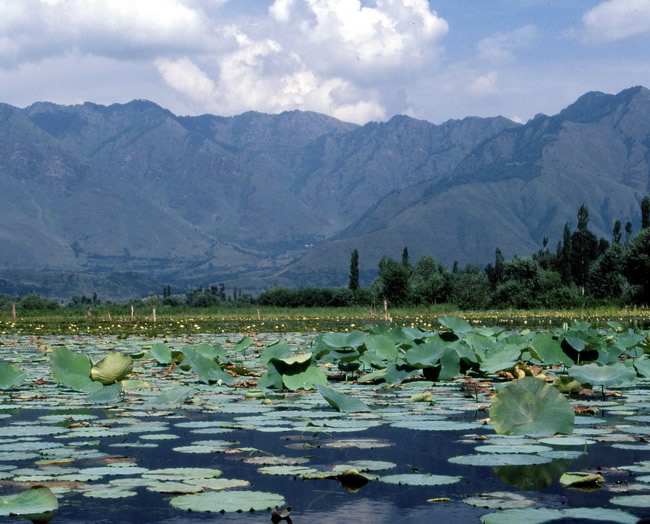
Photo: Dal Lake, Srinagar. Image Credit: Saka Bonetto.
Paris, France, November 8, 2021 — UNESCO announced today that the city of Srinagar had joined the UNESCO Network of Creative Cities. UNESCO has designated it as a Creative City of Craft and Folk Arts.
Prime Minister Narendra Modi has expressed happiness over Srinagar joining the UNESCO Creative Cities Network (UCCN) as a Creative City of Craft and Folk Arts.
In a tweet, the Prime Minister said: “Delighted that beautiful Srinagar joins the UNESCO Creative Cities Network (UCCN) with a special mention for its craft and folk art. It is fitting recognition for the vibrant cultural ethos of Srinagar. Congratulations to the people of Jammu and Kashmir.”
Srinagar joins Chennai and Varanasi - UNESCO Cities of music; Jaipur - UNESCO City of crafts and folk arts; Mumbai - UNESCO City of the film; and Hyderabad - UNESCO City of gastronomy.
Worldwide, 49 new cities have joined the UNESCO Creative Cities Network (UCCN) following their designation by UNESCO Director-General Audrey Azoulay to recognize their commitment to placing culture and creativity at the heart of their development and sharing knowledge & good practices.
The Network now numbers 295 cities reaching 90 countries that invest in culture and creativity - crafts and folk art, design, film, gastronomy, literature, media arts, and music - to advance sustainable urban development.
“A new urban model needs to be developed in every city, with its architects, town planners, landscapers, and citizens. We are urging everyone to work with States to reinforce the international cooperation between cities which UNESCO wishes to promote”, said UNESCO Director-General Audrey Azoulay.
“I would like to offer my warm congratulations to India and especially to Srinagar. This is a great recognition of the vitality of the arts and crafts sector in Srinagar”, Eric Falt, UNESCO New Delhi Director, remarked.
By joining the UNESCO Creative Cities Network (UCCN), cities commit to sharing their best practices and developing partnerships involving the public and private sectors and civil society to strengthen the creation, production, distribution, and dissemination of cultural activities and goods and services. They also pledge to develop hubs of creativity and innovation and broaden opportunities for creators and professionals in the cultural sector.
• Here are the New Creative Cities:
- Abu Dhabi (United Arab Emirates) - Music
- Batumi (Georgia) - Music
- Belfast (United Kingdom of Great Britain and Northern Ireland) - Music
- Bida (Nigeria) - Handicrafts and Folk Art
- Bohicon (Benin) - Gastronomy
- Buraidah (Saudi Arabia) - Gastronomy
- Bursa (Turkey) - Crafts and Folk Art
- Campina Grande (Brazil) - Media Arts
- Cannes (France) - Film
- Cluj-Napoca (Romania) - Film
- Como (Italy) - Craft and Folk Art
- Covilhã (Portugal) - Design
- Doha (Qatar) - Design
- Gdynia (Poland) - Film
- Gimhae (Republic of Korea) - Craft and Folk Art
- Göteborg (Sweden) - Literature
- Hamar (Norway) - Media Arts
- Huai’an (China) - Gastronomy
- Huancayo (Peru) - Music
- Ibagué (Colombia) - Music
- Jakarta (Indonesia) - Literature
- Kermanshah (Iran) - Gastronomy
- Kharkiv (Ukraine) - Music
- Kuching (Malaysia) - Gastronomy
- Lankaran (Azerbaijan) - Gastronomy
- Launceston (Australia) - Gastronomy
- London (Canada) - Music
- Manises (Spain) - Crafts and Folk Art
- Modena (Italy) - Media Arts
- Nakuru (Kenya) - Crafts and Folk Art
- Namur (Belgium) - Media Arts
- Pasto (Colombia) - Crafts and Folk Art
- Perth (United Kingdom of Great Britain and Northern Ireland) - Crafts and Folk Art
- Phetchaburi (Thailand) - Gastronomy
- Port Louis (Mauritius) - Music
- Recife (Brazil) - Music
- Rouen (France) - Gastronomy
- Saint Petersburg (Russian Federation) - Gastronomy
- Santa Maria da Feira (Portugal) - Gastronomy
- Santiago de Cuba (Cuba) - Music
- Srinagar (India) - Crafts and Folk Art
- Tallinn (Estonia) - Music
- Tbilisi (Georgia) - Media Arts
- Thessaloniki (Greece) - Gastronomy
- Usuki (Japan) - Gastronomy
- Vilnius (Lithuania) - Literature
- Weifang (China) - Handicraft and Folk Art
- Whanganui (New Zealand) - Design
- Xalapa (Mexico) - Music
Source: UNESCO
|GlobalGiants.Com|
— The editor contributes to the enhancement of the UNESCO Creative Cities Network (UCCN) worldwide.
Edited & Posted by the Editor | 5:00 AM | View the original post