























« November 27, 2021 | Main | December 3, 2021 »
December 2, 2021
Indian School of Hospitality and Sommet Education Kick-off Development Plans for India Region
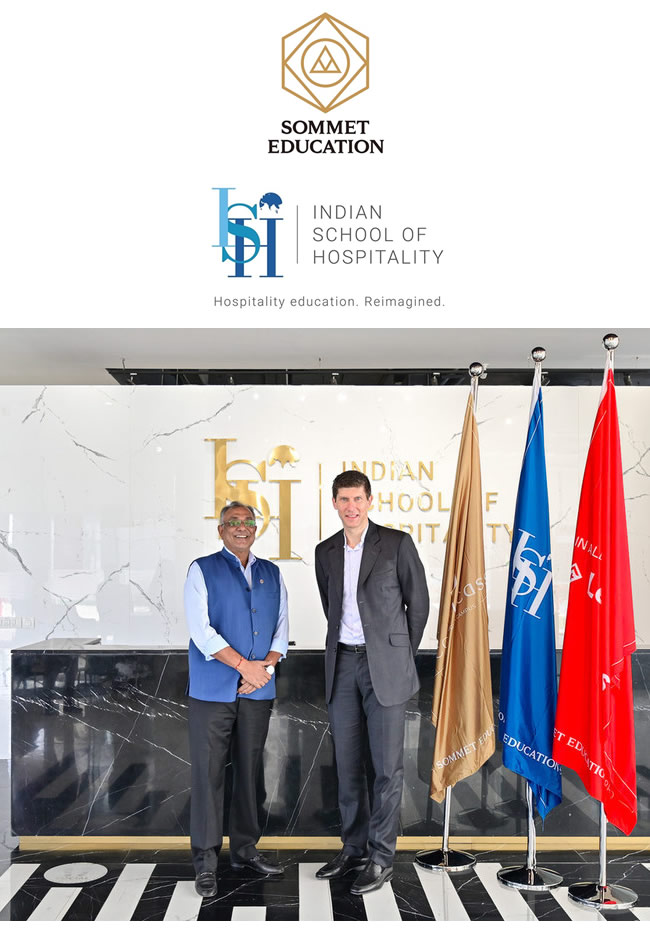
Photo: Benoît-Etienne Domenget, CEO, Sommet Education and Dilip Puri, Founder & CEO, Indian School of Hospitality.
GURUGRAM, India and GLION-SUR-MONTREUX, Switzerland, December 01, 2021 — Sommet Education, a world leader in hospitality and culinary education, has entered into a strategic partnership with the Indian School of Hospitality (ISH), founded by hospitality veteran Dilip Puri.
Sommet Education is the world’s leader in hospitality management education. Its global network of prestigious institutions comprises Swiss-originated hospitality business schools Glion Institute of Higher Education and Les Roches.
The partners aim at offering a global standard of education to a more significant number of hospitality and culinary arts aspirants in the years to come in India and neighboring countries. Through this partnership, worldwide education reference in culinary arts, École Ducasse now has its first campus in India at ISH, and Les Roches, one of the world’s leading hospitality business schools.
At an event in Delhi NCR to celebrate the partnership, Benoît-Etienne Domenget, CEO, Sommet Education, and Dilip Puri, Founder & CEO, Indian School of Hospitality, announced their future development plans for India. The first step of this plan is to expand the current ISH Gurugram campus, which will feature an additional 25,000 sq. ft of classrooms, training kitchens, and student experience areas. This expansion will take up the capacity of the campus to over 500 students per intake, with an overall total of 1,200 students per year. New facilities are under construction and will be operational by early 2022.
While ISH has set benchmarks with its global curriculum, faculty, and state-of-the-art infrastructure, expansion of the campus will lay grounds for more talented students to choose the exciting field of hospitality and culinary arts and become future leaders in the industry.
In terms of expansion outside the Gurugram campus, Sommet Education and ISH are evaluating opportunities for a second campus in Mumbai, Bengaluru, or Hyderabad. They also intend to launch a network of Ecole Ducasse studios in select cities across India. These culinary institutes will cater to the needs of professionals, enthusiasts, and career changers for upskilling and acquiring new skills. The targeted cities include New Delhi, Mumbai, and Bengaluru.
Together, the partners shared their ambition to become India’s largest hospitality and culinary arts education player in the next three years.
Indian School of Hospitality (ISH) is an institute of higher education focused on reimagining hospitality education for today’s generation and tomorrow’s businesses. ISH is part of Sommet Education’s global network of 18 campuses across eight countries.
At its ultra-modern campus in Gurugram (Delhi NCR), ISH offers degree and diploma, and certificate programs in hospitality management and culinary arts at the undergraduate and postgraduate levels.
Source: Sommet Education
|GlobalGiants.Com|


Edited & Posted by the Editor | 2:22 PM | View the original post
Autonomous Car arrives at Florida Poly for Enhance Research.
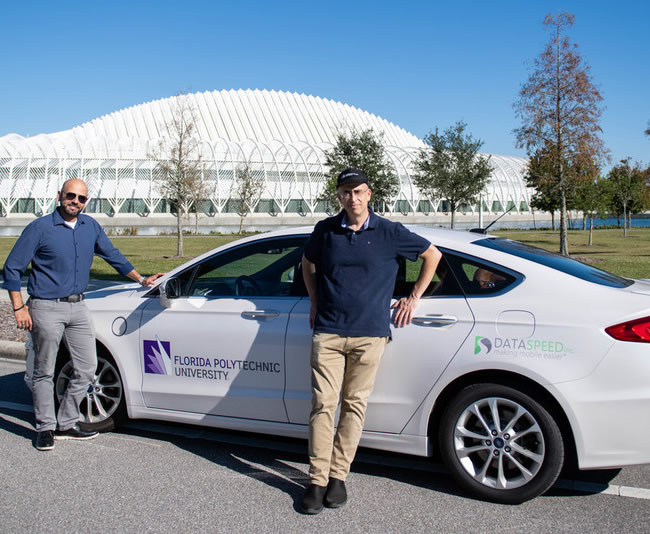
Photo: Florida Polytechnic University researchers Dr. AJ Alnaser (left) and Dr. Onur Toker stand alongside the new drive-by-wire autonomous test vehicle on campus in Lakeland, Florida.
LAKELAND, Fla., December 2, 2021 — Researchers at Florida Polytechnic University’s Advanced Mobility Institute are beginning a new phase in their work on autonomous vehicle testing and verification. The research is shifting gears from software to hardware testing at a new simulation facility on campus, funded in part by a $350,000 grant from the National Science Foundation.
The project’s centerpiece - a tricked-out, autonomous sedan - recently arrived at Florida Poly. The car is equipped with sophisticated electronics and transformed into a drive-by-wire autonomous test vehicle.
“Drive-by-wire means you can control the steering, acceleration, braking by electronic signals,” said Dr. Onur Toker, associate professor of electrical and computer engineering and researcher. “If you put a computer in it, it becomes an autonomous vehicle test car.”
The researchers will put the autonomous car to work on Polytechnic Circle, the road encircling campus.
“Autonomous vehicles have computer systems that you can think of like a child - it needs time to mature, grow, and learn,” said Dr. AJ Alnaser, assistant professor of applied mathematics and researcher. “Once it learns enough, we have to test it. Then, finally, we have to be able to trust that we can give it a driver’s license and it can drive safely.”
Researchers can emulate driving conditions inside the new simulation lab and test whether a car’s programming is accurate. The lab’s equipment includes advanced computers connected to two lifelike driving simulators, complete with racing seats, steering wheels, pedals, and large monitor screens.
Alnaser said testing and verifying connected autonomous vehicle (CAV) technology is a vast, multidisciplinary industry problem.
“We want to define what’s a safety measure for cars and then go after how to make conditions as dangerous as possible in a simulation platform,” Alnaser said. “It’s cheaper and safer.”
Dr. Arman Sargolzaei, assistant professor of mechanical engineering at Tennessee Technological University, is working with Florida Poly researchers on the project.
“CAVs will be used in the future to transfer people and goods, and we need to make sure this technology is ready and safe in advance,” said Sargolzaei. “This new facility at Florida Poly allows researchers to develop, implement, and test their algorithms in realistic and safe environments.”
Source: Florida Polytechnic University
|GlobalGiants.Com|
Edited & Posted by the Editor | 12:22 PM | View the original post