





















« May 18, 2022 | Main | May 22, 2022 »
May 19, 2022
UNESCO World Conference in Barcelona to shape the future of Higher Education
- The third UNESCO World Conference on Higher Education is taking place from May 18 to May 20, 2022, in Barcelona, Spain, to chart a renewed vision for higher education in the next decade.
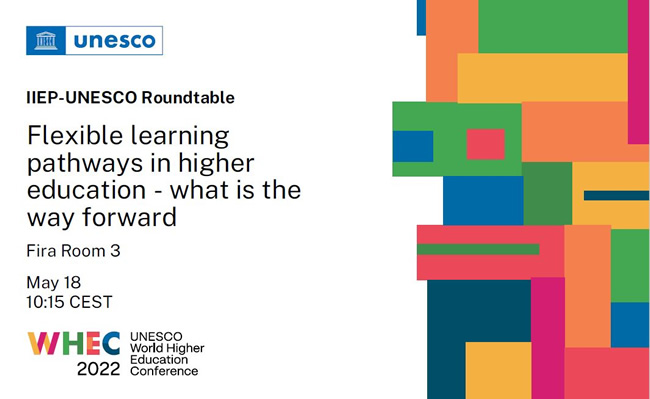
Barcelona, Spain, May 18, 2022 — There are 235 million students enrolled in higher education worldwide. This number has more than doubled in the last 20 years and will likely double again over the coming decade.
Faced with such growing demand, how can we ensure quality higher education adapted to contemporary challenges such as sustainable development? How can international academic mobility be supported? What lessons can we learn from the COVID-19 pandemic? These questions will be at the heart of the World Conference.
More than 1,500 participants are attending the event coming from universities, governments, multilateral agencies, the private sector, and civil society to share their experiences and ideas to draw a joint global roadmap for the coming decade.
UNESCO Director-General Audrey Azoulay, the Spanish Minister of Universities, Joan Subirats, the President of the Generalitat of Catalonia, Pere Aragonès, and the Mayor of Barcelona, Ada Colau, opened the Conference.
• Democratizing access
Disparities persist despite a remarkable 200% increase in enrolment in 20 years in sub-Saharan Africa, Central Asia, and South and South-East Asia. As a result, between 40% and 50% of an age group are enrolled in higher education in East and South-East Asia, Latin America, and the Caribbean. In Central and South Asia, however, only 25% are registered. And the figure drops to 9% for sub-Saharan Africa.
Expanding access to education is necessary, but it has significant logistical and budgetary implications for governments, particularly developing countries. There has been a trend toward increasing tuition fees and other indirect costs in many places, burdening the finances of students and their families.
• Increasing student mobility
Six million of the global student population are studying abroad, and this number will rise to 8 million by 2025. But international frameworks are needed to support mobility, an academic asset for students and a boost to knowledge sharing and mutual understanding.
At the Barcelona Conference, UNESCO will call on its Member States to pursue ratification of the Global Convention on the Recognition of Qualifications concerning Higher Education, the first UN treaty to strengthen inter-university cooperation and cross-border academic research. Fourteen states have already ratified the text, and only seven more signatures are needed to enter it into force.
• Learning from the pandemic
The COVID-19 pandemic challenged higher education systems resulting in learning losses and increased inequalities. However, it has also shown that higher education systems with significant public funding are more resilient in the face of a global crisis and better able to ensure continuity of provision and inclusion of the most important number of students. The Conference will draw lessons from the past two years to design more robust and resilient systems.
To develop the roadmap for higher education to 2030, the Conference will focus on the following themes: (1) Impact of COVID-19 on Higher Education; (2) Higher Education and the Sustainable Development Goals; (3) Inclusion; (4) Quality and Relevance of Programmes; (5) Academic Mobility; (6) Governance; (7) Financing; (8) Data and Knowledge Production; (9) International Cooperation and (10) The Futures of Higher Education.
The International Council for Science (ICS) and the International Association of Universities (IAU) are among the conference partners, as well as the Global Universities Network for Innovation (GUNI/ACUP) and the Catalan Association of Public Universities.
Source: UNESCO
|GlobalGiants.Com|
— The Editor is a UNESCO IIEP (International Institute for Educational Planning, Paris) trained “Independent Appraiser” of Education Sector Plans.


Edited & Posted by the Editor | 6:27 AM | View the original post
Global Survey Comparing University Mindsets and Student Expectations Identifies Critical Shifts in the Learner Experience
Global Anthology research study reveals accessibility barriers and technology needs in higher education.

BOCA RATON, Fla., May 17, 2022 — Anthology, a leading provider of education solutions that support the entire learner lifecycle, today announced the results of its 2022 global research study: Comparing Global University Mindsets and Student Expectations. The study surveyed more than 5,000 higher education leaders and current students from countries worldwide, including the United States, Australia, Brazil, Colombia, India, Japan, Spain, Saudi Arabia, South Africa, and the United Kingdom.
Findings revealed that student expectations following the pandemic do not fully align with what university leaders envision for the future, indicating an opportunity for higher education institutions to adjust to the learner experience to support better outcomes.
“As universities continue to drive digital transformation, they face new hurdles around everything from course delivery and support services to accessibility and how they equip their students and staff with technology,” said Jim Milton, Chairman and CEO at Anthology. “We believe that technology plays a vital role in shaping the future of higher education across the globe, and results from this study validate that viewpoint as leaders consider the impact of technology and data on the overall student experience.”
• Financial Barriers and Lack of Technology Access
Outside the pandemic, the economy continues to have the most significant impact on learners across all regions (73 percent), followed by a lack of access to technology (35 percent). Lack of technology access was significantly higher in the Middle East and Africa, where 54 percent of students indicated this was a challenge. University leaders in most regions are mainly in sync with these challenges. Still, only 30 percent of higher education leaders in the Middle East and Africa felt that technology access was a concern for their students, indicating a discrepancy between their perception and the student experience.
• Hybrid Instruction for the Foreseeable Future
More than 80 percent of students globally now prefer that at least some of their courses or instructional meetings take place online. As a result, leaders are moving their universities in the right direction, with more than a third (38 percent) indicating that a mix of online and in-person course delivery would be the model at their institution by 2025, increasing from 16 percent currently.
Nearly a quarter of North American leaders (24 percent) stated that courses would still be offered in an entirely in-person format by 2025 - a significantly higher percentage than any other region. The highest percentage of students interested in fully asynchronous courses were from North America, representing the most significant gap compared to student preferences for how classes are offered.
• Investing in Holistic Technology
Learners globally want - and expect - technology to be more prevalent in their higher education experience. University leaders agree, with 60 percent stating that their university currently lacks the appropriate digital learning tools to help students succeed. While only 26 percent of university leaders have significantly increased the number of digital learning tools utilized over the past two years, more than half are considering additional technology investments.
The majority (94 percent) of university leaders agree that a holistic view of learner data pulled across multiple systems would benefit their team and help more students achieve their goals. The same percentage indicates that their university is actively looking for new opportunities to aggregate and analyze data to drive more insights, ultimately seeking to use data to help improve outcomes for student populations through personalization.
Anthology partnered with Thrive Analytics to execute its 2022 survey, Comparing Global University Mindsets and Student Expectations. The survey targeted student respondents currently enrolled at a higher education institution pursuing a degree or diploma. University leader respondents are senior leaders (Dean, Provost, Rector, etc.) at a higher education institution. In total, 2,572 current university leaders and 2,725 students completed the survey.
“Anthology” offers the largest EdTech ecosystem globally for education, recently combining with Blackboard to support more than 150 million users in 80 countries.
Source: Anthology
|GlobalGiants.Com|
Edited & Posted by the Editor | 1:47 AM | View the original post