





















« January 14, 2022 | Main | January 16, 2022 »
January 15, 2022
U.S. Institute of Peace Nominations are Open for the 2022 Women Building Peace Award
• The annual award recognizes women peacebuilders from conflict-affected countries.
WASHINGTON, January 13, 2022 — The U.S. Institute of Peace (USIP) has announced that nominations are open for the 2022 Women Building Peace Award. This prestigious annual award honors women building peace in countries impacted by violent conflict.
The nominations period will run until February 14, 2022. USIP will recognize the awardee at a ceremony in October 2022.
Countless women risk their lives to create peace in their communities, leading movements for justice and inclusivity despite often being overlooked in their efforts. USIP said it is committed to doing more to support and celebrate these women and the impact they have as agents of peace. USIP invites organizations and people across the globe to take part in identifying and honoring exceptional women who have dedicated their lives to peace.
USIP strongly encourages nominations for women who have not been previously recognized for their peacebuilding work. USIP will review the nominations on the following criteria:
Commitment to Peace: A woman who shows a commitment to peace through her work to prevent or resolve conflict nonviolently in a fragile or conflict-affected country or region.
Exceptional Leadership: A woman who embodies outstanding leadership through her vision and innovation and has earned the respect of others in the pursuit of peace.
Outstanding Practitioner: A woman who is a peacebuilding practitioner and works with members of local, national, or international communities in an inclusive and participatory manner.
Substantial Impact: A woman whose peacebuilding work has led to tangible results.
Women Building Peace Council, a group of distinguished experts who advise USIP on matters of gender and peacebuilding, will choose the 2022 award winner.
Previous Women Building Peace Award recipients include Josephine Ekiru of Kenya and Rita Lopidia of South Sudan. USIP has recognized nineteen women as finalists for the award since its inception in 2019.
The United States Institute of Peace is a national, nonpartisan, independent Institute founded by Congress and dedicated to the proposition that a world without violent conflict is possible, practical, and essential for the U.S. and global security. The Institute works with local partners to prevent, mitigate, and resolve violent conflict in conflict zones abroad. In addition, USIP works with governments and civil societies to build local capacities to manage conflict peacefully to reduce future crises and the need for costly interventions. The Institute pursues its mission by linking research, policy, training, analysis, and direct action to support those working to build a more peaceful, inclusive world.
Source: United States Institute of Peace
|GlobalGiants.Com|


Edited & Posted by the Editor | 11:12 AM | View the original post
World Economic Forum: Davos Agenda 2022 to Mobilize World Leaders around Global Challenges
First global platform for crucial world leaders to share their visions for 2022
The Davos Agenda 2022 will convene on ‘The State of the World’
Heads of state and government will join CEOs and other leaders for a virtual week-long dialogue on critical collective challenges and how to address them
Dialogue will be a springboard to the Annual Meeting in Davos, scheduled for early summer
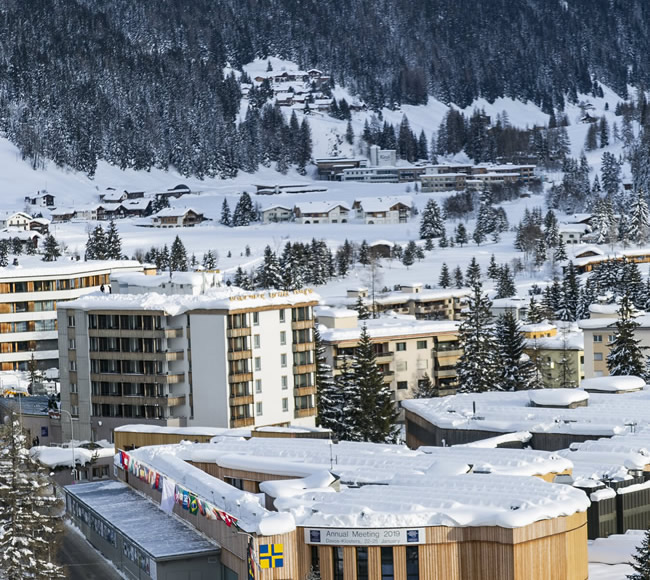
Photo: Impressions from the Annual Meeting 2019 of the World Economic Forum in Davos, January 20, 2019. Image provided by & copyright © World Economic Forum / Benedikt von Loebell.
Geneva, Switzerland, January 14, 2022 - Two years since the start of the COVID-19 pandemic, global leaders will convene for the World Economic Forum’s Davos Agenda 2022, from 17-21 January. This year, it will be the first global platform to provide an opportunity for crucial heads of state and government, together with chief executives and leaders from civil society and international organizations, to reflect on the “State of the World” and shape solutions for critical challenges in the year ahead.
Radically different pandemic experiences have exacerbated global divisions. Vaccine inequities, combined with new strains, have also slowed global economic recovery. However, as the Global Risks Report 2022 clarifies, COVID-19 is only one of the critical global challenges that may become unmanageable unless world leaders prioritize proactive collaboration. Accordingly, the Davos Agenda will drive concerted action among key international stakeholders.
Klaus Schwab, Founder and Executive Chairman of the World Economic Forum, said: “Everyone hopes that in 2022 the COVID-19 pandemic, and the crises that accompanied it, will finally begin to recede. But major global challenges await us, from climate change to rebuilding trust and social cohesion. To address them, leaders will need to adopt new models, look long term, renew cooperation and act systemically. The Davos Agenda 2022 is the starting point for the dialogue needed for global cooperation in 2022.”
Through Special Addresses and panels with leaders of G20 economies and international organizations, the Davos Agenda 2022 will provide crucial insights into a range of critical challenges. In addition, participants will hear first-hand how these leaders will drive action in these and other areas.
• World leaders delivering “State of the World” Special Addresses will include:
- Narendra Modi, Prime Minister of India;
- Kishida Fumio, Prime Minister of Japan;
- António Guterres, Secretary-General, United Nations;
- Ursula von der Leyen, President of the European Commission;
- Scott Morrison, Prime Minister of Australia;
- Joko Widodo, President of Indonesia;
- Naftali Bennett, Prime Minister of Israel;
- Janet L. Yellen, Secretary of the Treasury of the United States;
- Yemi Osinbajo, Vice-President of Nigeria.
The Davos Agenda 2022 will also mobilize government and business leaders, international organizations, and civil society to share their outlook, insights, and plans on the most urgent global issues such as climate change, social contracts, and vaccine equity. These sessions will also provide a platform for a broader connection, enabling the international public to engage and get included in the conversation.
• Key sessions will include:
- COVID-19 - What’s next? (January 17)
- Technology Cooperation in the Fourth Industrial Revolution (January 17)
- Renewing a Global Social Contract (January 18)
- Meeting the Challenge of Vaccine Equity (January 18)
- Navigating the Energy Transition (January 19)
- Accelerating and Scaling up Climate Innovation (January 19)
- ESG Metrics for a Sustainable Future (January 20)
- Live from Space: The Next Frontier for Knowledge and Action (January 20)
- Global Economic Outlook (January 21)
- Building Future Preparedness (January 21)
• The program will feature:
- Tedros Adhanom Ghebreyesus, Director-General, World Health Organization (WHO);
- Fatih Birol, Executive Director, International Energy Agency;
- José Pedro Castillo Terrones, President of Peru;
- Ivan Duque, President of Colombia;
- Anthony S. Fauci, Director, National Institute of Allergy and Infectious Diseases, National Institutes of Health of the United States of America;
- Yasmine Fouad, Minister of Environment of Egypt;
- Kristalina Georgieva, Managing Director, International Monetary Fund (IMF);
- Alejandro Giammattei, President of Guatemala;
- Al Gore, Vice-President of the United States (1993-2001) and Chairman and Co-Founder, Generation Investment Management;
- Paulo Guedes, Minister of Economy of Brazil;
- Paula Ingabire, Minister of Information Communication Technology and Innovation of Rwanda;
- Paul Kagame, President of Rwanda;
- John F. Kerry, Special Presidential Envoy for Climate of the United States of America;
- Christine Lagarde, President, European Central Bank;
- Guillermo Lasso, President of Ecuador;
- Ngozi Okonjo-Iweala, Director-General, World Trade Organization (WTO);
- Carlos Alvarado Quesada, President of Costa Rica;
- Abdulaziz Bin Salman Bin Abdulaziz Al Saud, Minister of Energy of Saudi Arabia;
- Nicolas Schmit, Commissioner for Jobs and Social Rights, European Commission;
- François Villeroy de Galhau, Governor of the Central Bank of France;
- Sarah bint Yousif Al-Amiri, Minister of State for Advanced Technology, UAE.
Source: World Economic Forum
|GlobalGiants.Com|
Edited & Posted by the Editor | 3:15 AM | View the original post