

















October 14, 2011
Georgetown University hosts U.S.-India Higher Education Summit


Photos: U.S. Secretary of State Hillary Rodham Clinton delivers remarks to the U.S.-India Higher Education Summit held at Georgetown University in Washington, DC. Photos Credit: Phil Humnicky/Georgetown University / October 13, 2011.
• The U.S.-India Higher Education Summit was held at Georgetown University in Washington, D.C. on Thursday, October 13. The Summit was jointly hosted by the Government of the United States and the Government of India and attended by 300 higher education leaders and government officials from the U.S. and India, as well as private sector leaders.
The objective of the summit was to further strengthen higher education collaboration and exchange between institutions in the United States and India through exploration of topics of mutual interest such as joint degrees, research partnerships, accreditation and quality assurance. In addition, the summit highlighted the importance of education as a pillar of the U.S.-India Strategic Dialogue and set forth goals for deepening this aspect of the bilateral relationship in cooperation with the many excellent institutions of higher education in both countries.
The summit featured a roundtable discussion on U.S.-India Higher Education Cooperation, co-chaired by Assistant Secretary Ann Stock and Indian Minister of Human Resource Development Kapil Sibal. Prominent higher education and thought leaders spoke at a plenary session and in breakout sessions on topics crucial to expanding and strengthening higher education collaboration between the two countries.
Minister Sibal thanked Secretary Clinton and her colleagues, as well as the academic, non-governmental, and business communities in the United States for their efforts in successfully organizing the U.S.-India Higher Education Summit, and expressed optimism about building on this successful Summit in the expanded U.S.-India Higher Education Dialogue to be held in 2012.
|GlobalGiants.Com|


Edited & Posted by Editor | 5:04 AM | Link to this Post
October 6, 2011
Times Higher Education Announces World University Rankings 2011-12
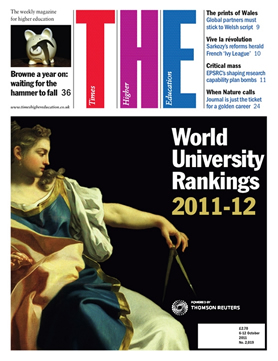
Times Higher Education World University Rankings, unveiled today, spring a surprise at the top, where Harvard University is dethroned by the California Institute of Technology. Caltech snatches first place thanks mainly to a 16 per cent rise in research funding.
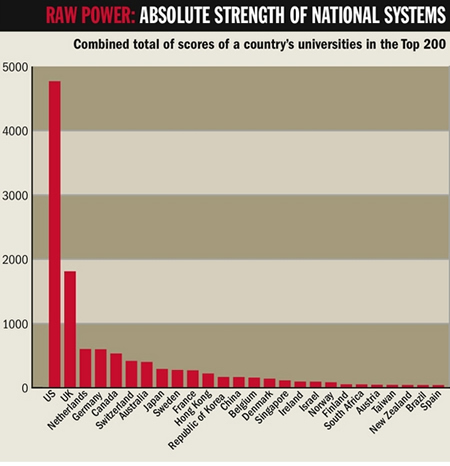
• In terms of overall number of institutions in the top 200, the US leads the way with 75, followed by the UK (32), Germany (12), the Netherlands (12) and Canada (9).
TOP 10 UNIVERSITIES
- California Institute of Technology
- Harvard University
- Stanford University
- University of Oxford
- Princeton University
- University of Cambridge
- Massachusetts Institute of Technology
- Imperial College London
- University of Chicago
- University of California, Berkeley
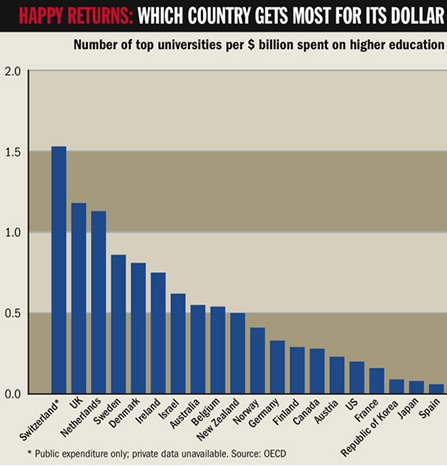
• According to John Morgan, deputy news editor at Times Higher Education, “Switzerland and the UK have the best-value higher education systems in the world while the US languishes in 16th place.”
“When the table is adjusted for national spending on higher education, Switzerland has the most universities in the top 200 per billion dollars spent, followed by the UK in second place and the Netherlands in third. The US finishes 16th by this measure (see graph below),” explains Morgan.
Critics of the higher education reforms in England, where the bulk of public funding is being replaced with private investment in the form of higher tuition fees, see the rankings as a warning against any shift to a market-driven US model.
Howard Hotson, professor of early modern intellectual history at the University of Oxford, who has become a prominent critic of his government’s higher education policy, said: “You can turn the data from the World University Rankings upside down and inside out…to measure different things; but the end results are more or less the same.
“Several small and prosperous countries - notably the Netherlands, Sweden and Denmark - do best in per capita terms; the UK comes at or near the top of the value-for-money table; and Switzerland does exceptionally well across the board.
“The US, by contrast, offers unimpressive performance in per capita terms and very poor value for money.” He added: “Although many of the world’s very best universities are private, all the world’s best university systems are public…All this puts a fresh onus on the UK minister for universities and science - and on his counterparts in other countries - to provide equally clear and compelling evidence to justify radical market-driven reforms.”

Many US public universities - notably those in California - have slipped in the rankings as funding falls amid state budget crises.
But Don Heller, professor of education and senior scientist at Pennsylvania State University, said it would “take a number of years of downturn” to damage the research reputation of US universities. “Most of the research funding in the US comes from the federal government. That hasn’t been cut and has gone up a bit, in comparison to general funding from the states.”
[The U.S. Department of Education has confirmed to the Publisher of GlobalGiants.Com that the U.S. federal government takes great interest in university research and directly provides a large amount of research funds to universities and colleges.]
• Bruce Johnstone, emeritus professor of higher and comparative education at the University at Buffalo, State University of New York, predicted that the US would remain globally dominant. “The bottom line is the US gives a tremendous amount of money to higher education because of the combination of taxpayer revenue, tuition revenue and philanthropic revenue,” he said. Professor Johnstone highlighted philanthropy as an income source not available to competitor nations.
|GlobalGiants.Com|

Edited & Posted by Editor | 12:20 PM | Link to this Post
September 25, 2011
Clinton Global Initiative: UNESCO and Varkey GEMS Foundation Announce Program to Train 10,000 School Principals


Photo: U.S. Secretary of State Hillary Rodham Clinton and Chelsea Clinton participate in the Clinton Global Initiative Annual Meeting and hold a one-on-one “conversation” during the Closing Plenary, at the Sheraton Midtown Hotel in New York, New York, on September 22, 2011. (State Department Photo).
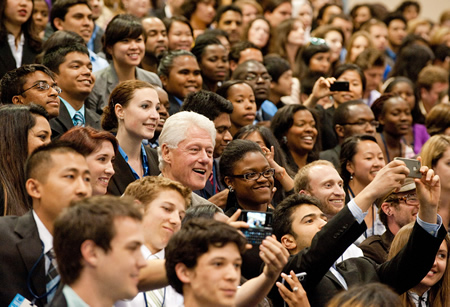
Photo: President Bill Clinton takes a group photo with the 1,200 attendees of the CGI U 2011 meeting. Photo Credit: Erik Jepsen / Clinton Global Initiative.
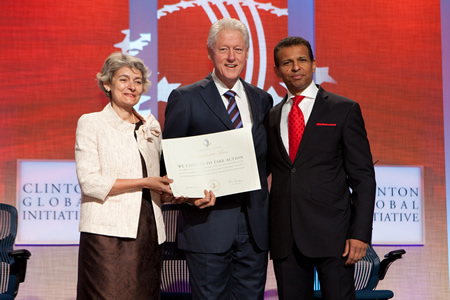
Photo: Along with the Director General of UNESCO, Irina Bokova, and the Chairman of GEMS Education, Sunny Varkey, the ‘10,000 Principals Leadership Program’ was announced by President Clinton as a ‘commitment to action’ at the Clinton Global Initiative annual meeting in New York. Photo Credit: Adam Schultz / Clinton Global Initiative.
• The Varkey GEMS Foundation, a not-for-profit education organization and The United Nations Educational, Scientific and Cultural Organization (UNESCO), today announced a school Principals training program. The ‘10,000 Principals Leadership Program’ was announced by President Clinton as a ‘commitment to action’ at the Clinton Global Initiative annual meeting in New York today.
The first phase of the program will involve Kenya, Ghana and India. 10,000 school principals will be trained over four years. “School Principals in many developing countries receive little, if any, leadership and development training,” explained GEMS Foundation. “This initiative will improve the skills of those school leaders and the multiplier effect will benefit thousands of teachers and up to 10 million children.”
The Director General of UNESCO, Irina Bokova said at the launch, “This partnership between UNESCO and the Varkey GEMS Foundation (including GEMS Education) is an excellent example of the new platforms for cooperation the world needs today. Tackling complex, global challenges requires also innovative and far reaching partnerships between the public and private spheres. GEMS Education works for education as a force for development, for individual realization, for tolerance and dialogue and indeed as a basic human right.”
The Founder of the Varkey GEMS Foundation and Chairman of GEMS Education, Sunny Varkey said at the launch of the initiative, “I believe the private sector can work with intergovernmental organizations, NGO’s and Governments, powerfully, to provide more education to those less fortunate. The fact that 67 million children around the world have no access to education is intolerable. Education is the most important issue in the world today. For us to confront, collectively, some of the world’s biggest challenges such as poverty, conflict, prejudice and intolerance we need to lift the standards of education worldwide.”

Photo: Student Volunteers at the CGI U 2011 Service Project at the San Diego Food Bank. Photo Credit: Adam Schultz / Clinton Global Initiative.
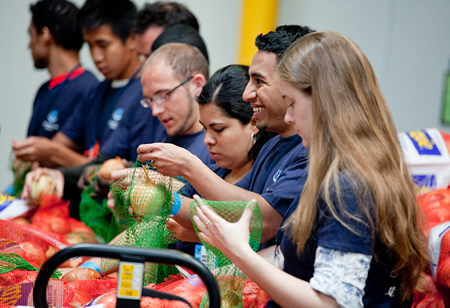
Photo: Students bag food at the CGI U 2011 Service Project at the San Diego Food Bank. Photo Credit: Adam Schultz / Clinton Global Initiative.
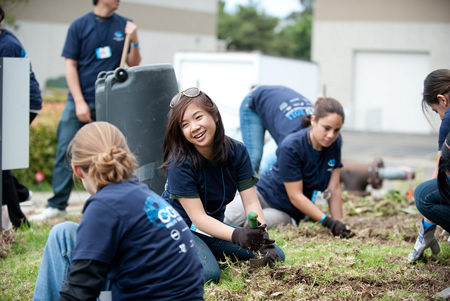
Photo: Students lend a hand at landscaping outside the San Diego Food Bank during the CGI U 2011 Service Project. Photo Credit: Erik Jepsen / Clinton Global Initiative.
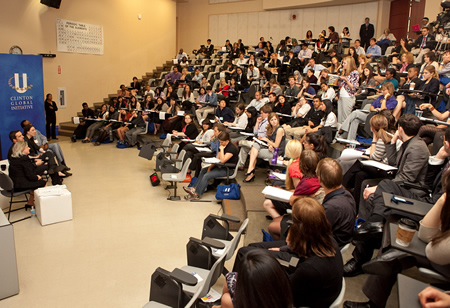
Photo: CGI U 2011 Working Session. Photo Credit: Adam Schultz / Clinton Global Initiative.
• Established in 2005 by President Bill Clinton, the Clinton Global Initiative (CGI) convenes global leaders to devise and implement innovative solutions to some of the world’s most pressing challenges.
|GlobalGiants.Com|
Edited & Posted by Editor | 11:36 PM | Link to this Post
September 23, 2011
Aspen Institute ranks Top MBA Programs that value the Social, Environmental and Ethical Impacts of Business Decisions
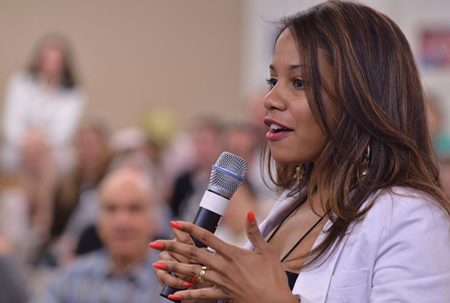
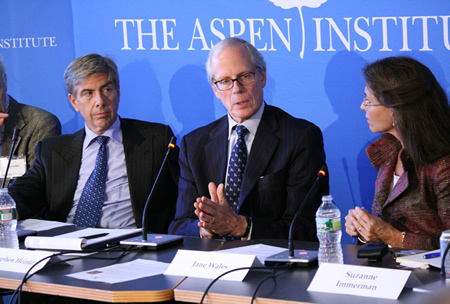
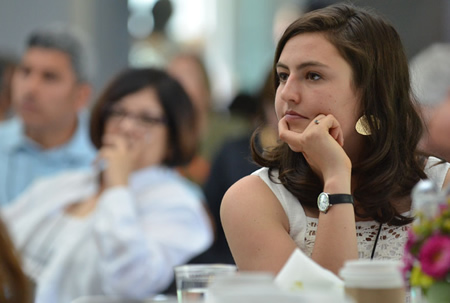
Photos © 2011 The Aspen Institute. Photographers Daniel Bayer/Michael Brands/Steve Johnson.
According to the Aspen Institute’s “Beyond Grey Pinstripes” (a biennial survey and alternative ranking of business schools) released today, the number of business schools teaching MBA students to examine the social, environmental and ethical impacts of business decisions continues to grow.
According to the institute, for the 2011-2012 “Beyond Grey Pinstripes” rankings, 149 schools from 22 countries submitted data. These data included more than 6,000 course descriptions and over 6,000 faculty research abstracts. In addition, the Beyond Grey Pinstripes project team received extensive information on participating schools’ extracurricular activities, institutes and centers, joint degrees and specializations. To arrive at this year’s ranking, the project team spent seven months analyzing the courses and faculty research.
Stanford University, ranked first in the 2005 and 2007 surveys, bounced back from a #4 ranking in 2009 to rank number one in the 2011 survey. Stanford received high marks for the number of courses with social and environmental content it offers students as well as courses that explicitly address the role of mainstream business in improving social and environmental conditions. It also ranked high in creating an environment in which faculty feel free to explore social and environmental topics in their research, says Aspen Institute.
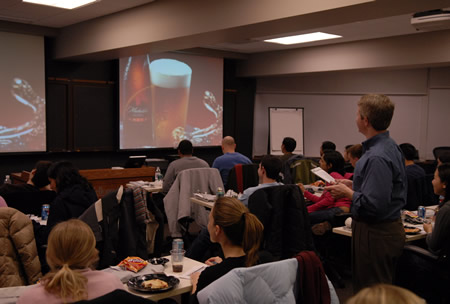
Photo: Kellogg School of Management Professor Tim Calkins studies ads with business school students during the Kellogg School’s Advertising Review.
• Aspen Institute’s Ranking of Top 10 MBA Programs:
1. Stanford Graduate School of Business
2. York University, Schulich School of Business (Canada)
3. IE University (Spain)
4. Notre Dame, Mendoza College of Business
5. Yale School of Management
6. Northwestern, Kellogg School of Management
7. University of Michigan, Ross School of Business
8. Cornell University, Johnson Graduate School of Management
9. University of North Carolina, Kenan-Flagler Business School
10. UC Berkeley, Haas School of Business
“In all scoring categories used to determine the ranking, business schools have raised the bar,” said Judith Samuelson, executive director of the Aspen Institute Business and Society Program, which conducted “Beyond Grey Pinstripes”. “There are more courses than ever before with content on social, ethical, and environmental issues, more courses about the role of business as a positive agent for change, more exposure of students to this content, and more research published by faculty on relevant topics.”
• Despite the gains being made, Samuelson noted, there is still work to be done to address the belief among some business educators that the sole role that business should play in society is to maximize profits - as measured by today’s stock price.
Aspen Institute is based in Washington, D.C. It also has offices in New York City and an international network of partners in Bucharest (Romania), Rome (Italy), Berlin (Germany), Lyons (France), Tokyo (Japan), Madrid (Spain), and New Delhi (India). Its mission is to foster values-based leadership, encouraging individuals to reflect on the ideals and ideas that define a good society.
|GlobalGiants.Com|
Edited & Posted by Editor | 7:59 AM | Link to this Post
August 7, 2011
Scholastic International Introduces the Everyday Book Box for Educators and Students

Global children’s publishing education and media company Scholastic Inc. today announced the launch of the Everyday Book Box, a leveled reading English-language book collection designed for the international market.
The Everyday Book Box contains 50 individual book titles, fiction and non-fiction, each marked with a Guided Reading level. There are three leveled collections available: Red (ages 5-6), Yellow (ages 6-7), and Blue (ages 7-8). Schools may also choose between books printed in American English or Commonwealth English.

Photo: “CBS Early Show” Co-anchor Erica Hill gets a big hug from Clifford The Big Red Dog at the Scholastic Store in New York City. Clifford the Big Red Dog is an American children’s book series first published in 1963.
In addition to the books, each Everyday Book Box contains a resource CD with activities, lesson plans, and reading tips for teachers and parents.
“The Everyday Book Box is a valuable resource that will help children build English fluency and reading skills,” said Shane Armstrong, President of Scholastic International Growth Markets.
|GlobalGiants.Com|
Edited & Posted by Editor | 10:56 AM | Link to this Post
July 26, 2011
Microsoft's Innovative Education Forum

Photo: Microsoft Connector vehicles arrive at the Overlake Transit Center next to the Microsoft Redmond Campus.
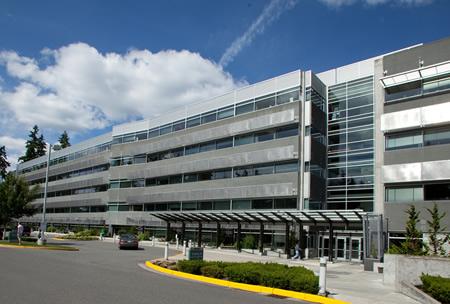
Photo: Entrance to Building 36 on the Microsoft Redmond Campus.

Photo: Entrance to Building 92 on the Microsoft Redmond Campus.

Photo: Entrance to restaurants in The Commons destination on the Microsoft Redmond Campus.
• Microsoft Corporation is bringing 100 of the USA’s best educators to its corporate headquarters this week to connect, collaborate and share their inventive teaching methods at the 2011 U.S. Innovative Education Forum.
The event aims to recognize outstanding educators who engage and inspire their students to learn by creatively including technology into their school and classroom curricula.
Educators who attend the forum will participate in hands-on learning sessions with the latest Microsoft technologies and present their innovative learning projects to a panel of judges.
• Judges will select 10 projects to represent the U.S. at the “Microsoft Partners in Learning Global Forum” Nov. 6-11 in Washington, D.C., where more than 500 educators from around the world are expected to compete.
|GlobalGiants.Com|
Edited & Posted by Editor | 4:19 AM | Link to this Post
July 14, 2011
Microsoft Imagine Cup 2011: Winners Announced

Photo: Microsoft sign outside Building 99 on the Microsoft Redmond Campus.
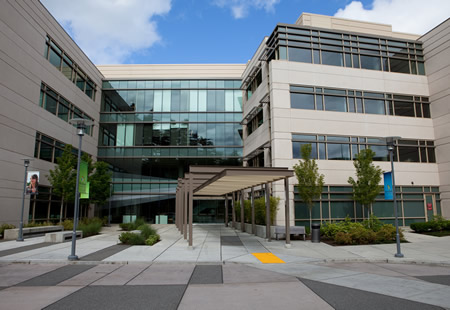
Photo: Entrance to Building 37 on the Microsoft Redmond Campus.
Microsoft Corp. today announced the winners of the ninth annual Microsoft Imagine Cup, the world’s premier student technology competition, honoring student innovations that address global problems such as improving road and fire safety, eradicating poverty, and creating a more sustainable environment.
The Imagine Cup 2011 competition winners were announced at the Imagine Cup World Festival and Awards Ceremony at the David H. Koch Theater at Lincoln Center in New York.
• Narrowed from more than 350,000 global registrants, more than 400 students from 70 countries traveled to New York to compete at the Worldwide Finals.
Team Hermes from Ireland took home top honors in the Software Design competition. The team designed a device that plugs into a car and monitors dangerous driving behavior and road conditions, providing instant feedback to both the driver and the car owner.
In the Embedded Development category, Team NTHUCS from Taiwan won first place and $25,000 (U.S.). Its project, RIGHT!! This Way, computes the safest fire escape routes, detected by a wireless sensor network in real time.
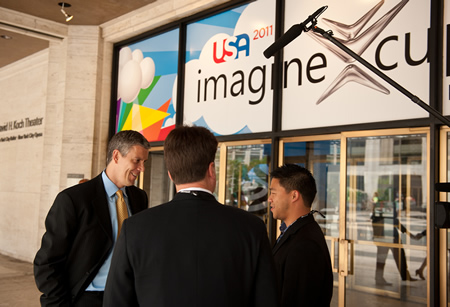
Photo: United States Secretary of Education Arne Duncan visited the Imagine Cup 2011 Worldwide Finals.
The following is a list of the top three winners in each of the five competition categories:
Software Design. Students create innovative software, service solutions and applications that unleash the power of technology to benefit society.
• First Place: Team Hermes (Ireland) • Second Place: Team Note-Taker (United States) • Third Place: OaSys (Jordan)
Embedded Development. Students develop embedded devices, working with hardware and software to build solutions that use Windows Embedded Compact 7.
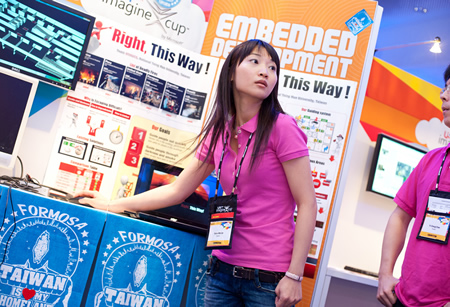
• First Place: NTHUCS (Taiwan) • Second Place: Harmonicare (China) • Third Place: Endeavour_Design (Romania)
Game Design. Students select one of three tracks (Mobile, Web or Windows/Xbox) to create games that are not only fun but also help to improve the global community at the same time.
Mobile
• First Place: Geekologic (France) • Second Place: Close World Mobile (France) • Third Place: Team Dragon (United States)
Web
• First Place: Cellardoor (Poland) • Second Place: Signum Fidei (Philippines) • Third Place: Quegee Team (Slovakia)
Windows/Xbox
• First Place: Signum Games (Brazil) • Second Place: JubJub (Thailand) • Third Place: WickedTeam (Czech Republic)
Digital Media. Students create Web videos to share their points of view and generate awareness of critical global issues.
• First Place: M.N.A. (Romania) • Second Place: Brothers Forever (Oman) • Third Place: CottonCandy (Taiwan)
Windows Phone 7. Students develop XAP applications for Windows Phone 7 that help solve the world’s toughest problems.

• First Place: HOMERUN (Korea) • Second Place: Zipi Zigi (Korea) • Third Place: The LifeLens Project (United States)
In addition to the competition categories above, Imagine Cup includes four challenges. These four challenges provided more opportunities for students to win their share of the total $215,000 (U.S.) cash, as well as other prizes. The following is a list of these winners:
Interoperability Challenge. Students are challenged to pair free and open source software with technology from Microsoft and other companies to create groundbreaking applications.
• First Place: alaniarides (Greece) • Second Place: Bells Team (Brazil) • Third Place: DemosceneSpirit (Poland)
IT Challenge. Students are tested on their knowledge of IT systems and faced with unique scenarios and diverse needs to solve, competing for the title of best of the best in the industry.
• First Place: Jean-Sebastien Duchene (France) • Second Place: Blazej Matuszyk (Poland) • Third Place: Yunheng Mong (Singapore)
Orchard Challenge. Students use a new CMS platform to create useful, common modules, such as shopping carts, checkout systems, maps and geolocation services, and social interactivity.
• First Place: MP Brun (Denmark) • Second Place: Virtual Dreams - Orchard (Brazil) • Third Place: Zveen Zveen Team (Serbia)
Windows 7 Touch Challenge. Students are tasked to develop solutions that use Windows Touch technology while expanding the possibilities of how a user can interact with a computer.
• First Place: India Rose (France) • Second Place: dreambender (Indonesia) • Third Place: IUVO (Japan)
|GlobalGiants.Com|
Edited & Posted by Editor | 7:29 AM | Link to this Post
April 13, 2011
DISCOVERY CHANNEL — POLAR BEAR: SPY ON THE ICE

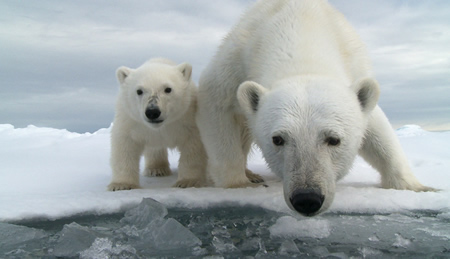
Photo: Mother polar bear with her cub. Credit: Discovery Channel / BBC.
Spy cameras capture the dramatic moments of polar bear motherhood, in POLAR BEAR: SPY ON THE ICE, premiering April 17 on Discovery Channel.
POLAR BEAR: SPY ON THE ICE follows polar bear mothers Aesa and Svanna as they lead their cubs on a journey across frozen land in arctic Norway. Their destination — sea ice on the edge of the polar ice cap surrounding the North Pole.
” It’s an expedition that will take months and the perils will be especially great, with brand new cubs in tow. Each mother will need endurance, ingenuity, and steadfast determination to safely make it through this incredible journey alive,” Discovery Channel explains.
POLAR BEAR: SPY ON THE ICE presents viewers with an enchanting look at the daily life of two very special polar bear families and the other bears they encounter along their journey.
|GlobalGiants.Com|
Edited & Posted by Editor | 3:06 AM | Link to this Post
March 23, 2011
Portrait Photography

Photo: Portrait of one of the young girls in the Kapisa Province of Afghanistan who are receiving Vocational Education and Training. Photo © United Nations/Eskinder Debebe.
The UN Security Council has unanimously adopted a resolution extending the mandate of the United Nations Assistance Mission in Afghanistan (UNAMA) until March 23, 2012.
|GlobalGiants.Com|
Edited & Posted by Editor | 5:56 AM | Link to this Post
March 14, 2011
UN Secretary-General Meets Students from Harvard's Kennedy School of Government
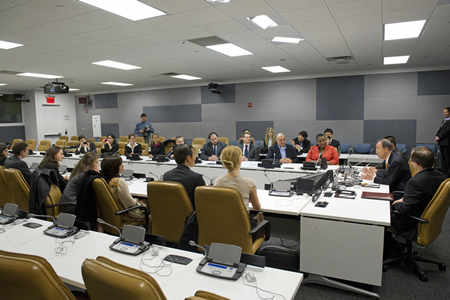
Photo: Secretary-General Ban Ki-moon (second from right) meets with students from Harvard University’s Kennedy School of Government. March 11, 2011. United Nations, New York. UN Photo/Eskinder Debebe.
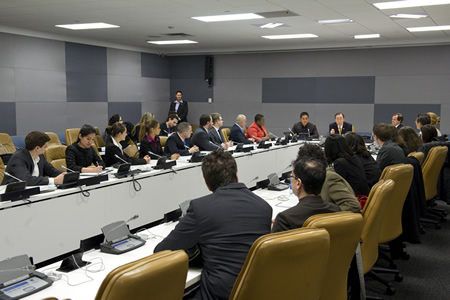
Photo: Secretary-General Ban Ki-moon (head table, centre) meets with students from Harvard University’s Kennedy School of Government. March 11, 2011. United Nations, New York. UN Photo/Eskinder Debebe.
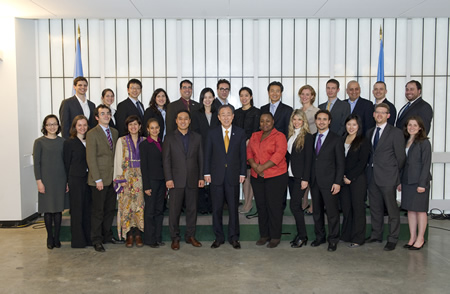
Photo: Secretary-General Ban Ki-moon (front, centre) poses for a group photo with students from Harvard University’s Kennedy School of Government. March 11, 2011. United Nations, New York. UN Photo/Eskinder Debebe.
|GlobalGiants.Com|
Edited & Posted by Editor | 12:21 PM | Link to this Post
March 11, 2011
Recalling Nalanda University

Photo: Buddhist Master and Harvard Ph.D. Trungram Gyaltrul Rinpoche examines the proportions of a hand-made copper Buddha statue as the artist constructs it. World Center for Peace and Unity, a large Buddhist temple complex, is being built in Lumbini, Nepal, where Prince Siddhartha Guatama, the Buddha, was born in 583 B.C. Lumbini is a UNESCO World Heritage Site.
The 48,600-square-foot structure’s central building, named Mahachaitya, is modeled on one of the surviving structures of Nalanda (Bihar, India) in order to recall the greatness of Nalanda University, the ancient Buddhist seat of learning that served as the Harvard of Asia from the 5th to 12th centuries A.D. Nalanda has been called “one of the first great universities in recorded history.” Some of its buildings were constructed by the Mauryan emperor Ashoka the Great. At its peak, the university attracted scholars and students from as far away as China, Greece, and Persia. Courses were drawn from every field of learning, foreign and native, that included science, astronomy, medicine, scriptures (all religions), metaphysics, and logic.
|GlobalGiants.Com|
Edited & Posted by Editor | 11:50 PM | Link to this Post
March 10, 2011
University Reputation
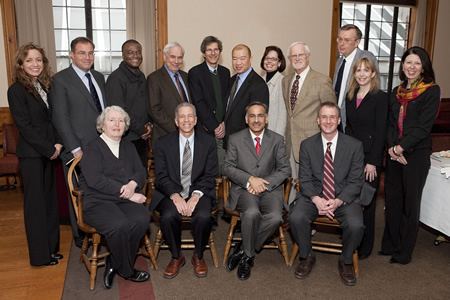
Photo: Executives from PepsiCo and Yale University gather to celebrate the opening of PepsiCo’s long-term research laboratory in New Haven, Connecticut, where the company will focus on the development of healthier products. The company also announced it will fund a M.D. - Ph.D. fellowship at Yale University School of Medicine.


A university’s brand - crucial in helping to attract students, staff and funding - is built on esteem. Times Higher Education’s first World Reputation Rankings reveal how academics view the strength of institutions’ teaching and research.
The results of the first Times Higher Education World Reputation Rankings is based on an invitation-only survey of more than 13,000 academics around the world.
The world regards an elite group of six universities as being head and shoulders above the rest. The rankings suggest that the top six - Harvard University; Massachusetts Institute of Technology; the University of Cambridge; the University of California, Berkeley; Stanford University and the University of Oxford - form a group of globally recognized “superbrands”.
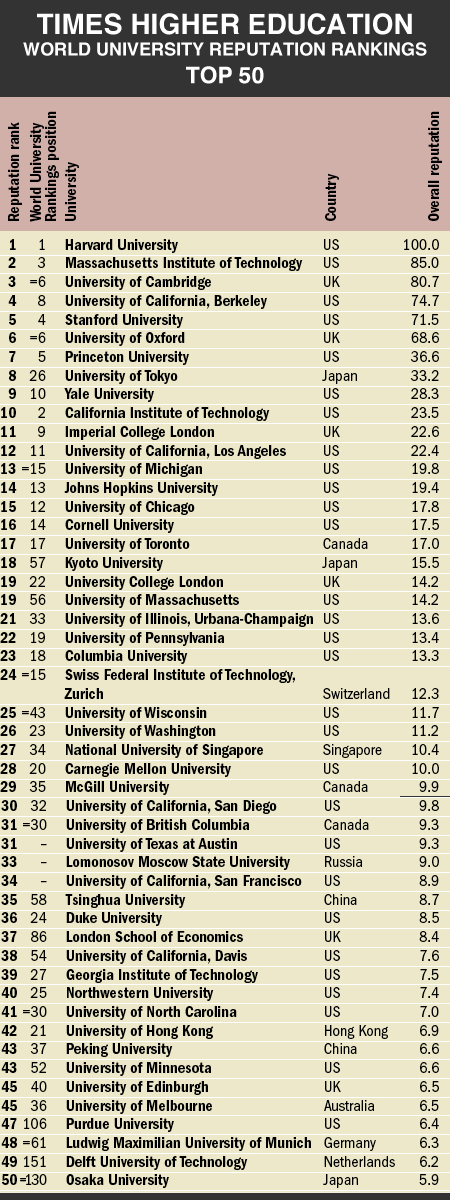
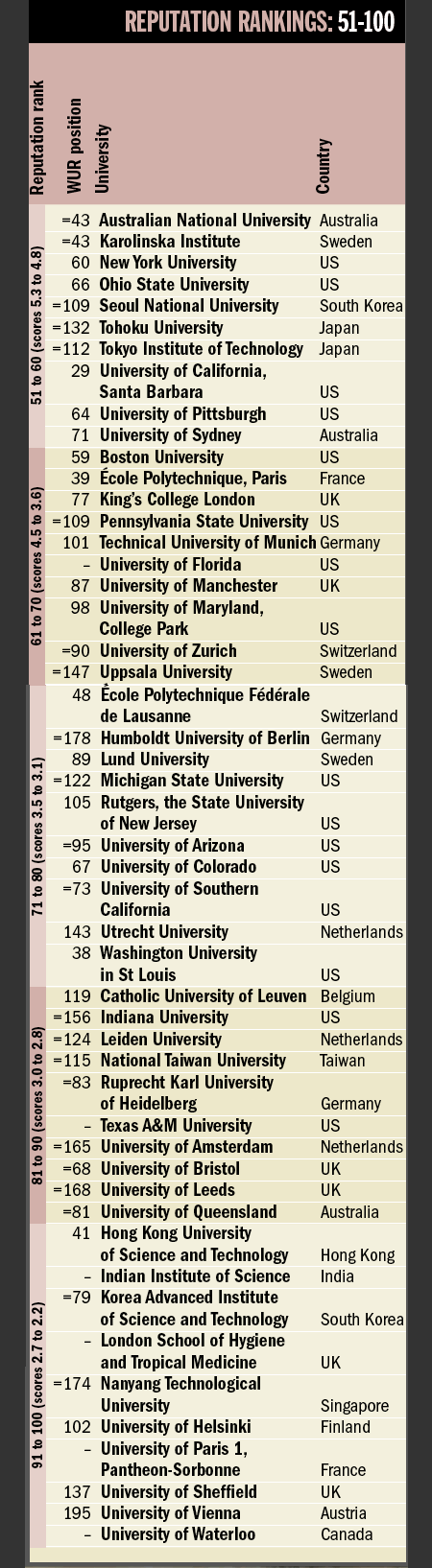
• Here is how John Morgan, a prominent Times Higher Education Writer, explores brand values in higher education:
“In an increasingly competitive higher education marketplace, branding has become big business for universities.
Institutions know that, in a sense, the degrees they confer are worth only as much as their brand. In nations where tuition fees are established, students “buy” a brand that will appeal to the right businesses when it is time to find a job; their choice of university will become part of their own “brand identity”. To attract the right calibre of academics, a university relies on its brand. And when those same academics submit a proposal for research funding or a paper to a leading journal, the brand of their institution may play a role in how their research is judged. The university’s brand becomes part of their own brand as an academic.
The notion of a university as a brand is one that many in higher education are comfortable with. But there are others, who warn that by focusing on branding, universities promote a view of higher education as a commodity rather than as a good in itself.
But if a university is a brand, a key factor determining its strength is reputation in teaching and research (brand and reputation are distinct but related). And the views of academics on university reputation are crucial, for they give an insight into which institutions are best placed to attract top talent, and also influence the views of students and parents.
The results of the first Times Higher Education World Reputation Rankings shed light on this increasingly important measure. The reputation ranking is drawn from a survey of more than 13,000 experienced academics worldwide, carried out by polling company Ipsos for data provider Thomson Reuters. The data informed the current Times Higher Education World University Rankings 2010-11, but are now published in isolation for the first time, revealing clear discrepancies between some institutions’ reputations and their overall ranking.
One notable surprise is the strong performance of Japanese institutions, with the University of Tokyo, Kyoto University and Osaka University all performing better in the World Reputation Rankings than they did in the World University Rankings.
Japan has five institutions in the reputation top 100, making it the best performer behind the US and the UK and producing a better score than major higher education nations such as Canada and Australia.
The US remains dominant in reputation, taking 45 of the places in the top 100.
The UK universities generally do better in the reputation rankings compared with their overall rankings.
China’s top-rated institution is Tsinghua University, in 35th place.”
• “India, despite having no representative in the top 200 of the World University Rankings, can boast of one in the reputation table — the Indian Institute of Science (in the 91-100 band),” John Morgan points out.
Reputation and brand are not the same thing. But Pat Freeland-Small, chief marketing officer at the University of Melbourne, says the former feeds the latter.
The world elite of universities, he says, do not need to advertise, “but in a way they are advertising. They are constantly communicating the quality of what they do through their people and what they naturally put out…It is their people, their quality of research - notions that come through the academic community - that advertise their international profile.”
|GlobalGiants.Com|
The Lioness.
A controversy prevailed among the beasts of the field as to which of the animals deserved the most credit for producing the greatest number of whelps at a birth. They rushed clamorously into the presence of the Lioness and demanded of her the settlement of the dispute. “And you,” they said, “how many sons have you at a birth?’ The Lioness laughed at them, and said: “Why! I have only one; but that one is altogether a thoroughbred Lion.”
The value is in the worth, not in the number.
— Aesop’s Fables. By Aesop (620-564 BC). Translated by George Fyler Townsend.

Edited & Posted by Editor | 8:20 AM | Link to this Post
March 9, 2011
University of Oregon hosts NIKE Clash of the Champions

Photo: Roger Federer serves the ball during the Clash of Champions at Matthew Knight Arena on March 8, 2011 in Eugene, Oregon. (Photo © 2011 Steve Dykes/Getty Images).

Photo: Roger Federer returns the shot of Rafael Nadal during their match at the Clash of Champions at Matthew Knight Arena on March 8, 2011 in Eugene, Oregon. (Photo © 2011 Steve Dykes/Getty Images).

Photo: Rafael Nadal returns the shot of Roger Federer during their match at the Clash of Champions at Matthew Knight Arena on March 8, 2011 in Eugene, Oregon. (Photo © 2011 Steve Dykes/Getty Images).

Photo: Maria Sharapova returns the shot of Victoria Azarenka during their match at the Clash of Champions at Matthew Knight Arena on March 8, 2011 in Eugene, Oregon. (Photo © 2011 Steve Dykes/Getty Images).

Photo: (L to R) Victoria Azarenka, Rafael Nadal, Roger Federer and Maria Sharapova play in a mixed doubles match as John McEnroe sits in the referees chair during the Clash of Champions at Matthew Knight Arena on March 8, 2011 in Eugene, Oregon. (Photo © 2011 Steve Dykes/Getty Images).

Photo: Roger Federer cheers on John McEnroe from the referees chair during the Clash of Champions at Matthew Knight Arena on March 8, 2011 in Eugene, Oregon. (Photo © 2011 Steve Dykes/Getty Images).
The University of Oregon’s sparkling new facility hosted four of the biggest stars from the professional tennis circuit, Roger Federer, Rafael Nadal, Maria Sharapova, and Victoria Azarenka, who appeared March 8 in the “NIKE Clash of the Champions.” The event featured Sharapova and Azarenka playing a singles set, followed by a mixed doubles set and then a men’s singles set between the top two players in the world, Nadal and Federer.
“The NIKE Clash of the Champions is one of the most unique events we could dream of hosting,” University of Oregon Director of Athletics Rob Mullens told the media gathered to cover the event.
|GlobalGiants.Com|
Edited & Posted by Editor | 7:13 AM | Link to this Post
March 8, 2011
Times Higher Education, London, publishes World University Rankings 2010-11
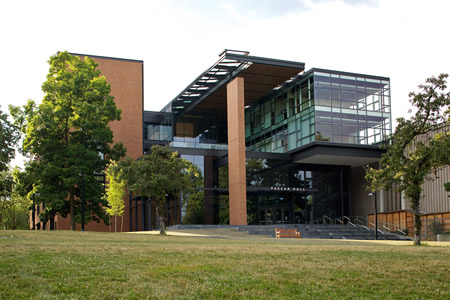
Photo: PACCAR Hall - University of Washington Foster School of Business, Seattle, Washington, USA.
Times Higher Education, London, has published its annual World University Rankings.
The Times Higher Education World University Rankings 2010-11 have been developed in concert with the new rankings data provider — Thomson Reuters.

“We believe we have created the gold standard in international university performance comparisons,” said Times Higher Education. “Our rankings of the top universities across the globe employ 13 separate performance indicators designed to capture the full range of university activities, from teaching to research to knowledge transfer. We are confident that the 2010-2011 world university rankings represent the most accurate picture of global higher education we have ever produced.”
|GlobalGiants.Com|
Edited & Posted by Editor | 1:37 AM | Link to this Post
March 4, 2011
Apple Launches iPad 2
New Design is Thinner, Lighter & Faster with FaceTime, Smart Covers & 10 Hour Battery.



Apple today introduced iPad 2, the next generation of its device for browsing the web, reading and sending email, enjoying photos, watching videos, listening to music, playing games, reading ebooks and more. iPad 2 features an entirely new design that is 33 percent thinner and up to 15 percent lighter than the original iPad, while maintaining the same 9.7-inch LED-backlit LCD screen.
With the new front and rear cameras, iPad 2 users can now make FaceTime calls to millions of iPhone 4, iPod touch and Mac users so they can see family and friends anywhere there is Wi-Fi.
iPad 2 with Wi-Fi will be available on March 11 in the USA, while it will be available in Australia, Austria, Belgium, Canada, Czech Republic, Denmark, Finland, France, Germany, Greece, Hungary, Iceland, Ireland, Italy, Japan, Luxembourg, Mexico, Netherlands, New Zealand, Norway, Poland, Portugal, Spain, Sweden, Switzerland and the UK on March 25; and later in more countries around the world.
|GlobalGiants.Com|
Edited & Posted by Editor | 4:31 AM | Link to this Post
March 2, 2011
Promoting Universal Education

Photo: Petra Nemcova, model, television host and Founder of the Happy Hearts Fund (HHF), addresses a joint press conference at UN Headquarters on “Partnering with the Philanthropic Community to Promote Education for All”. The Event was organized by the UN Department of Economic and Social Affairs in collaboration with the United Nations Children’s Fund (UNICEF), the United Nations Educational, Scientific and Cultural Organization (UNESCO), the United Nations Office for Partnerships and the Committee Encouraging Corporate Philanthropy. February 28, 2011. United Nations, New York. UN Photo/Mark Garten.
Joining Ms. Nemcova at the press conference were Susan Durston, Associate Director of Education Programmes for UNICEF, Olav Seim, Director of the Education for All Global Partnership Team; Danielle Ryan, Representative of the Cathal Ryan Trust; Carlos Domínguez, Senior Vice-President of Cisco Corporation; Hikmet Ersek, President, Chief Executive Officer and Director of Western Union; and Jaime Barclay, Senior Philanthropy Specialist of the Symantec Corporation. Ms. Barclay said that Symantec had donated funds, time and software to causes around the world in the area of education through such proven organizations as Room to Read, to which it was announcing a $1 million grant for literacy facilities and related initiatives in India.
|GlobalGiants.Com|
Edited & Posted by Editor | 6:21 AM | Link to this Post
December 28, 2010
UN Security Council Hosts Informal Exchange with Youth on Peace and Security
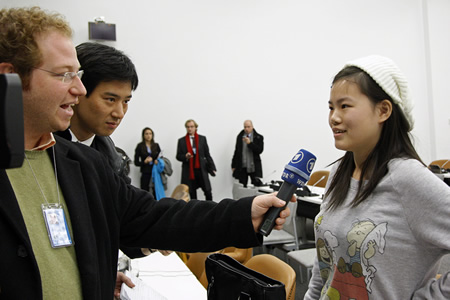
Photo: Members of the press interview a participant of the special Security Council meeting that focused on the concerns of young people, “Your World, Your Future: Voices of a New Generation.” UN Photo/Paulo Filgueiras.
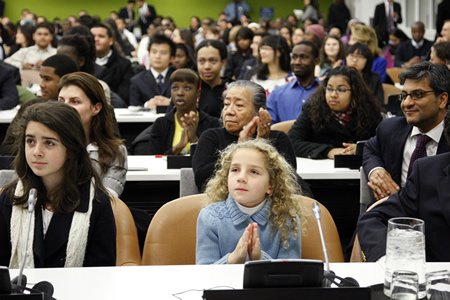
Photo: Young People at Unprecedented Security Council Event. Participants at “Your World, Your Future: Voices of a New Generation” at United Nations Headquarters. New York City school students and other young people from around the world told Members of the Security Council what the greatest challenges to peace and security would be for their generation. This special event was sponsored by the United States, whose delegation holds that body’s rotating presidency for the month of December. UN Photo/Paulo Filgueiras.
Among the responses shared at the event were statements and queries about nuclear disarmament, peacebuilding, terrorism, violence against civilians during armed conflict, sustainable development and the threats posed by the persistence of economic inequality worldwide. Also addressed were climate change, the so-called digital divide, skyrocketing needs for energy and the need for universal education.
|GlobalGiants.Com|
“The child is father of the man.”
— William Wordsworth.
“The wolf also shall dwell with the lamb, and the leopard shall lie down with the kid; and the calf and the young lion and the fatling together; and a little child shall lead them.”
— Isaiah 11:6.
Edited & Posted by Editor | 4:09 AM | Link to this Post
November 24, 2010
UN Launches Academic Impact

Photo: A close-up of a flute soloist performing alongside the Asia-Pacific United Orchestra, under the leadership of Maestro Lü Jia, inside the General Assembly Hall, as part of the UN Academic Impact's inaugural concert. As part of Academic Impact's official launch, 68 musicians from 14 countries and representing 19 symphony orchestras gave a classical concert. November 19, 2010. United Nations, New York. UN Photo/Paulo Filgueiras.
• In an effort to bolster "intellectual social responsibility" for such global goals as promoting human rights, protecting the environment and ending wars, the United Nations is partnering with institutions of higher learning around the world in a new initiative called "Academic Impact".
Since formal launch of the initiative at the UN Headquarters on November 19, 2010, 167 representatives from 40 countries have participated in a two-day series of related conferences, seminars and other activities to share ideas on how to match academic innovation with the work of the United Nations.
Each participating college or university is expected to engage in one activity or project annually in support of those principles. In 2011, the United Nations would set up 10 hubs, one for each principle, to serve as focal points to receive and disseminate ideas among participating universities. Academic Impact would also contribute to the UN Economic and Social Council's Annual Ministerial Review on Education. With close to 500 members in more than 90 countries, the new initiative is aimed to promote a culture of intellectual superiority.
|GlobalGiants.Com|
"Knowledge comes, but wisdom lingers."
- Alfred Lord Tennyson (English Poet. 1809 - 1892).
"The saddest aspect of life right now is that science gathers knowledge faster than society gathers wisdom."
- Isaac Asimov. (Isaac Asimov was an American author and professor of biochemistry at Boston University, best known for his works of science fiction.)
"To myself I am only a child playing on the beach, while vast oceans of truth lie undiscovered before me."
- Isaac Newton.
Edited & Posted by Editor | 9:33 AM | Link to this Post
October 31, 2010
2010 Worldwide Innovative Teacher Awards


Microsoft Partners in Learning today announced the winners of the 2010 Worldwide Innovative Teacher Awards at the sixth annual Worldwide Innovative Education Forum in Cape Town, South Africa.
These awards are the global culmination of local and regional events held around the world throughout the year, where teachers present ideas on how technology can further educational transformation to help improve the way students learn.
"The Innovative Teacher Awards exemplify the creativity and dedication of the world's most forward-thinking educators," said Anthony Salcito, vice president of Worldwide Public Sector Education for Microsoft Corp. "I am inspired by the energy and unique approaches of the winning teachers. They demonstrate the infinite possibilities that technology can create to improve learning opportunities and meet the needs of today's generation of students. Microsoft remains committed to supporting the education community to advance both teaching and learning around the world. I'd like to extend warm congratulations to our winners and to everyone who participated in the regional events that led up to today's celebration."

The 2010 Worldwide Innovation Education Forum award ceremony, held in Cape Town, South Africa, was attended by 500 educators, school leaders, government officials and others from more than 60 countries.
Participating teachers were judged by an international panel of education experts on a number of criteria.
The following are the top three finalists in each category, in finishing order:
Innovation in Community
• Best Practice: Samuel Avornyo (Ghana), " Rural Food Processing Industries": Students were exposed to some of the food processing techniques used by local industries and then identified and shared ways these industries could maximize profit through quality packaging, developing marketing strategies for their products and keeping proper records using information and communication technology (ICT).
• First Runner-Up: Barry Corrigan (Northern Ireland): " Making Homework Count -- Engaging Parents": Designed to break the cycle of child and parent frustration over homework when assistance is not available, pupils were provided with additional tools to support their learning. Students could e-mail with teachers, access materials through an online source and contribute to discussion forums -- all enabling learners to exchange ideas as well as develop the art of debate.
• Second Runner-Up: Simone Timms (Australia): " It Takes a Community to Raise a Child": This project created opportunities for busy families to engage in their children's education through the sharing of knowledge. The teacher looked beyond obvious materials and resources to create a multitude of opportunities for students to develop assessment strategies in keeping with their learning styles.

Innovation in Collaboration
• Best Practice: Martin Ryum and Mette Hauch (Denmark), "Teachers Leave Them Kids Alone": Expert groups of students engaged in peer-to-peer teaching and learning through producing, editing and analyzing a five-minute film in only one week. The film recognizes that some children are IT experts and can educate their peers and teachers.
• First Runner-Up: Jan Webb (U.K.), "Working in a Classroom Without Walls": Students engaged with peers in Singapore on a healthy living project and had a virtual field trip with peers in Brunei to learn about the rainforest. The project presented an opportunity to work with a class from another country, share results from science experiments, present information and understand diversity in the world.
• Second Runner-Up (tie): Ian Fogarty (Canada), "Xenotransplant Debate": Students learned complex thought through a semi-fictitious, bioethical issue debate. After researching a variety of stakeholder perspectives, deciding on a position and creating a political party with an associated media campaign, students engaged in a town hall debate and bill proposal.
• Second Runner-up (tie): Anna Karlsson (Sweden), "ICT Enriched Learning": Students worked to design, construct and program a robot using technology and mathematics in a laboratory environment and were encouraged to bring an entrepreneurial and creative approach and attitude to their work.
Innovation in Content
• Best Practice: Pat Yongpradit (U.S.), "Game Programming with the Zune to Promote High School Women in Technology": This project encouraged female students to engage in game programming. Using XNA Game Studio as software and the Zune as hardware provided students a comprehensive experience in game design and deployment that mirrors industry experiences.
• First Runner-Up: Adriana Silva de Oliveira (Brazil), "School on the Cloud": Aimed at breaking down barriers between teachers and students, this programme made use of the internet in order to facilitate learning and make it more enjoyable for students of the "digital age." Learning materials were made available online via the school blog so that students as well as parents could assess them after school hours and track learning tasks and projects through the year.
• Second Runner-Up: Peter de Lisle (South Africa), "Biodiversity": This project involved using thinking and research tools to find out about biomes and involved the creation of a collaborative spreadsheet tool to evaluate the best biome to live in. Learners then used creativity tools to create a biome as a context for a computer game and to design a suitably adapted creature to live in it. Finally, they narrated an adventure in their biome.
Educators Choice
• Best Practice: Tareq Mahjoub, Tareq Mahmoud, Shahzlan Al Saffar, Omar Ashour, Futooh Khareetah and Majdi Daoud (Arabic region), "Accepting Each other": Created by a group of teachers, the project aims to answer the question: "We are all human beings. How can we accept each other despite our differences?" The project includes dramas, creating brochures and a press article, producing a documentary and a music concert, establishing a blog, and creating presentations. Through this, students gain understanding of "tolerance, communication, dialogue, peaceful coexistence and acceptance of others."
• First Runner-Up: Preesheila Bheem singh Ujoodha (Mauritius), "Wellness and Fitness for Life": Students conducted research on causes and cures of the epidemic proportion of noncommunicable diseases (NCD) such as diabetes and hypertension. They shared this information with peers in the community and through tools such as Glogster, auto collages, posters, video clips, brochures and blogs that they created.
• Second Runner-Up: Ricardo Espino Gonzalez (Mexico), "Electronic Logbook": Educator best practices and teaching methods are captured digitally and made available to others as a means of collaboration and to ensure that the years of experience of retired teachers are not lost to the academic world in the future.

Since 2003, the Partners in Learning award competition has been recognizing individuals with the Worldwide Innovative Education Awards for excellence in teaching. Teachers participate in country-level and regional events. Winners move up to the Worldwide competition.
The judging community includes education experts from all over the world. At the event, 47 judges representing more than 35 countries spend nearly 20 hours talking to the teachers and learning about their projects; then in a private room, they discuss, debate and share with one another until the winners are finally selected.
According to Microsoft, through its Partners in Learning program, it intends to transform education systems around the world. Since its inception in 2003, the Partners in Learning program has reached more than 196 million teachers and students in 114 countries, says the company.
• Next year's Innovative Teacher Awards results will be announced at the 2011 Worldwide Innovation Education Forum, which will take place in Washington, D.C., USA. Country and regional competitions will take place beginning in November 2010. Interested teachers should contact their local Microsoft office for more information.
|GlobalGiants.Com|
Edited & Posted by Editor | 11:09 AM | Link to this Post
October 24, 2010
Measuring University Performance
Global Research Benchmarking System for University Performance.
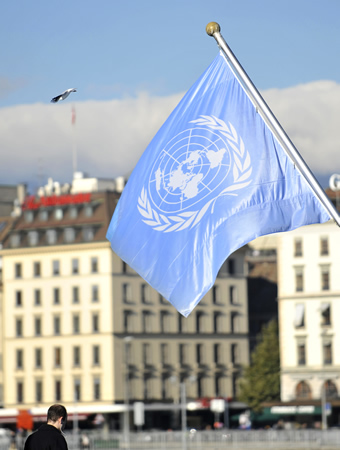
Photo: October 21, 2010. The United Nations flag flies on the Pont du Mont-Blanc, one of the bridges spanning the Rhone River in Geneva, Switzerland. UN Photo/Jean-Marc Ferre.
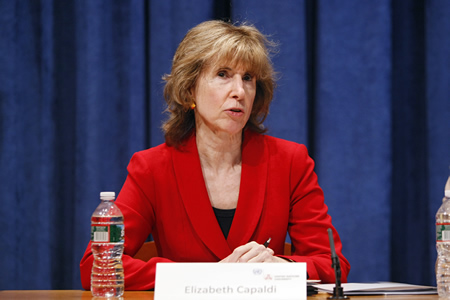
Photo: October 20, 2010. Elizabeth Capaldi, Provost of Arizona State University and Co-Editor at the Center for Measuring University Performance, briefs correspondents on a new alliance for measuring university performance called the Global Research Benchmarking System (GRBS). United Nations, New York. UN Photo/Paulo Filgueiras.
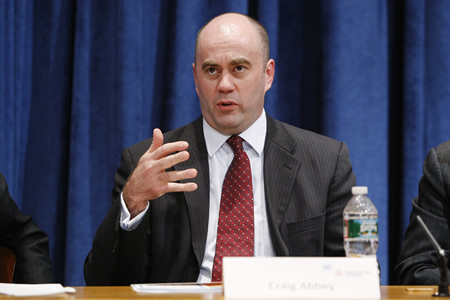
Photo: October 20, 2010. Craig Abbey, Assistant Vice President for Academic Planning and Budget of the State University of New York (SUNY) at Buffalo and Research Director of the Center for Measuring University Performance, briefs correspondents on a new alliance for measuring university performance called the Global Research Benchmarking System (GRBS), conceived by Mr. Abbey's Center and the UN University International Institute for Software Technology (UNU-IIST). United Nations, New York. UN Photo/Paulo Filgueiras.
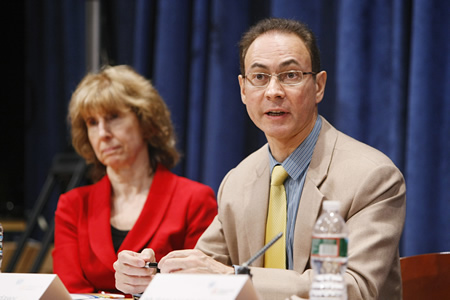
Photo: October 20, 2010. Peter Haddawy, Director of the United Nations University International Institute for Software Technology (UNU-IIST), briefs correspondents on a new alliance for measuring university performance called the Global Research Benchmarking System (GRBS). Pictured next to him is Elizabeth Capaldi, Provost of Arizona State University and Co-Editor at the Center. United Nations, New York. UN Photo/Paulo Filgueiras.
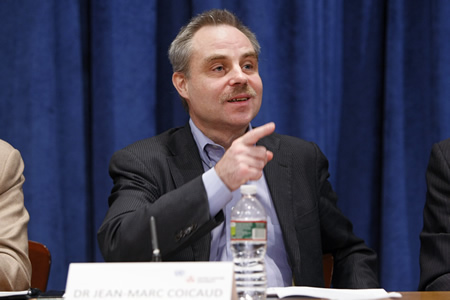
Photo: October 20, 2010. Jean-Marc Coicaud, Director of the United Nations University Office in New York, moderates the press conference launching a new alliance for measuring university performance called the Global Research Benchmarking System (GRBS). United Nations, New York. UN Photo/Paulo Filgueiras.
• Announcing the launch of the Global Research Benchmarking System (GRBS) at the UN Headquarters in New York, Jean-Marc Coicaud, Director of the United Nations University, said that university performance was comprised of complex and informative components and, as such, more than numbers defined their ranking.
The newly formed Global Alliance for Measuring University Performance would be developing the benchmarking system. The Alliance's collaborating partners include universities from around the world, the United States-based Center for Measuring University Performance, the United Nations University's International Institute for Software Technology (UNU-IIST) and Elsevier, one of the world's largest science publishers.
"As an academic and intellectual analysis project, all of the data would be publicly available, downloadable, and all the measures picked would ensure reliable and valid sources," said Elizabeth Capaldi, Provost of Arizona State University and Co-Editor at the Center for Measuring University Performance. "That would offer governing bodies and institutions information that would help them manage their operations more efficiently."
Peter Haddawy, Director of UNU-IIST, in an overview of the project, described the "broad vision of the Alliance", which, by providing objective data to universities, would help universities improve their performance in all areas, including education, community engagement, and research, as well as the societal impact of their activities. The Alliance's first project would be a benchmarking initiative on evaluating university research performance. That was "so important", he said, and should be done in a rigorous manner with full participation of the academic community.
• The benchmarking system overall was in stark contrast to existing university ranking systems, he said. The "richness of the contributions of the universities can't be represented by simple number in a lead table." Their contributions were much more complex and the new system would be designed to measure and represent that.
|GlobalGiants.Com|

Edited & Posted by Editor | 3:24 AM | Link to this Post